MESA — The nation's top education official came to Arizona to prod Gov. Katie Hobbs to allow Arizona parents and students to have access to an additional source of free education funds.
At an event Tuesday in Mesa with partisan overtones, Education Secretary Linda McMahon said a provision of the "One Big Beautiful Bill'' approved by the Republican-controlled Congress last year allows individuals to contribute up to $1,700 a year — double that for married couples — to organizations that would grant scholarships to be used at public and private schools. Donors would get a dollar-for-dollar credit against any federal taxes owed.
The only thing is, the law requires the governor of each state to opt in to what are known as Education Freedom Tax Credits. Without that, Arizona students will be ineligible for the scholarships, which begin in January.
And to date, Hobbs has declined. In fact, she vetoed legislation more than once seeking to force her to join.
People are also reading…
"It is irresponsible to sign this bill before the federal government has released any regulatory guidance,'' Hobbs wrote in one veto message. "We have seen what happens when these types of programs lack accountability, transparency, and oversight.''
The Democratic governor said she wants to be sure there are "much-needed guardrails,'' the kind she said are missing in the state's own Empowerment Scholarship Accounts, commonly called vouchers. There have been multiple reports about abuse of that program, which provides at least $7,500 a year per student to attend private and parochial schools, including purchases of noneducational items such as trips to theme parks, kitchen appliances and jewelry.
McMahon said there will be oversight of the Education Freedom Tax Credits, although the U.S. Treasury and the Internal Revenue Service, which are charged with coming up with guidance, have yet to issue final rules. Those are due at the end of September.

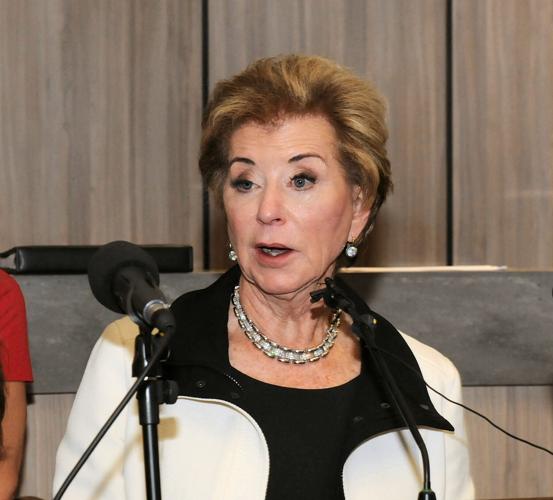
U.S. Education Secretary Linda McMahon at an event Tuesday in Mesa.
But the Trump administration education secretary said there's really no reason for Hobbs to balk.
She pointed out that 30 states already decided to participate. They include Colorado, which, like Arizona, has a Democratic governor.
New York's Democratic Gov. Kathy Hochul also announced she plans to have her state join the program, though the final papers have not yet been signed. That would make 31 states.
Hobbs' press aide Christian Slater said what is happening elsewhere is not relevant to the Arizona governor's position.
"She's not paying attention to other governors,'' he said. "She wants to see how the federal government will administer the program.''
McMahon pointed out the program is set to start at the first of the year and that any delay in the governor penning her approval will translate into time that Arizonans can't access the money.
Anyway, she said, if Hobbs is unhappy with the program, "You're not signing on for life. You can sign off and opt out of the program if it's not working for you.''
McMahon also noted that the program involves no state dollars at all, nor does any money spent on these scholarships mean less money for public schools in Arizona. Put simply, she said, there's no reason for Hobbs to balk.
Slater declined to respond. "We're sticking with our original statement,'' he said.
As approved by Congress, the program is not just about private and parochial school students, though the money can be used for them.
Students in public schools also can take advantage of scholarship funds for everything from hiring tutors to buying books and equipment that isn't covered by the state.
That point was driven home by Chad Wilson, superintendent of the East Valley Institute of Technology, which offers career and technical education to students from area school districts.
In most cases, he said the state pays the tuition. But not all students qualify, including adults who have graduated from high school and are upgrading skills or changing careers.
But that's just part of it. "All of our programs carry with it supplies,'' Wilson said. "And in some programs those supplies are significantly pricey because the industry requires them to be pricey. And our students have to come out-of-pocket for those dollars so they can be part of the program.''
Wilson said having scholarship funds available to pick up the costs can be crucial.
"Because, at the end of the day, the pathway to the American dream isn't just through college,'' he said. "It can be through one of the 52 programs we have here.''

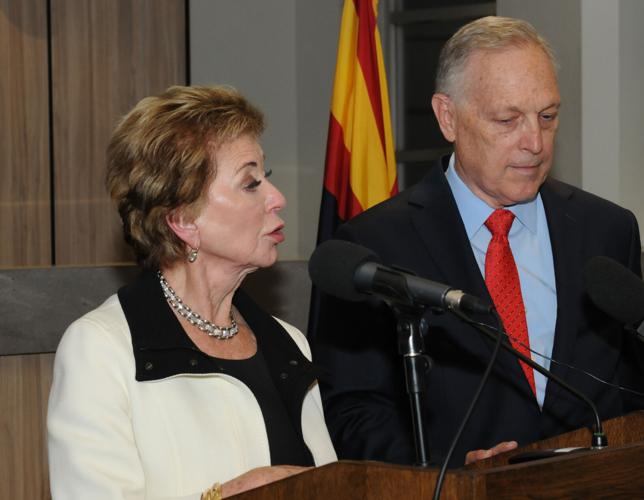
U.S. Education Secretary Linda McMahon with GOP candidate U.S. Rep. Andy Biggs at an event Tuesday urging Democratic Gov. Katie Hobbs to opt in to a new federal scholarship program.
The law starts with the $1,700 donations, or $3,400 for couples filing jointly, that can go to any one of what are expected to be multiple "scholarship granting organizations'' that can be set up in each state.
Each of these SGOs must be set up as a charity, must be approved by the governor, and each must give out at least 90% of what they collect. Funds have to be given out to 10 or more students who do not attend the same school. Donations cannot be earmarked for specific students.
Eligibility is limited to students from households with income that does not exceed 300% of the area median household income, a figure that varies from county to county.
According to 2024 figures from the Census Bureau, that median is $80,266. It's higher at $89,300 in Maricopa County, and lower in places including $72,966 in Coconino County, $70,315 in Pima County, $69,613 in Yavapai County, $62,876 in Yuma County and $57,684 in Mohave County.
Strictly speaking, Arizona taxpayers can contribute to an SGO, and get that federal tax credit, even if Hobbs does not opt in. But those dollars would go to an SGO in another state, meaning none of the money donated by Arizonans would go to Arizona students.
"It can pay for tutoring in Florida, but it can't pay for tutoring in Flagstaff,'' said Arizona House Speaker Steve Montenegro, a Goodyear Republican who also was at the event. "It can support a student with special needs in Utah but it can't in Yuma.''
U.S. Education Secretary Linda McMahon with GOP candidate U.S. Rep. Andy Biggs at an event Tuesday urging Democratic Gov. Katie Hobbs to opt in to a new federal scholarship program.
And since it takes no money away from the state or impose a new tax, he said, the governor's refusal "makes no sense to me.''
There was a decidedly partisan element to the event — and not just because McMahon works for President Donald Trump and the "One Big Beautiful Bill" was passed on a party-line vote by Republicans, with Democrats against it.
Also, no Democrats in the Arizona Legislature supported the bill to opt into the scholarship program. Rep. Nancy Gutierrez, D-Tucson, said during debate her concern is that public money would be going to schools with no oversight.
"I don't think thousands of dollars of tax credit money should be going just out the door with no thought to where it's going, if students are being educated, if classrooms have a teacher who is certified, if there is any thought to safety and fingerprint clearance,'' she said.
Montenegro, who has been a major proponent of all forms of funding for school choice, including private and parochial schools, said there's an opportunity for Arizonans who support the program to have some influence.
"They can have their voice loudly heard in November,'' he said. "And they can elect a new governor, Andy Biggs.''
The Republican gubernatorial hopeful, invited to the event, took the opportunity to criticize his Democratic foe.
"Because of her refusal to join this visionary program, families and students will not have an opportunity to take advantage of these dollars to help fund a better education for their kids,'' said Biggs, a congressman.
Howard Fischer is a veteran journalist who has been reporting since 1970 and covering state politics and the Legislature since 1982. Follow him on X, Bluesky and Threads at @azcapmedia or email azcapmedia@gmail.com.