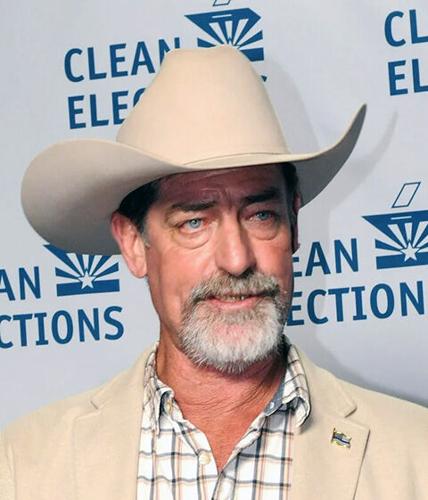
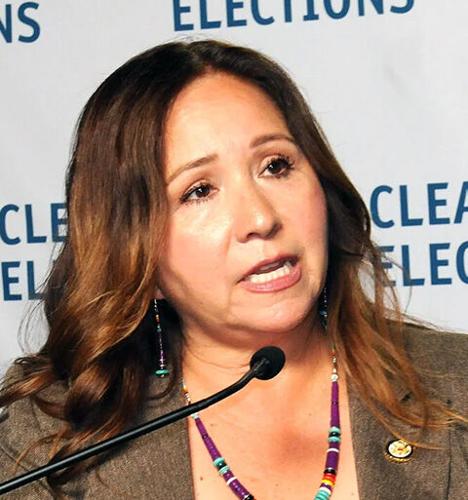
SCOTTSDALE — The Republican candidate for Congress in CD 7 says he supports changes proposed by President Donald Trump for mail-in voting.
"I don't think that mail-in voting should be ended at all,'' said Daniel Butierez Sr. during a debate Wednesday night with the incumbent, Democratic U.S. Rep. Adelita Grijalva. But he argued that isn't what Trump is trying to do, despite repeated statements by the president calling it "mail-in cheating.''
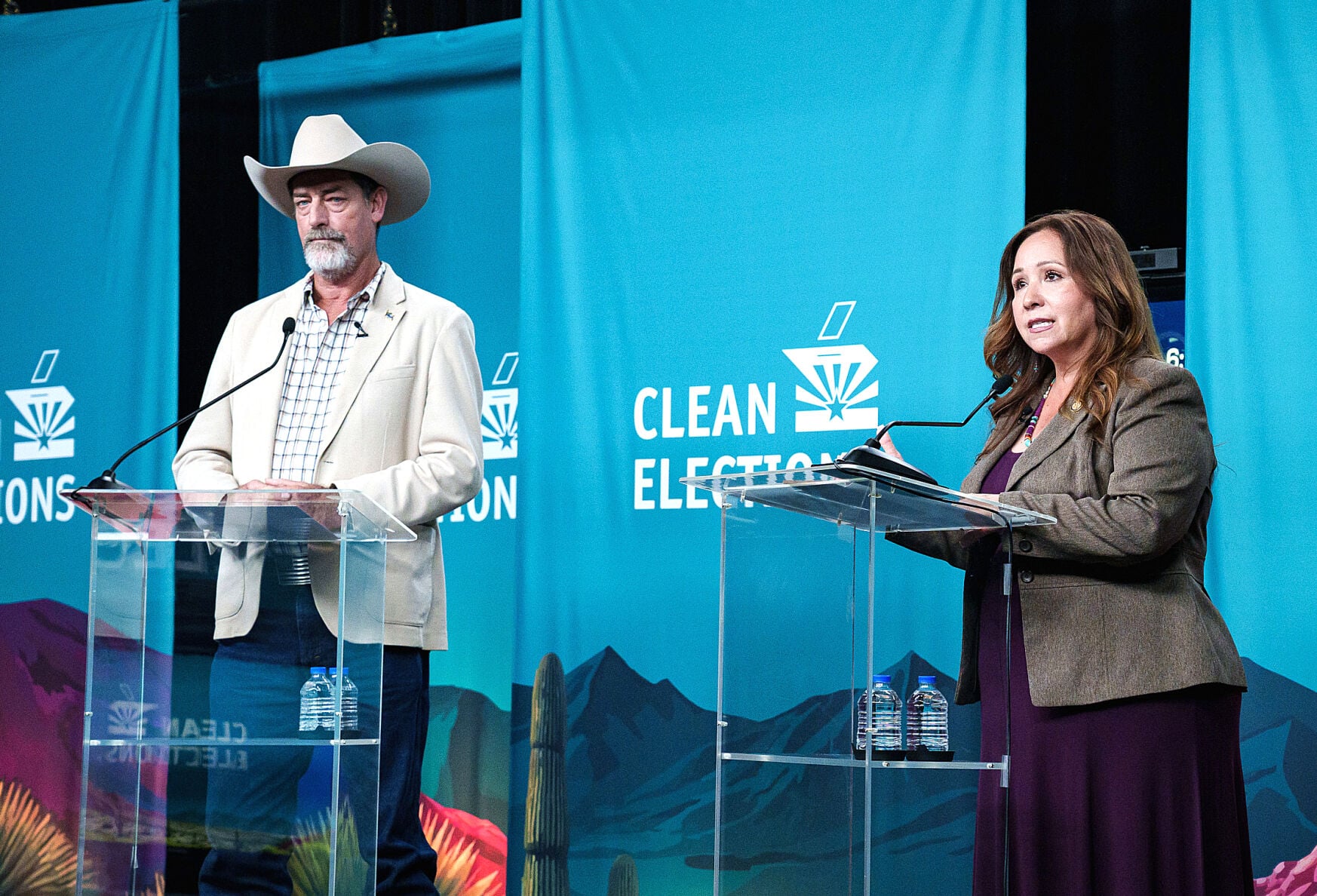
Republican Daniel Butierez Sr. faces off against incumbent Democratic Rep. Adelita Grijalva Wednesday night in a debate between the two Congressional District 7 candidates.
"Right now, what he's asking for in Arizona — and Arizona's all upset — is that the voting roster be turned over so they can make sure that everyone that's on there is actually a legal voter,'' Butierez said.
That move has been fought by Secretary of State Adrian Fontes and Attorney General Kris Mayes, both Democrats, who argue that the federal government has no right to seek this kind of personal information.
People are also reading…
"I don't understand the point,'' Butierez said.
But incumbent Democratic U.S. Rep. Adelita Grijalva said the record shows that Trump, despite his disclaimers, is trying to undermine the ability of people to vote by mail.
"Trump voted by mail in Florida,'' she said. "Why is it OK for him and not OK for the rest of us?''
She said 80% of Arizonans vote by mail.
SAVE Act
A parallel issue involves the federal Safeguard American Voter Eligibility or SAVE Act, which would require people to present certain specified forms of identification prior to being able to register to vote.
This measure also has drawn opposition from Democrats on both the federal and state levels who say it would put the federal government in charge of running elections, which have traditionally been the purview of each state.
Grijalva said Butierez does not understand that the proof of citizenship requirements the SAVE Act would require could impact people without documents the federal government considers acceptable that match their names at birth. Those include women if they took their husband's name when they got married, she said. Grijalva said that creates an extra hurdle.
Butierez sniffed at that being a problem. "I would not say that women are not capable of going out and getting their voter registration,'' he said. "My wife got married, and she managed to do it. And, boy, she would be really upset with me if I said, 'Honey, you're not smart enough to do it.' ''

Butierez Sr.
Grijalva snapped back that it has nothing to do with intelligence. "It has to do with having to pay for a passport in order to prove that you are, because when you get married, your married name does not match your birth certificate. And this is an extra level," she said.
But Grijalva said there's also a larger issue with the efforts by Trump and many Republicans to have the federal government play a larger role in how elections are run. "I don't trust the federal government to run our system,'' she said.
Grijalva also said she finds it interesting that the plan comes from Republicans, who have consistently pushed for less federal control and turning more matters over to the state, unless it's an issue they want to put their "thumb on the scale on.''

Grijalva
Butierez, who is trying to oust Grijalva in the district that includes parts of Tucson, contended the objections from Democrats to the SAVE Act make no sense. "It is a federal election that they're looking at dealing with, not the local elections,'' he said. "I would absolutely trust the federal government to do that.''
In fact, however, federal elections have always been handled by the states.
Grijalva said much of what the Trump administration wants to do, both with how mail-in ballots are handled and the registration process, would affect all elections at all levels.
"I'm concerned with the federal government insinuating that there's something wrong and corrupt with our local races, with our state races,'' Grijalva said.
That goes beyond the fight over mail-in ballots and the SAVE Act, she said. It includes the possibility of placing federal Immigration and Customs Enforcement agents at polling places, something that Homeland Security Secretary Markwayne Mullin mentioned at his confirmation hearing.
Butierez did say that, despite his support for changes in election laws and procedures, he does not share the concerns of some fellow Republicans who have said there is a lack of security and integrity in the process.
What he has seen, he said, is a pattern that when one person wins a presidential election, the other side complains, and vice versa. He said he wants people on either side to "stop attacking our elections and let people feel confident in our elections.''
And Butierez also parted ways with some Republicans who continue to insist without evidence that Trump won the 2020 election, saying that's not his focus.
"My windshield is bigger than my rear-view mirror,'' he said.
ICE, border issues
He and Grijalva, each seeking to represent the border congressional district for the next two years, had sharply divergent views on immigration — and the role of ICE in particular.
"I believe that ICE should be abolished,'' said Grijalva. "There is no reform for a system that is completely fundamentally corrupt.''
The Democrat said she has no problem with looking at securing the border and modernizing ports of entry. But "I do not believe ICE has a role in that,'' she said.
That's not how Butierez sees it. "I believe that ICE is law enforcement,'' he said. "I believe it needs to be there.''
He said if there are concerns about how the agency is being operated, the answer is not to protest it but "go to Washington and rewrite the laws to improve it.''
Butierez also said he supports additional construction of border walls. If nothing else, he said, it deters people from making the hazardous trek through the desert in hopes of entering the United States, while reducing the flow of weapons into Mexico.
There is a slight bit more agreement between the two on the issues of dealing with people already in this country who either entered illegally or overstayed a visa.
Grijalva wants a permanent path to citizenship for those who are in the Deferred Action for Childhood Arrivals program created by the Obama administration in 2012 to provide some sort of legal status for those who were brought into this country as children by parents. Under that program, they were allowed to stay and given work permits.
Trump, in his first administration, stopped processing new applications in 2017. But there are more than 455,000 active DACA recipients in the country.
Butierez said if he is elected, he would support the Dignity Act crafted by a bipartisan group of federal lawmakers. It has some protections for DACA recipients and a pathway to legal status for others who are undocumented.
But the measure, which has been stalled since its introduction last year, also includes some Republican priorities, including more money for physical barriers and surveillance technology and requiring all employers to use the federal E-Verify program to check the legal status of all workers.
Water
Some of the debate sponsored by the Citizens Clean Elections Commission focused on water, particularly the recent U.S. Bureau of Reclamation announcement that Arizona will lose about 1.5 million acre-feet of water from the Colorado River over the next two years.
Grijalva lashed out at the federal agency for deciding that the Upper Basin states of Colorado, Wyoming, Utah and New Mexico will not have to absorb any cuts at all.
She said that is a slap at Arizona, which has proven it has the ability to conserve, pointing out that the state uses about the same amount of water now, in actual gallons, that it did in the 1950s, despite major population growth.
But Grijalva said there's little she can do about it as a member of Congress, other than possibly seek federal funding for projects to conserve water.
Butierez concurred that while it is the federal government making the decision, there really is no role for Congress to tell states how to deal with the lost water.
"I think it should be up to the local governments,'' he said. "I think the feds should stay out of it.''
Data centers
Both agreed there needs to be some "safeguards'' on data centers, which can be large users of water.
Grijalva said they should be forced to find methods of cooling that don't require water. Butierez said the key is requiring any new data center to provide its own water source before construction is allowed.
And both agreed that the loss of scarce water outweighs the number of permanent jobs created from data centers.
Howard Fischer is a veteran journalist who has been reporting since 1970 and covering state politics and the Legislature since 1982. Follow him on X, Bluesky and Threads at @azcapmedia or email azcapmedia@gmail.com.