ELKO, Nev. — Mother Nature almost didn't raise the curtain on Saturday morning's much anticipated solar spectacle in Elko.
But just in time for the 9:20 a.m. annular solar eclipse, clouds thinned and parted to reveal the dramatic celestial coincidence that drew thousands of people to the high-desert town: Earth's moon passing directly in front of its life-giving star, the sun. The eclipse was all the more special because of a lunar phenomenon: The moon was at apogee, or farther from Earth then normal, meaning it didn't appear quite large enough to entirely cover the sun.
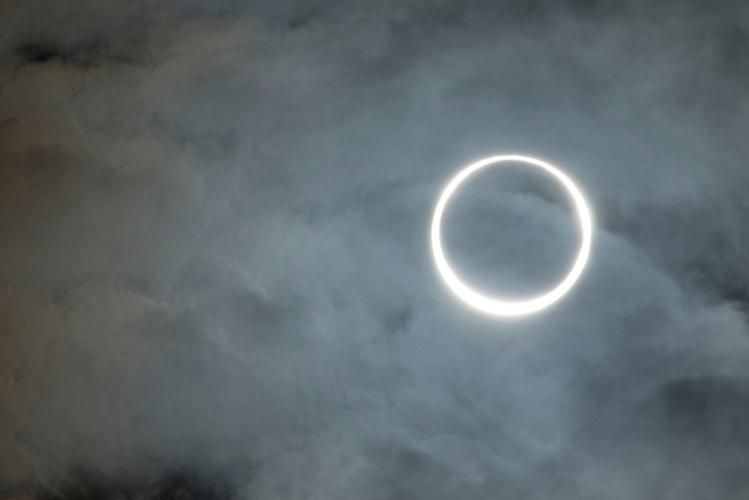
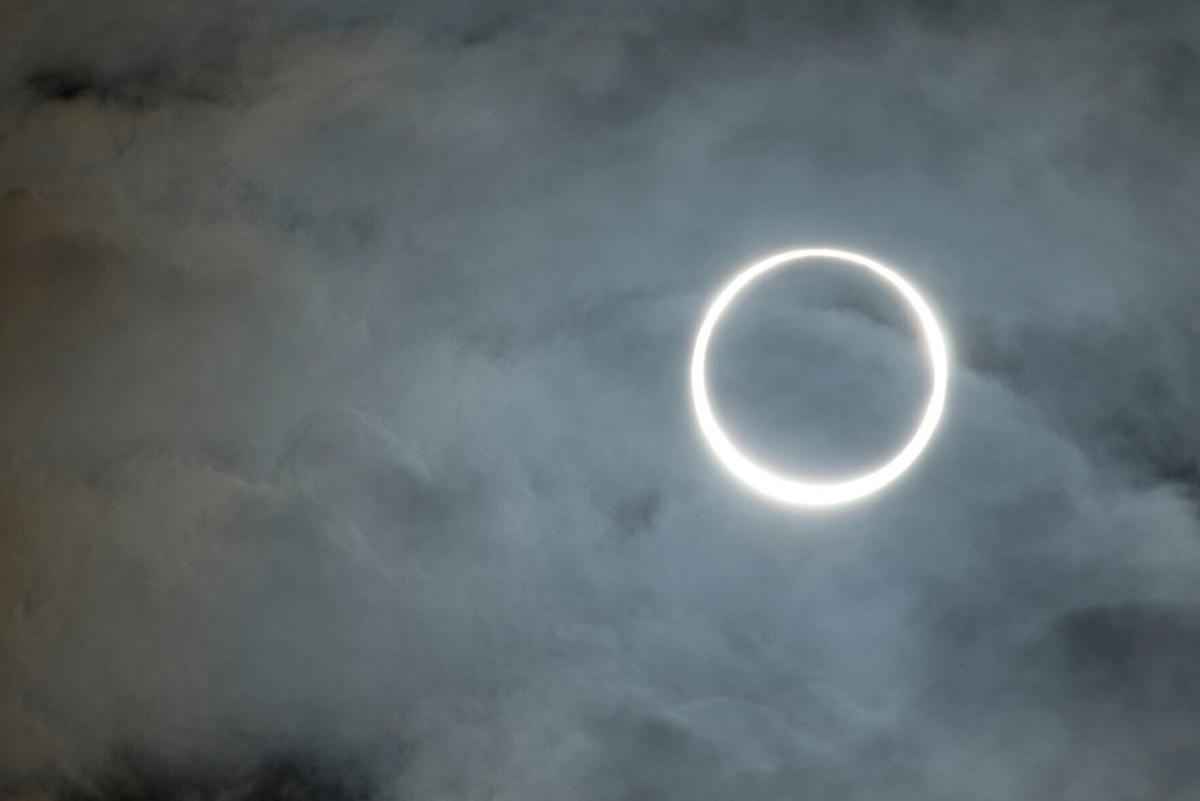
The result was an annular eclipse, also known as a "Ring of Fire" eclipse for the thin band of the sun that remained visible around the moon. People across the town and surrounding area cheered and peered through specialized solar-viewing glasses, telescopes and camera equipment. The air chilled and the landscape slightly dimmed, having lost nearly all of the sun's rays.
People are also reading…

A collage of multiple photos shows the progression of the Oct. 14, 2023, annular eclipse as seen from south of Elko, Nevada. Also known as a "Ring of Fire" eclipse, an annular eclipse occurs when the moon is too far from the Earth to fully block the sun.
And in less than five minutes it was over. The moon began its hour-long slide off the lower-left side of the sun, which gradually became whole for viewers who kept their gaze skyward.
On Saturday morning, longtime friends Dorothy Hudig and James C. Powers were parked along a dirt road about a 45-minute drive south of Elko, a town of roughly 20,000. Powers, a serious amateur photographer from Atlanta, and his wife traveled to Seattle and then Elko, where they rendezvoused with Hudig, who came over from Reno. It was Hudig's first eclipse; Powers photographed an eclipse only once previously: the 2017 total solar eclipse that crossed the U.S. from coast to coast.
"It was awesome, and I was not prepared for how cold it got," Hugid said. "That was amazing."

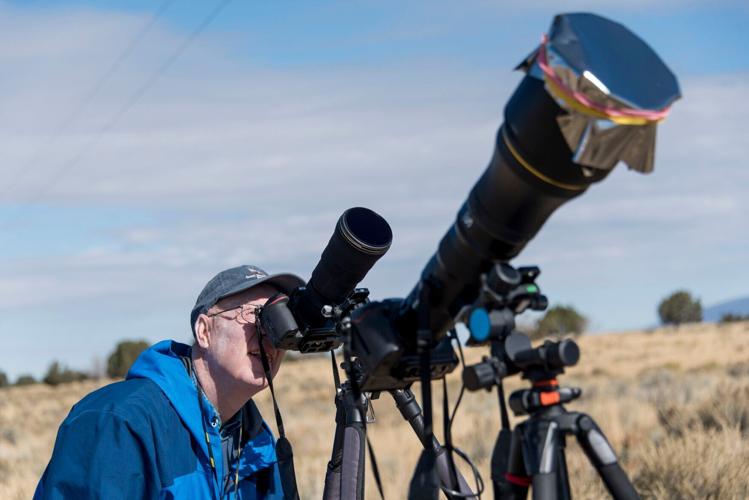
Photographer James C. Powers peers through the viewfinder of one of his cameras as he photographs and videos the annular eclipse near Elko, Nevada, on Oct. 14. Powers and his wife traveled from Atlanta, Georgia, to see the event.
Equipped with multiple full-frame digital cameras and an array of lenses including a new 800-millimeter super-telephoto lens, Powers was simultaneously photographing and recording video of the eclipse in its entirety. He researched the eclipse path, from Oregon to Texas, in advance and selected Elko as the place to be.
"I wanted a place with good weather," he said. "It had to be drivable from Seattle. It looked like good weather on the path."
Ultimately the weather was good, but thin, patchy clouds moving across the sky complicated Powers' efforts.
"The changing conditions, especially the clouds and the light" were a challenge, he said. "I need to go to four or five eclipses to practice."
He confessed that he probably won't ever see four or five eclipses. But he already has a trip booked to Austin, Texas, to view the total solar eclipse that will sweep from Texas to Maine on April 8, 2024.

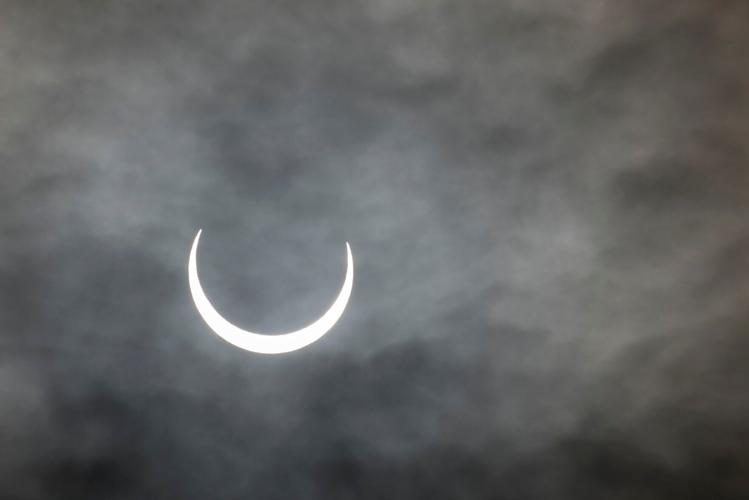
An annular eclipse, also called a "Ring of Fire" eclipse, is visible through clouds south of Elko, Nevada, on Oct. 14.
Cloudy wait
Powers wasn't the only person nearly stymied by clouds. As Elko awoke Saturday to clouds overhead, blue sky beckoned to the south. Vehicles with plates from across the U.S. sped down State Route 228 south toward Jiggs and east toward Harrison Pass while others continued south down the valley on the dirt-surface Huntington Road. They were all hoping to pop out from under a shelf of clouds that only occasionally offered a teasing view of the sun.
Others stayed put in Elko, setting up equipment, waiting, watching and hoping for clouds to dissipate.

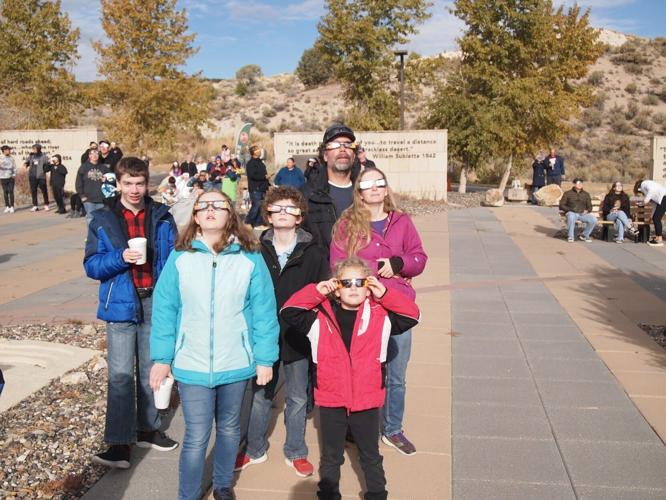
Visitors to the California Trail Center view the annular eclipse, Oct. 14, 2023.
At Johnny Appleseed Park, Tyler Nielsen from Ogden, Utah, set up his Lunt LSHT60 solar telescope, made specifically for viewing the sun.
"It’s on a tracking mount so that if the clouds do part, we can dial it directly to the sun," he said before the eclipse peaked, "and then it’s connected to a camera that will take pictures of the sun."
In Peace Park, Donald Stump, a wedding photographer from Ogden, Utah, had his camera aimed upward with a large white paper shield attached to the front.
"You need to have a large sun shield for the lens itself or you won’t be able to get the right exposure," he explained.

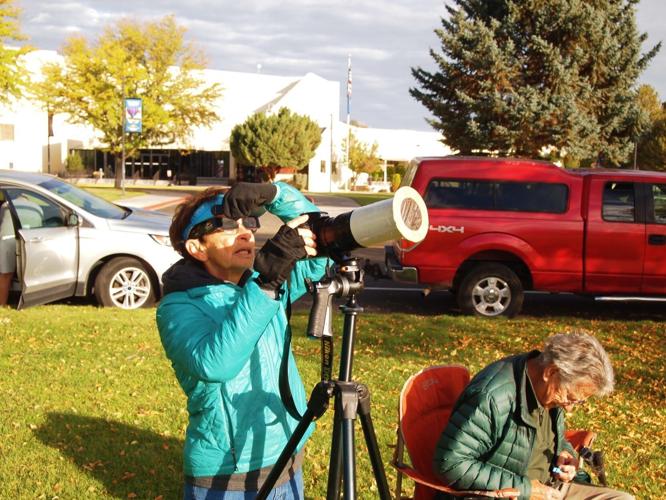
During the annular solar eclipse, on Oct. 14, 2023, Shauna Robinson of Twin Falls, Idaho, aims her camera lens with a homemade filter at the sun.
In City Park, Shauna Robinson from Twin Falls, Idaho, was also waiting for the clouds to part. A homemade filter covered with cardboard and tape covered the lens of her camera. Peter Elliott from Boise had an Astromaster 90 EQ telescope with a solar filter and cardboard shade taped to the end. Hank Thurston, Ph.D., a former physics lecturer at Michigan's Hillsdale College, went to Elko two days before the eclipse and brought his 6-inch Newtonian telescope.
"We were really excited it was so close to Twin (Falls)," Robinson said, "and disappointed at the cloud cover, but we’re hopeful it will break so we can get some shots."
The clouds did part, mesmerizing viewers and eliciting cheers from the well-attended watch-party at the California Trail Interpretive Center about 12 miles southwest of Elko on Interstate 80.
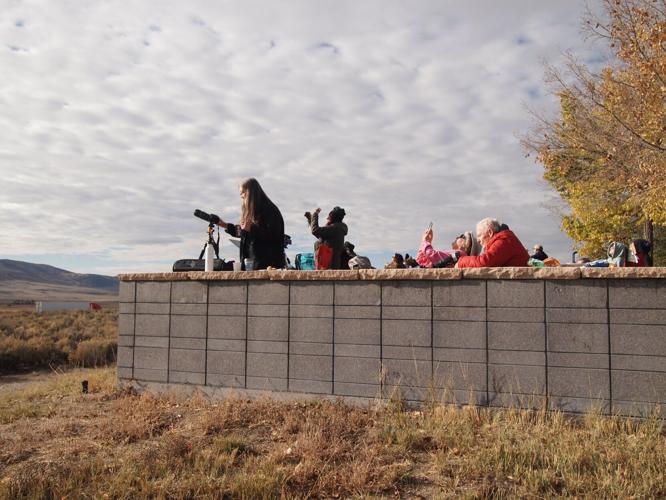
Eclipse viewers there crowded the entrance road and lined up in the museum’s yard. More vehicles parked in the lawn behind the building. A computer monitor and a shadow box were among the many eclipse-viewing instruments lined up along the stone wall in the yard. Families with young children sat on the steps, a few children holding up eclipse-viewing glasses made with paper plates. Some viewers crowded around the covered wagons or ventured up on the hillside behind the museum.

Eclipse viewers line up along the wall of the California Trail Center yard, Oct. 14, 2023.
Booked full
In addition to filling camera memory cards and bucket lists, the eclipse also seemed to fill every hotel room and RV spot in Elko. Business owners talked of hotel rooms going for astronomical rates in a town where $100 a night is the norm. And visitors recounted struggles to find any place to stay, no matter the price. City estimates placed the number of visitors at 10,000.
"We’ve had two gentlemen from the Netherlands," said Amber Dupee, co-owner of 7018 Brewery in downtown Elko. "Everybody’s been really nice, really great. We’ve had several people from other states. Somebody was saying if you could even get a hotel they’re charging $600 to $800 a room."
Dupee said she "heard Battle Mountain was the place to be" for the eclipse. But Sarah Wrenfrow, operations manager at Iron Horse RV Park in Elko, said Wednesday, "I heard that Battle Mountain is also sold out."

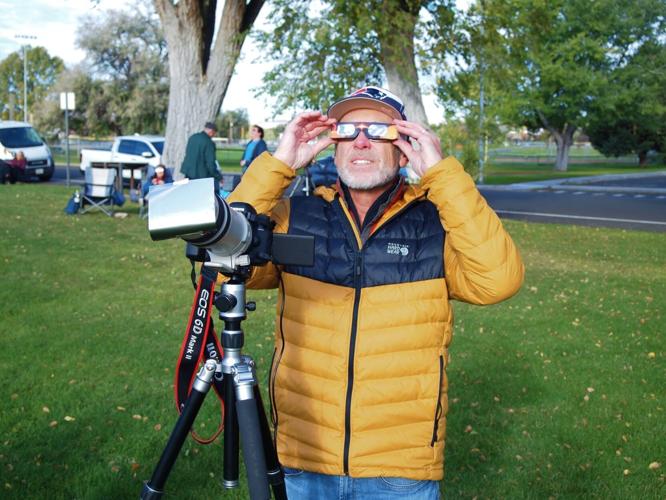
Randy Tibbetts from Kimberly, Idaho, views the Oct. 14, 2023 annular eclipse through solar filter on his camera at the Elko City Park.
Michael Alvarez traveled to Elko from Nampa, Idaho, with his three kids. He had seen an eclipse as a child and wanted his children to experience one, too. He used NASA's interactive map of the eclipse path to choose Elko: "I followed that track and I was like, oh, that’s the biggest city south of here. There’s nothing else around really."
He found a room in town, but only because he booked it more than three months in advance.
Nicole Marshall and Mike Ball, owners of XP Gaming Cafe in Elko, said they noticed an uptick in visitation for the eclipse. Ball, an Elko resident since 1995, said the town seemed different with all the extra people. And the cafe was busier than normal, they said.
"It’s f---ing crowded right now," Marshall said. "All the hotels are booked, it’s full right now."

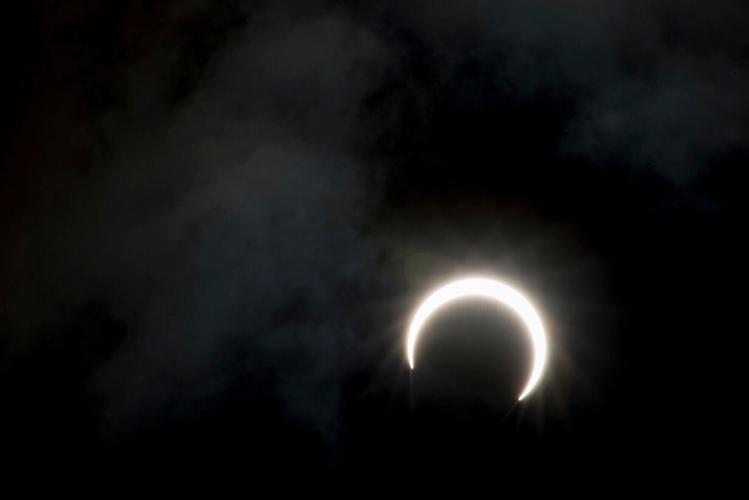
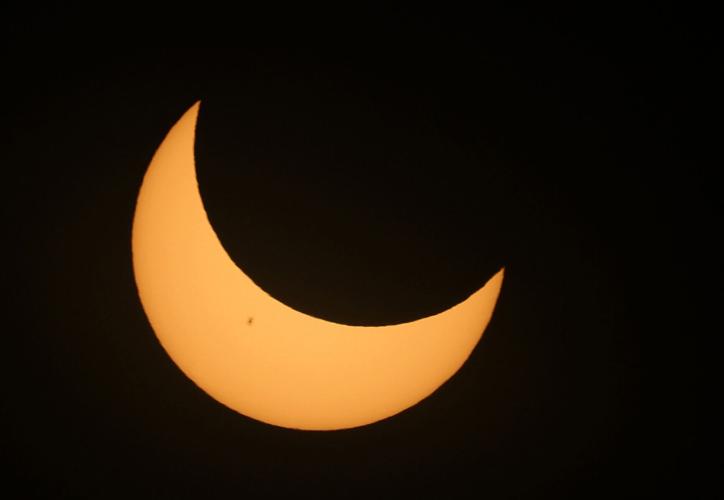
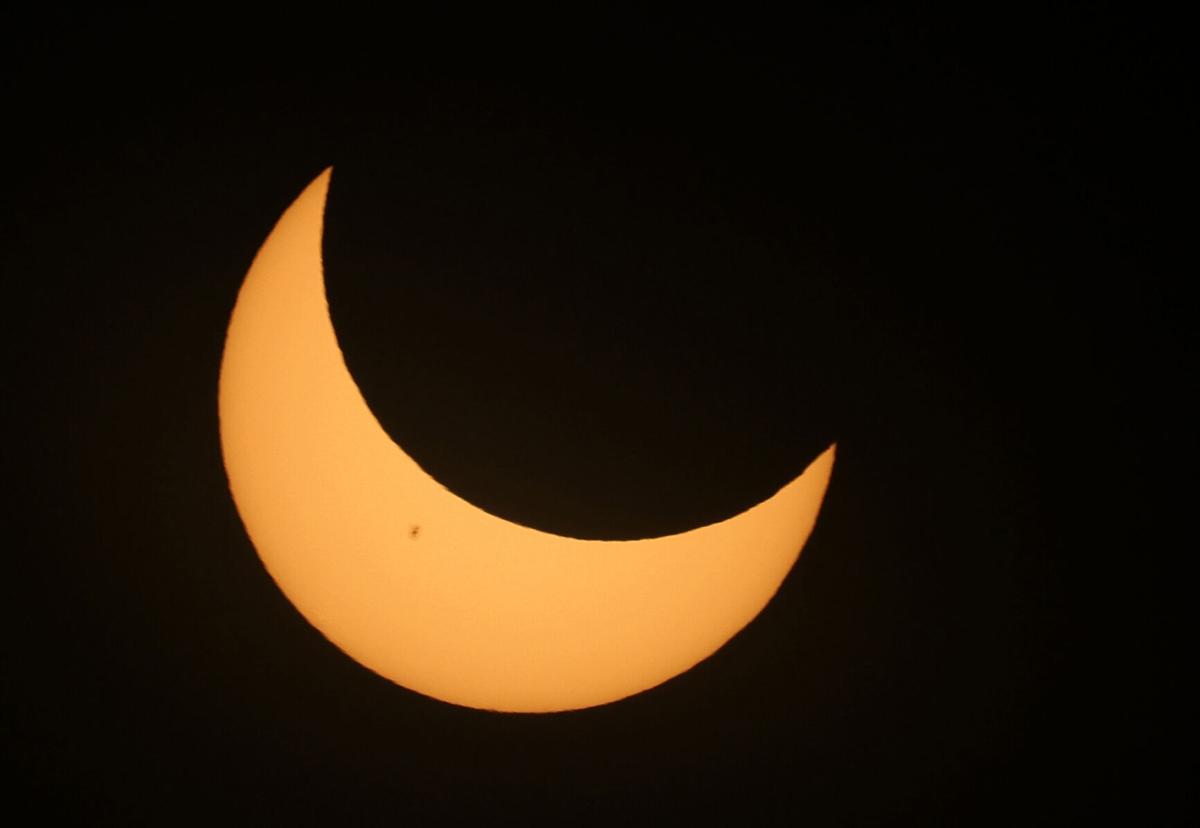
The moon almost fully obscures the sun, viewed here from near Elko, Nevada, just the before the peak of the annular eclipse that crossed from Oregon to Texas on Oct. 14.
At the brewery, situated inside the ornate high-ceiling lobby of a former bank in a stately historic building, Dupee said, "We were slammed for a good three hours and most of it was people from out of town" the night before the eclipse. She ordered 50 pairs of eclipse-viewing glasses and sold them all within an hour the Monday before. She rush-ordered 50 more and sold them all in two hours.
"I’ve had tons of people coming in asking for glasses for it," she said. "I think as business owners we didn’t anticipate this much business from it."
And then Dupee had to dart back inside: Three more kegs had just run out again.

The sun, mostly obscured by the moon, is visible through clouds south of Elko, Nevada, just after the peak of the annular eclipse on Oct. 14.
Joshua Murdock covers the outdoors and natural resources for the Missoulian.