

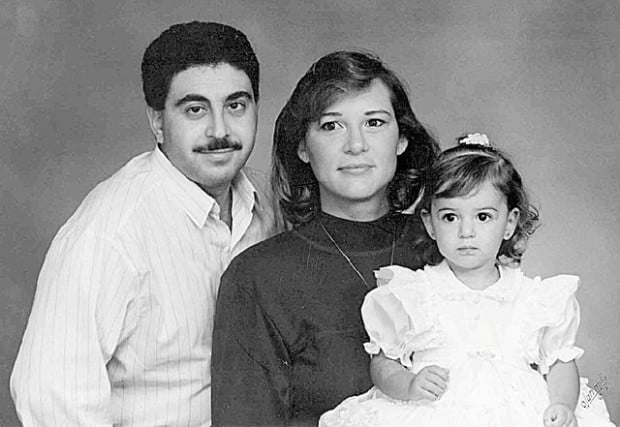
EDITOR'S NOTE: When her ex-husband spirited their 2 1/2-year-old daughter to the Middle East, Maureen Dabbagh could find no one to help her — until she discovered the secret world of the child-recovery industry. First of a five-part series.
The man in the tailored suit looked to be in his 70s. He had crisp, dark hair, a refined nose and blue eyes, sharp and blank at the same time. It was a face of effortless composure, a face that would know how to hide a secret.
The hand he extended had perfectly manicured nails.
"Mitch Rogovin."
"Maureen Dabbagh."
"Come in," the man said. He had supple, pale skin, the kind that comes from too many years under fluorescent lights. "A pleasure to meet you."
People are also reading…
The room was large and rectangular, colorless and cold, with a desk that nobody seemed to use. There were no notes taped to a phone, no business cards in a Rolodex, no legal folders in a pile. The trash bin beside it held nothing but air.
On the far side of the room was a conference table. Around it sat three men. They had broad shoulders, thick necks, tightly cropped hair. One had a graying ponytail.
Rogovin said, "These boys used to be Special Forces." One, he said, was a Navy SEAL, another an Army Ranger, the third a Green Beret. "They're retired," he added, smiling, "on paper."
Maureen reached for her shoulder bag, to pull out the paperwork on her kidnapped daughter, Nadia. Rogovin stopped her. "No need," he said, "I've got your file."
When he'd called Maureen out of the blue, Rogovin had introduced himself as a lawyer. Evidently, she thought, this guy is no ordinary lawyer. How did he get a file on my kid?
"Now," Rogovin said, "there's something I want to show you."
On the wall behind him ran a row of plaques, "CIA" and "Mitchell Rogovin" engraved on each. On another wall hung a row of framed photographs. The first showed Rogovin, much younger, shaking hands with President Kennedy. In the others, he stood alongside Presidents Johnson, Nixon, Ford, Carter, Reagan and Bush.
To a third wall was pinned a single Polaroid. Rogovin plucked the snapshot and held it up, as though it were a trophy.
"This is Colleen Piper," he said. "The little girl in the photo is her daughter, Jasmine. When she was 6, Jasmine was kidnapped and taken to Syria. Damascus. These guys recovered her."
He handed her the picture.
"We're going to do the same for you," he said. "We're going to get your daughter back."
If there are junctures in life when an individual's destiny is radically transformed, this was undoubtedly Maureen Richardson Dabbagh's moment.
Disease forced separation
For most of her 34 years, her life had been typical: She'd been educated in a small town, married, had three children, divorced; she'd worked as an emergency medical technician and a seamstress, never more than a paycheck away from poverty.
Then it all changed. A rare nerve disease she contracted caused such paralysis that she could no longer care for her children and gave up custody to her ex-husband.
In this vulnerable state, she met a technician at the hospital where she was being treated, a Syrian named Hisham Dabbagh. They married shortly after her release, but that union also ended unhappily a few years later.
Bitter divorce proceedings led to temporary, alternating custody of their 2 1/2-year-old daughter, Nadia — 30 days at a time for each parent.
During one visitation, Hisham vanished with Nadia — and most likely spirited her overseas.
Now Maureen was about to step into a universe she had no idea existed: a shadowy subculture known as the "snatchback industry," in which former military commandos, spies and bounty hunters are hired to recover parentally abducted children from hostile foreign countries.
She eyed Rogovin.
"I don't have any money."
"This isn't going to cost you anything."
Careful, Maureen, she thought. You've been lied to by the best — judges, cops, lawyers. And now this, a freebie from a spook lawyer and the Rambo triplets.
Then again, what did she have to lose? Nadia had vanished from West Palm Beach, Fla., on Feb. 12, 1993. It was now January 1994, and the State Department, FBI, Florida police and Interpol had done nothing to find her.
"All right."
Out of nowhere, a grandfatherly man with perfect, platinum hair and wire-rimmed spectacles appeared. Easing into a chair, he smiled mischievously, leaned over, and said with mock politeness:
"I'm not here."
Rogovin then introduced the gentlemen as Bill Colby — the former director of the CIA.
Clandestine recovery work
This is a tale of hate and love, revenge and courage — of a Cherokee preacher's daughter from the pine country of Florida whose quest to recover her kidnapped daughter transformed her from a sensitive, charitable woman into a gun-toting warrior.
It is also, however, an epic international saga that unveils the volatile, secret world of the child recovery industry, a big-money business in which the interests of desperate parents, mercenaries and governments dovetail and collide.
In this world, smugglers, guerrillas, even members of terrorist groups would become allies, and men of law would turn their backs on her, leaving Maureen to push on, alone.
This account is, in large part, Maureen's version of events. Much of it is supported by other interviews and hundreds of documents, including court papers, immigration records, cables from Interpol, the State Department, the FBI, and other documents obtained under the Freedom of Information Act.
It cannot all be corroborated; portions of many documents have been blacked out, and others classified on grounds of national security. As a matter of policy, the government does not disclose details of cases of international child abduction. The State Department declined multiple requests to present its side, and would discuss snatchbacks only in general terms and anonymously.
Although Maureen Dabbagh shared her story exclusively with an AP reporter, she would not discuss some things she did or some aspects of the snatchback world, for fear of compromising active agents or violating the privacy of parents who turned to them out of desperation.
For 12 more years, Maureen would struggle to get her daughter back, exhausting every legal and diplomatic channel open to her. Whenever she turned to officials in the United States or the Middle East, she got excuses, delays, empty promises, indifference.
In many ways, her experience is typical of thousands of "left-behinds" — parents whose children have been kidnapped by estranged spouses and taken abroad in violation of U.S. court orders. Since 1977, the government has opened files on more than 16,000 cases of international child abduction. In most cases, the children are lost for good.
When Hisham kidnapped their daughter and authorities were slow to respond, Maureen had two choices: let go of her child forever, or attempt a snatchback.
Hiring a recovery agent would be costly — anywhere between $50,000 and $150,000 per attempt — and there was no guarantee of success. Recovery agents have ended up in foreign prisons, and parents and agents are known to have died in failed recoveries.
Ultimately, Maureen didn't hire an agent.
She became one herself.
Heart-rending phone call
"MOMMA!"
"Hello?"
"MOMMA! MOMMA!"
Maureen's heart seized: It was Christmas Day, 1992, and this was the first phone contact she'd had with her daughter in weeks.
"Nadia?"
"I WANT TO HOLD YOU!"
The child had been sent to her father's home in Florida on Nov. 3, 1992, for a court-ordered, 30-day visit, according to court records in Medina County, Ohio, where she and Maureen lived.
But then seven weeks passed with no Nadia, and Maureen grew sick with worry, unable to eat, sleep, work, or return calls from family.
She wanted to reassure Nadia that soon she would be back home in Ohio, in her mother's arms …
"I love you!"
"I WANT TO HOLD YOU! I WANT TO HOLD — "
The line went dead.
Earlier that year, after an Ohio judge had granted Maureen a divorce, Hisham told her repeatedly that if ever he got a chance to see Nadia he would never give her up — even if that meant taking her far away from America forever.
That, she knew, was no idle threat. Hisham had once confided to her that members of his family belonged to the Muslim Brotherhood, a rigidly conservative, often secretive organization spread across the Arab world. The group has espoused nonviolence, but it also has been linked to bloodletting — Hamas is the Palestinian arm of the Brotherhood.
Now, as she slumped to the floor, her hand still clutching the receiver, the weight of Hisham's threats came crashing down upon her.
Ex-husband's head start
The visitation order violated, Maureen's lawyer petitioned Medina County Court for an emergency hearing.
January came and went, however, with no hearing. Hisham told the court he wouldn't be able to appear in Ohio that month, and the hearing was postponed until February, court papers show.
All this time, Nadia stayed at her father's house in West Palm Beach. With the custody dispute unresolved, authorities in both Ohio and Florida wouldn't intervene on Maureen's behalf, regardless of her pleas.
Maureen also called Hisham's apartment and Palm Beach Regional, where he worked as a lab technician. On Feb. 17, 1993, two weeks after Nadia's third birthday, she phoned the hospital and was told that Hisham hadn't shown up that week.
Calling Hisham's home, she got no answer.
She phoned the apartment complex where Hisham lived. No, the manager told her, she hadn't seen Hisham lately. And he was behind on the rent. In a panic, Maureen called the sheriff's office.
She was already too late.
Hisham's car had been found inside the long-term parking area of Palm Beach International Airport. According to the ticket on the dash, it had been there since Feb. 12.
Wherever he'd taken Nadia, Hisham had a big head start.


