

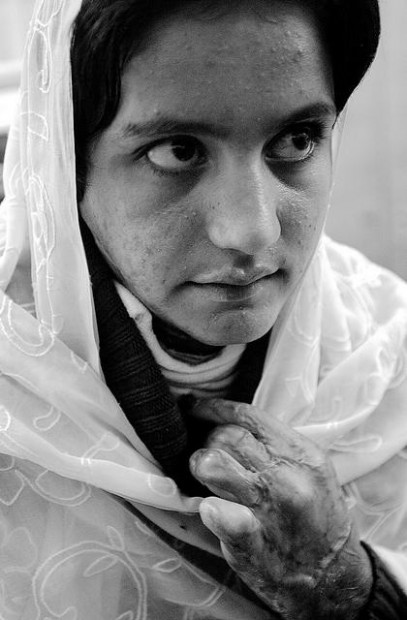
KABUL, Afghanistan — Blood dripped down the 16-year-old girl's face after another beating by her drug-addict husband. Worn down by life's pain, she ran to the kitchen, doused herself with gas from a lamp and struck a match.
Desperate to escape domestic violence, forced marriage and hardship, scores of women across Afghanistan each year are committing suicide by fire.
While some gains have been made since the fall of the Taliban five years ago, life remains bleak for many Afghan women in the conservative, violence-plagued country, and suicide is a common escape.
Young Gulsum survived to tell her story. Her pretty face and delicate feet were untouched by the flames, but beneath her turtleneck sweater, floral skirt and white shawl, her skin is puffy and scarred.
More than a month after her attempt, her gnarled hands still bleed.
People are also reading…
"It was my decision to die. I didn't want to be like this, with my hands and body like this," she said, sitting on a hospital bed in Kabul and hiding her deformed hands beneath her shawl.
Reliable statistics on self-immolation nationwide are difficult to gauge. In Herat province, where the practice has been most reported and publicized, there were 93 cases last year and 54 so far this year. More than 70 percent of these women die.
"It's all over the country. … The trend is upward," said Ancil Adrian-Paul of Medica Mondiale, a nonprofit that supports women and girls in crisis zones.
The group has seen girls as young as 9 and women as old as 40 set themselves on fire. But many incidents remain hidden, Adrian-Paul said.
"A lot of self-immolation and suicide cases are not reported to police for religious reasons, for reasons of honor, shame, stigma," Adrian-Paul said on the sidelines of a conference last week in Kabul on self-immolation.
Domestic violence affects "an overwhelming majority" of Afghan women and girls, according to a recent report from Womankind, an international women's rights groups.
An estimated 60 to 80 percent of Afghan marriages are forced, the report said. More than half of Afghan women are married before 16 and many girls are married to men decades older.
Under the Taliban regime, women were unable to vote, receive education or be employed. In recent years, women have gained the vote and female candidates have run for parliament, but women are often regarded as second-class citizens.
For Gulsum, who goes by one name, the marriage proposal came with a simple cultural gesture her father could not refuse: The groom's sister-in-law laid her newborn son at the father's feet — an act signifying purity and innocence — and asked for the girl's hand. "My father said, 'The baby is like a holy book, so I can't say no,' " the teenager recalled of her abrupt betrothal last year to a 40-year-old man.
She and her husband lived for six months at her parents' home in northern Afghanistan. The couple then moved in with his family in neighboring Iran, home to many Afghan refugees.
Her husband turned to heroin and alcohol, and the beatings began, Gulsum said. The beatings became worse when she confronted her husband about his addictions. The last time he hit her was earlier this fall when she set herself on fire.


