

Note: This article ran in the Tucson Citizen July 13, 1963.
Have wash day blues got you? When laundry day comes around do you have the feeling you just can't face that pile of sheets, towels, levis, T-shirts, dresses, lingerie and table linen once more?
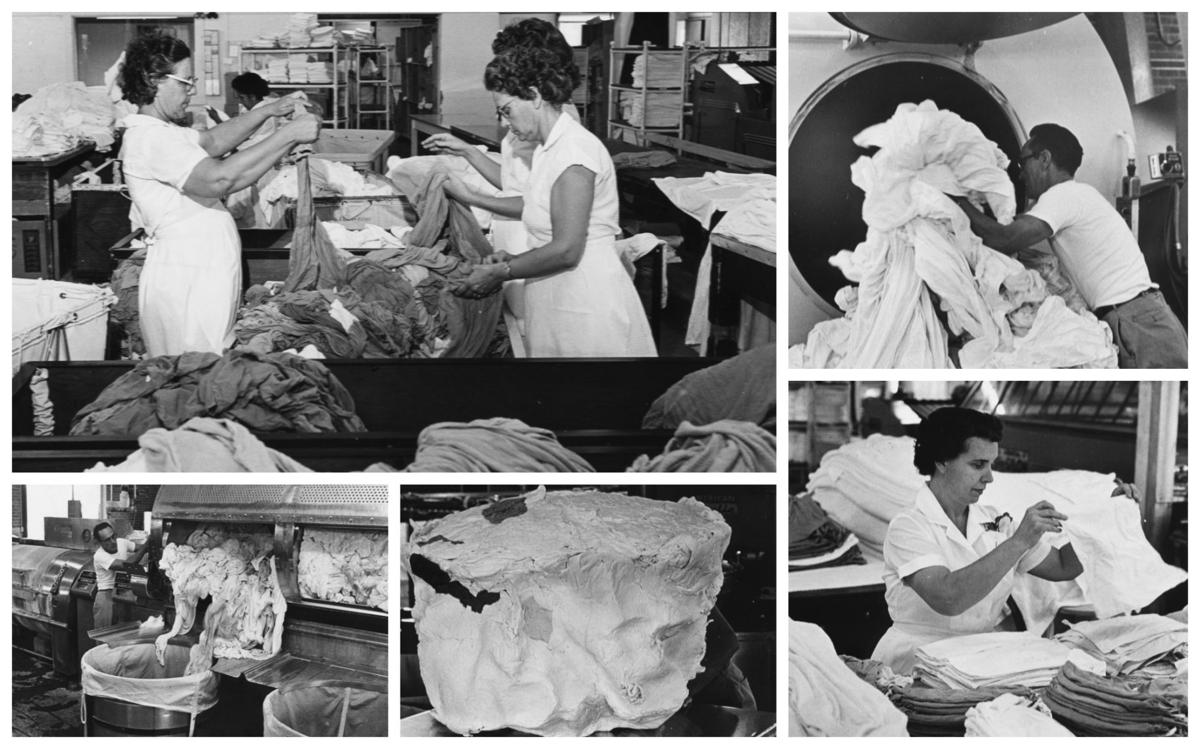
Next time that feeling sweeps over you consider the pile of laundry that confronts Mrs. Blanche Bright every day in the week. Mrs. Bright, laundry manager fro Tucson Medical Center, has charge of seeing that 6,522 pounds of linen is washed, ironed, folded and delivered every day in the week.
And it's not a one day in the week operation. This goes on six days every week of the 52 in a year.
And if you think your laundry bill is a bit steep what would you say to an annual bill of $6,813.14 for soap, bleach and water softener. That's what the tab for the past fiscal year totaled at the center.
People are also reading…
Mrs. Bright has a crew of 26 people to help with this monumental task plus some volunteers who help with the sewing end of it. Oh yes, just as socks have to be darned at home and rips mended so it is at the center. Patches are pressed onto ripped sheets by a vulcanizing machine, but much mending and sewing is done too by power sewing machines. Things like bibs, bed pan covers, surgical towels, slippers are stitched up in the laundry area.
A daily laundry list for Mrs. Bright would include such items as diapers, sheets, receiving blankets, undershirts, pediatric linen, linen for labor and delivery rooms, robes, bedspreads, operating room towels, wrappers of all sizes and kinds, surgeons' gowns, nurses' uniforms, doctors' scrub clothes, isolation gowns and on and on.
Soiled laundry is picked up six times a day. It is loaded on a large platform at the end of the laundry where it is sorted by women who wear gowns and masks if they wish.
Laundry from surgery, obstetrics and isolation is placed unsorted immediately into one of the tremendous washing machines. These monsters hold 350 pounds. Before the first soap is used the machine flushes five times to remove the soil. This is followed by not one sudsing, but three and not one rinse but five. The fifth rinse contains a water softener and staph killer.
The regular laundry has one flush; two sudsings and five rinses.
And right here, Mrs. Bright has a tip for home laundresses. "You don't rinse your clothes often enough," says she. Also the water is HOT. Two huge boilers in an adjoining building provide instantaneous hot water and steam.
The washer automatically empties itself into a vat which is lifted by an automatic hoist into an extractor where it is squeezed by 400 pounds of pressure to remove most of the water.
Next trip for the laundry is into a huge conditioning gas tumbler for eight minutes. It's then dumped out of the drier partially dried.
That needing pressing goes to the flat work ironer, the rest into a smaller dryer where it is throughly dried, then sorted and folded ready for use.
The ironer takes the sheets (some 2,000 per day) into its rollers lengthwise. They come out beautifully ironed and folded lengthwise four times. The mangle will handle 16 sheets per minute.
One small washer which runs all day is used exclusively for items that require a special process such as rubber sheets, plastic cases, isolation bags, and sheep skins to prevent bed sores.
Each department of the hospital sends Mrs. Bright a list of required linen each day. During the day the clean laundry is made up into bundles and loaded into a partitioned truck, ready for delivery to the wings, departments and courts early the next morning. Emergency requests of course are filled immediately.
Oddly enough according to Mrs. Bright the bleach used at the laundry isn't as strong as what the housewife probably uses. "It's about one-half of one percent," she explains. "We use it often but not in strength. Nothing can take the place of soap. In heavy bleaching you lose the textile strength of your linen and once that happens the item goes to pieces."
Mrs. Bright has a few suggestions for homemakers when it comes to doing laundry.
"Don't crowd you washing machines. Don't oversuds. When you oversuds, this cushions the blow and the agitator can't beat when it's all cushioned inside. With less bleach but more consistent bleaching your clothes will last longer and be whiter."
Mrs. Bright who is a member of the American Institute of Laundries, has been in Tucson 15 years and at the Medical Center almost that long. She's been manager of the laundry for seven years.
How about her own laundry at home? "At least twice a week I put three loads through my washer," she laughed. "Seems like I'm always washing sheets."

