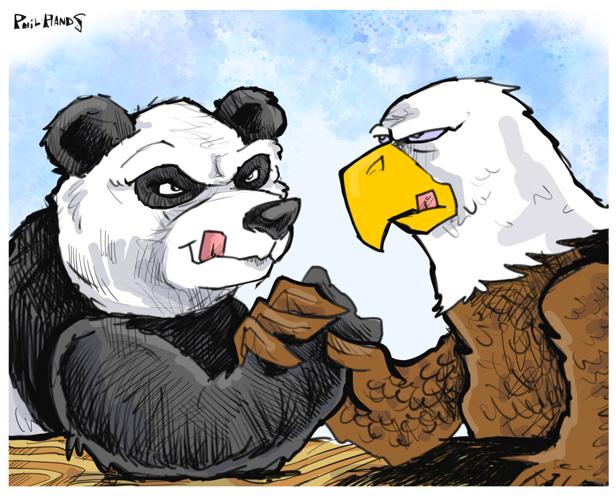
Xi Jinping sees the United States as the primary obstacle to China’s ultimate ambitions: communism’s victory over capitalism, the forced “re-unification” of Taiwan, and China’s return to the center of the global stage.

Jonathan Fritz
But Xi is also a pragmatist. He recognizes that the U.S. is a formidable power and benefits China’s economy. So he prefers to avoid direct military confrontation.
Our two countries are not enemies, and we are not at war. Hundreds of thousands of citizens from both countries travel, study and work in each other’s territory.

Despite higher tariffs, bilateral commerce totaled nearly $500 billion last year, making China the third-largest U.S. trading partner. We have collaborated before on climate, the financial crisis and Iran, and we should do so again on those issues and others, such as ensuring artificial intelligence is safe.
People are also reading…
China is absolutely a competitor across arenas vital to the American people. This friction stems mainly from Xi’s drive to build Chinese power and influence. Xi’s strategy is to pull so far ahead of Washington that he can achieve his core goals without risking a war.

Is China a competitor or an adversary?
His priority is to dominate the global supply chains of key manufacturing industries, from steel and shipbuilding to electric vehicles, pharmaceuticals and AI. China’s massive, decades-long support for favored industries incurred huge costs for China’s struggling economy and inflicted severe harm on factories and workers in the U.S. and other nations.
But it has paid geopolitical dividends. Beijing successfully used control over rare earth magnets to force the Trump administration to back off its tsunami of tariffs last year on Chinese imports and its export controls on advanced semiconductors.
In the security realm, China continues to deploy mounting pressure — militarily and otherwise — on U.S. partners and allies in the Western Pacific, and most especially Taiwan, the Philippines and Japan. While carefully avoiding open conflict, Beijing is wearing down governments it doesn’t like in Taipei, Manila and Tokyo, and intimidating others. All the while, it tries to prove that the U.S. cannot be relied on to back its friends.
Xi’s China also is trying to reshape international organizations to make them more amenable to authoritarianism, in clear opposition to the democratic values embodied in the United Nations Charter. Simultaneously, Beijing is passing sweeping laws claiming unprecedented extraterritorial authority to target dissidents, including inside America.
To deal with such a serious competitor, Washington must quickly implement a clear, dual-pronged strategy.
First, the U.S. must strengthen itself at home, the opposite of what the Trump administration is doing. We must maintain the moral high ground and political resiliency that come from a properly functioning democracy, not lower ourselves to banana republic standards of corruption and coercion.
We must support, not attack, our universities and research institutions. And we must reopen our doors to the international talent that has long been essential to American entrepreneurialism and innovation. Otherwise, it will be hard to prevail over China on technology.
Second, the U.S. needs to systematically rebuild trust with the allies and partners that Trump has insulted and bullied. The U.S. will be far more effective in pushing back Chinese industrial capacity, resisting regional intimidation and blocking attempts to reshape international norms if it works in lockstep with like-minded teammates. Dithering on Taiwan arms sales, downgrading military exercises with South Korea and directing hostile tariff and immigration policies undermine our competitiveness.
Undermining U.S. strength at home while alienating friends abroad could easily embolden Beijing to overreach. It may even accelerate Xi’s timeline for Taiwan “reunification,” regional domination and global preeminence. That trajectory risks turning a tense competition into an open conflict with devastating global consequences.
The stronger we are and the more aligned we are with our friends, the more likely we are to remain competitors with China instead of enemies.
Fritz is a senior fellow for China policy at the Center for American Progress. He wrote this for InsideSources.com.