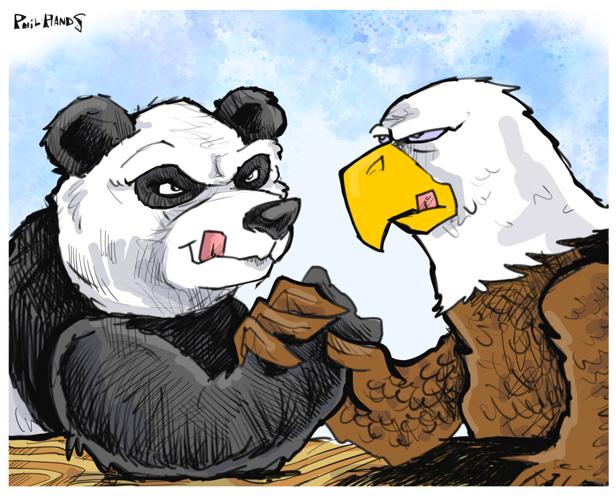
Is China a competitor or an adversary?

Roslyn Layton
The distinction matters because "competitor" implies a contest governed by rules. Competitors agree to play the same game, use common standards, submit to refereeing and accept the outcome. Economic competition assumes a positive sum: companies compete, consumers benefit, innovation expands the market and the overall pie grows.
That’s not how the Chinese Communist Party sees it. For China, engagement is a struggle for national power and global dominance. You don't need to fire a missile if you control the technology, supply chains, capital, data, industrial capacity and critical infrastructure on which the world depends.
China has repeatedly demonstrated its willingness to deploy economic, technological, legal, diplomatic and intelligence tools in pursuit of strategic objectives. Intellectual property theft, cyber espionage, state subsidies, market restrictions, forced technology transfer and economic coercion are tools in its box.
People are also reading…

Beijing’s National Intelligence Law requires organizations and citizens to support national intelligence work. China maintains extensive authority over companies and can mobilize economic resources in pursuit of national security objectives.
Washington wagered that capitalism would “democratize” China. That was the prevailing hope surrounding China’s accession to the World Trade Organization in 2001. But under Xi Jinping since 2012, the Communist Party built a military capable of challenging the U.S. It clamped down on human rights and tightened its control over enterprise.
If the expectation was that American companies would enter China and flourish, the opposite happened. Nike, Starbucks, Best Buy, Home Depot, Uber, Google, LinkedIn, Yahoo, eBay and Gap have exited or significantly reduced their footprints in the Chinese market. Most U.S. media and content companies were never allowed to compete.
Meanwhile, China has built enormous industrial capacity, often with state support that has been the subject of WTO disputes. China now accounts for 80% or more of global production capacity in major parts of the solar photovoltaic and battery supply chains. It dominates electric vehicles, telecommunications equipment, drones, shipbuilding, steel and critical-mineral processing.
The problem is not that foreign companies lose market share. Once industries become dependent on China, economic dependence becomes a source of leverage. Nor is the problem Chinese enterprise or its extraordinarily capable entrepreneurs. The problem is a political system that can capture foreign assets and technology, direct private enterprise toward state objectives, and use economic tools to advance national power.
The same distinction must be made between the Chinese people and the Chinese Communist Party. China’s citizens should not be conflated with the government. Millions have little meaningful ability to challenge state policy, organize politically or seek independent redress. Chinese military, government, business and cultural figures who challenge the party can face detention, disappearance, imprisonment or execution.
Leaders of Hong Kong’s Tiananmen vigil received lengthy prison sentences. Human rights movements in Tibet, Xinjiang, Inner Mongolia and elsewhere are crushed while ethnic and religious assimilation is enforced. Taiwan is next on the roadmap.
Americans are vulnerable, particularly to Chinese technology. TikTok’s ownership structure leaves China’s ByteDance with a 19.9% stake and ownership of the recommendation algorithm, which it licenses to the U.S. joint venture. Cameras, smartphones, telecommunications equipment, cloud services, sensors, wearables, vehicles and other connected devices generate extraordinarily valuable information. China excels in aggregating data on identities, relationships, locations, purchases, communications and behavior.
President Trump knows China does not play by WTO rules. Xi comes to Washington seeking access to essential American tech. Let’s hope Trump keeps America first.
Layton is executive vice president of Strand Consult and a senior fellow at the National Security Institute. She wrote this for InsideSources.com.