


About five years ago, a bizarre idea occurred to me. At the time, I was designing complex electronic circuits to mimic a small portion of an insect brain. These circuits would be created on a tiny computer chip, but the prototyping costs would be in the tens of thousands of dollars. Despite having a brain with 10,000 times fewer neurons than our own, insects have remarkable flight capabilities and have a lot to teach people about building flying robots.
I had to wonder: Was it worth all the trouble and expense just to mimic a small slice of an insect brain? Why couldn't I just use a real insect brain? Surely insect brains were cheaper than manufacturing custom integrated circuits!
Since that time, my students and I have been interfacing the living brains of insects to robots.
We started by using a moth because its brain is larger than that of many insects. The focus of my laboratory is on vision, so we tapped into neurons that carry information about objects moving in front of the moth.
People are also reading…
In our first insect-robot interfacing experiment (dubbed the "robo-moth"), we had moderate success in making an autonomous robot turn to face objects moving in front of it. The limitation was our ability to continue recording from one particular neuron while the robot moved, which required precise electrode placement.
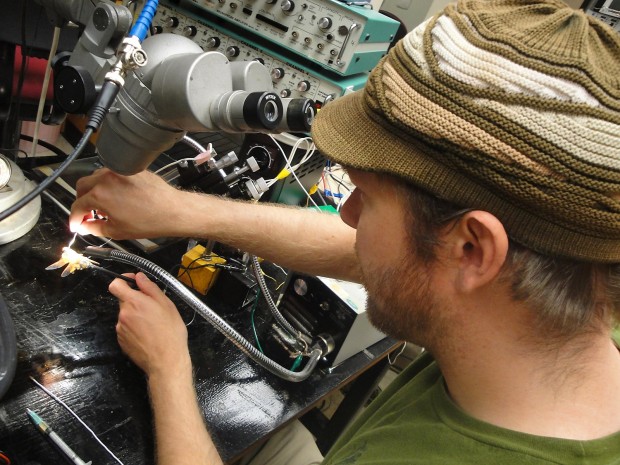
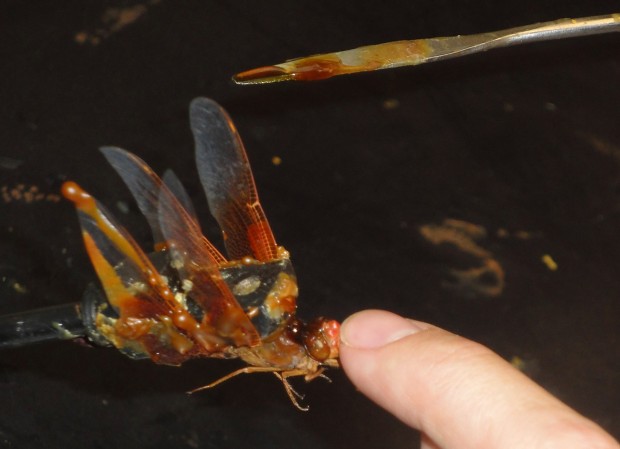
In the current iteration of this project ("robo-dragonfly?"), we are interfacing the vision system of a dragonfly to a new robot. When hunting small targets, dragonflies move almost faster than our eyes can see.
This time, instead of going into the brain, we are tapping into the "spinal cord" of the insect. Because of this, precise electrode placement is not necessary and we will be able to record for long periods. We are tapping into cells that report the movement of small objects in front of the dragonfly and expect our robot to be able to track small moving targets using the dragonfly's visual system.
Beyond visual sensors, where might this line of research take us? Modern computing systems have their strengths and weaknesses. The average human is completely unable to compete with a common desktop computer in multiplying large numbers, for example. However, the fastest supercomputer on the planet will have trouble matching a human child at face recognition. So you might say that conventional computing and "brain" computing have complementary strengths. So why not engineer a system with the best of both worlds?
In the long term, I imagine hybrid computers that contain both conventional electronics and genetically engineered biological neural networks that work together to make "intelligent" computing systems. Despite decades of improvement in computing and some really remarkable reductions in size, computers today are still pretty dumb.
Might combining computers with biology allow us to extend computing beyond its current limitations, and in combination with robotics, create artificially intelligent beings? I hope so, but only time will tell.
About the scientist
Charles M. Higgins is an associate professor of neuroscience and of electrical engineering at the University of Arizona. The Higgins laboratory studies the visual systems of insects (flies, dragonflies, moths and bees) to enable advanced autonomous robots. This research includes electrical recordings from insect brains, computer modeling, behavioral experiments and the interfacing of living insects to mobile robots.
Experience science
Higgins lab video of dragonfly brain recordings:
School of Mind, Brain, and Behavior:
About the school
The School of Mind, Brain, and Behavior studies subjects ranging from molecules to psychiatric disorders by spanning disciplinary boundaries. The school comprises the Departments of Neuroscience, Psychology, and Speech, Language and Hearing Sciences and the Program in Cognitive Science and the Graduate Interdisciplinary Program in Neuroscience.