Pac-12 commissioner Teresa Gould’s flight landed Monday night at Washington’s Dulles Airport, followed by a lengthy ride to her hotel. Early the next morning, Gould was on Capitol Hill to discuss perhaps the most significant congressional legislation in college sports history.
Yes, she was nervous — but not merely because of the appearance in front of the Senate Commerce Committee for a hearing on the Protect College Sports Act.
“I have a Pac-12 perspective, but I wasn’t only representing the Pac-12,” Gould told the Hotline. “It was an opportunity to frame the sense of urgency and tell our story.”

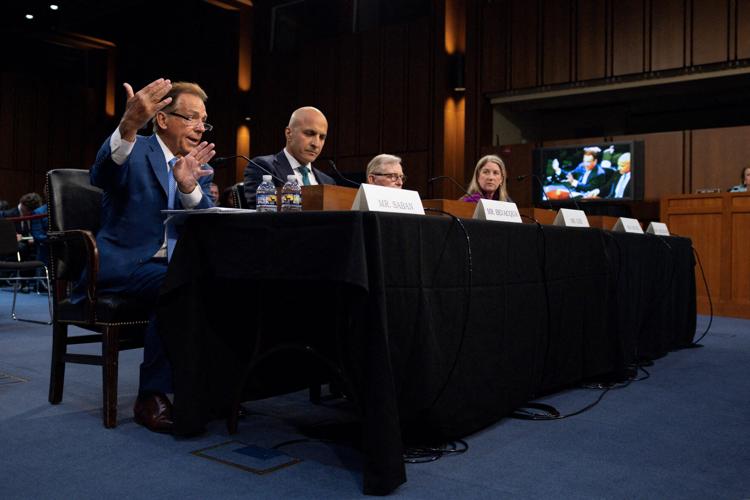
Former University of Alabama football coach Nick Saban arrives to testify on the “Protect College Sports Act” before the Senate Commerce Committee, on Capitol Hill in Washington, D.C., U.S., June 3, 2026. From left, Saban, University of Notre Dame Athletic Director Pete Bevacqua, West Virginia University President Gordon Gee, and Pac-12 Commissioner Teresa Gould.
But exactly whose story was “our story”?
Was it the Group of Six conferences’ story?
Was it the Group of Six in concert with the ACC and Big 12?
People are also reading…
Or was it everyone’s story, including the Big Ten and SEC?
Within the increasingly bifurcated world of college football, it’s difficult to know where alignments begin and end.
The Big Ten and SEC have moved to a different tier.
They generate hundreds of millions more in annual revenue than even the ACC and Big 12.
They dominate the competitive landscape and TV ratings and control the format of the College Football Playoff.
At least one of them, the SEC, is openly mulling self-governance.
And with regards to the Protect College Sports Act, the Big Ten and SEC stand in opposition to both the legislation itself (as written) and the position of their counterparts across major college football.
The ACC, Big 12, Pac-12 and other leagues support the bill, which Gould said in her sworn testimony “represents the most impactful and comprehensive reform proposal advanced to date to address the challenges facing college athletics.”
Authored by Sens. Maria Cantwell (D-Washington) and Ted Cruz (R-Texas), the Protect College Sports Act (PCSA) includes provisions that allow athletes one free transfer and five years of eligibility. It limits agent compensation, prevents professional players from returning to college, encourages regionalized conferences and bans coaches from leaving for a different school during the competition season.

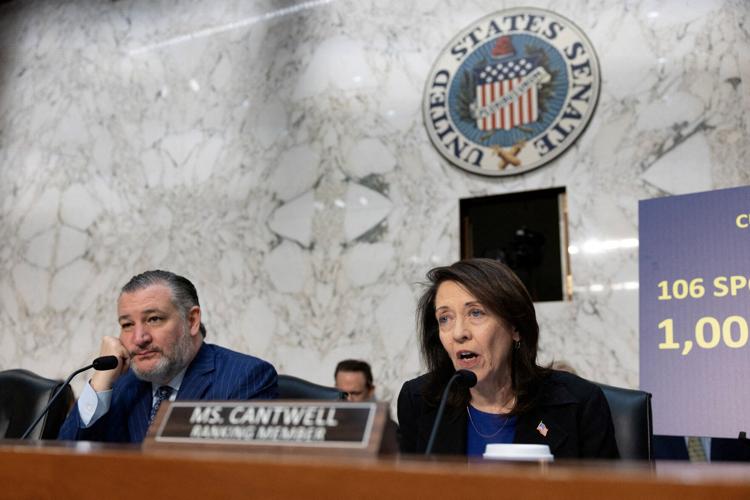
Sen. Ted Cruz (R-TX) listens as Sen. Maria Cantwell (D-WA) speaks during a hearing on the “Protect College Sports Act” before the Senate Commerce Committee, on Capitol Hill in Washington, D.C., U.S., June 3, 2026.
But two aspects make the Big Ten and SEC recoil:
– The bill prevents them from expanding or joining forces in a manner that could lead to a super league.
– It creates a pathway for FBS conferences to pool their media rights, a momentous step that would reduce the massive financial and competitive advantages currently held by the sport’s twin behemoths.
You don’t need to squint to see a line forming in the sand, but Gould struck a more hopeful tone.
“The bill has been out in the universe for a week, and it’s 111 pages,” she said. “There’s a lot embedded. There will be a lot of conversation. There will be a lot of changes during the mark-up process.”
Prior to her appearance, Gould spoke to ACC commissioner Jim Phillips and exchanged voice messages with the Big 12's Brett Yormark. She also chatted with the Big Ten's Tony Petitti and called it “a really positive conversation.”
“I won’t speak for them,” she added of the Big Ten. “But everybody is evaluating how they can get something done. How do we get this bill to where we want it?”
One problem: The stakeholders want different things.
What works for the campus administrators (and their budgets) doesn't necessarily work for the athletes.
What works for football and men's basketball doesn't necessarily work for Olympic sports.
And what works for the SEC and Big Ten, which are loath to relinquish control in any form, doesn't work for the other eight FBS conferences.

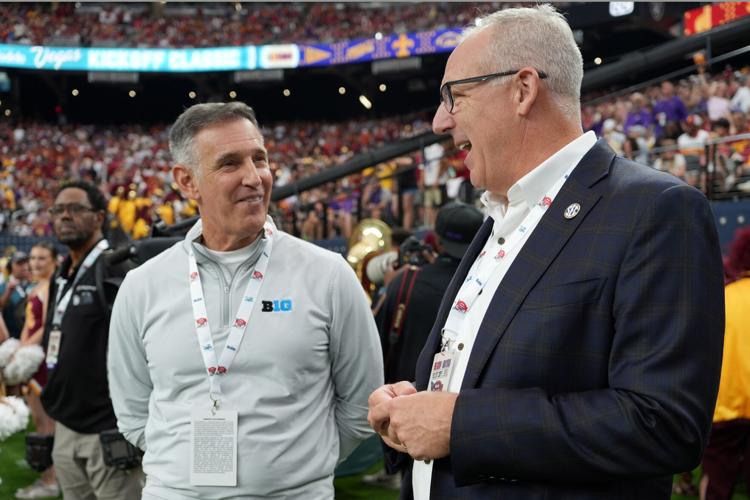
Big 10 commissioner Tony Petitti (left) and SEC commissioner Greg Sankey attend a game between the LSU Tigers and the USC Trojans at Allegiant Stadium Sept. 1, 2024, in Paradise, Nevada.
Schools across the ACC, Big 12 and Group of Six leagues are joined at the panic button, worried they will be left behind in the next restructuring just as Washington State and Oregon State were left behind when the legacy Pac-12 imploded in 2023.
Cantwell addressed that very issue, directly, in her remarks during the hearing:
"The reason why Sen. Cruz and I have a letter (supporting the legislation) from the … Big 12 and the ACC is because they think that's what's going to happen to them next, that somebody is going to come in and rearrange the deck chairs of those conferences, steal the eyeball schools and then basically leave everybody with everything else."
The Power Four is effectively the Power Two, as Cruz himself noted.
The Group of Six is, in many ways, really the Group of Eight.
And judging by support for the PCSA, the rebuilt Pac-12 arguably has more in common with the Big 12 and ACC than they have with the Big Ten and SEC.
"We aren’t all situated in the same space," Gould said. "Some are willing to compromise more than others to get something done."
What of the Big Ten and SEC specifically?
"Hopefully," she added, "they participate in the conversations to move something forward."