Pac-12 commissioner Teresa Gould on Wednesday called for college sports to have an "honest" conversation about athlete employment and collective bargaining, momentous steps for an industry that has long resisted adopting two defining features of professional sports.
"Student-athletes today generate significant revenue and help define the identity of the conferences and institutions they represent," Gould told the Senate Commerce Committee in sworn testimony.
"That honest conversation begins with recognizing that student-athletes deserve a meaningful and formal voice in the decisions that affect them and building a structure that reflects it."
Gould's remarks came during the committee's hearing on the Protect College Sports Act, bipartisan legislation authored last month by Maria Cantwell (D-Washington) and Ted Cruz (R-Texas) that's designed to reshape the industry — and, for better or worse, give Congress a hand in how college sports operates.
People are also reading…
She said the Pac-12 "strongly supports" the bill, which "represents the most impactful and comprehensive reform proposal advanced to date to address the challenges facing college athletics."
One of those challenges: keeping the focus on the athletes.
"What has transpired across a lot of conference realignment," she said in the question-and-answer portion, "is the well-being of the student-athletes is no longer at the center because of the (financial) pressures we're dealing with."
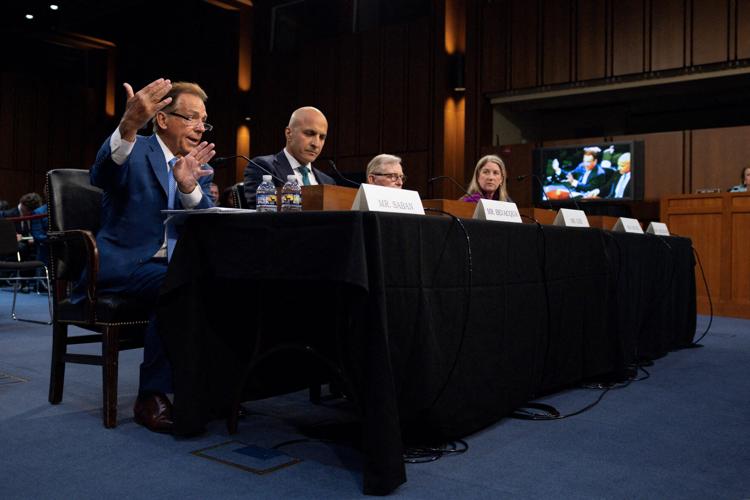
Gould was one of several expert witnesses, along with former Alabama coach Nick Saban, former West Virginia president Gordon Gee, Notre Dame athletic director Pete Bevacqua and Utah football player Lance Holtzclaw.

Former University of Alabama football coach Nick Saban arrives to testify on the “Protect College Sports Act” before the Senate Commerce Committee, on Capitol Hill in Washington, D.C., U.S., June 3, 2026. From left, Saban, University of Notre Dame Athletic Director Pete Bevacqua, West Virginia University President Gordon Gee, and Pac-12 Commissioner Teresa Gould.
There was a bevy of notable comments across the three-hour event, not all directly related to the legislation itself:
Gee opined that college sports has "turned over too much power to the commissioners."
Saban voiced his support for regional conferences and called USC playing Rutgers "crazy."
Bevacqua offered that any legislation must have "real teeth" to protect Olympic sports during an era in which unprecedented dollars are being plowed into football and men's basketball.
The Protect College Sports Act (PCSA) includes provisions that allow athletes one free transfer and five years of eligibility. It also limits agent compensation, prevents professional players from returning to college, encourages regionalized conferences and bans coaches from leaving for a different school during the competition season (the so-called Lane Kiffin rule).

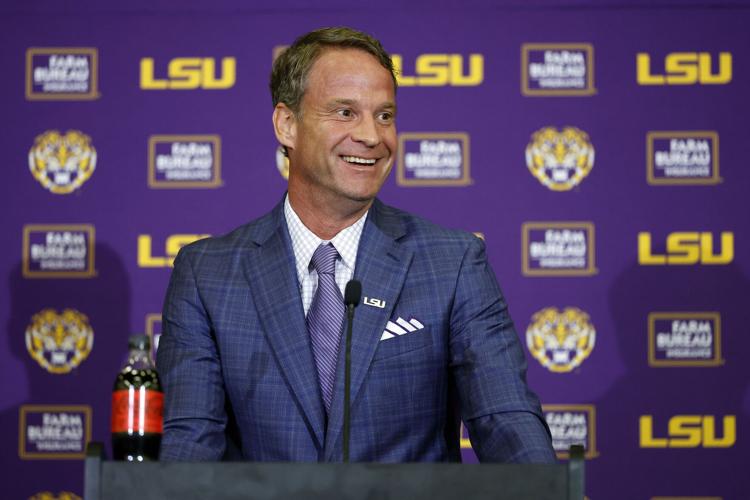
Lane Kiffin speaks at a news conference as he is introduced as the new head football coach of the LSU Tigers at Tiger Stadium on Dec. 1, 2025, in Baton Rouge, Louisiana.
The 111-page bill has the backing of the ACC and Big 12 (and others) but is opposed in its current form by the SEC and Big Ten.
The two most powerful conferences are wary of provisions that 1) prevent them from expanding or joining forces in a manner that could lead to a super league and 2) create a pathway for all the FBS conferences to pool their media rights, thereby undermining the massive financial and competitive advantages the SEC and Big Ten currently hold.
Bevacqua, who was chair of NBC Sports before taking charge in South Bend, believes pooling media rights would be challenging given the duration of the current agreements between the conferences and their network partners.
"That's why I like the fact that it's voluntary," he said of the provision, which is triggered only if 75% of FBS schools agree to join the pool.
Legal experts believe the PCSA has a chance to become law, albeit not without revisions in both the Senate and House. (Republicans are viewed as more likely to support the legislation than Democrats.) Clearly, it possesses a cleaner path through Congress than the SCORE Act, which imploded last month before ever reaching the House floor.
Many view federal legislation that includes limited antitrust protection (to end the stream of lawsuits against the NCAA) as the only option for preserving competitive balance.
"If this continues, we'll be left with 30-50 teams in essentially a mini-NFL," Cruz said. "The victims will be the fans seeing their favorite teams, storied teams and programs disappear and hundreds of student-athletes will lose scholarship opportunities."
Gould, whose remarks were obtained by the Hotline prior to her testimony, isn't the first college sports executive to lean into collective bargaining as a viable option.

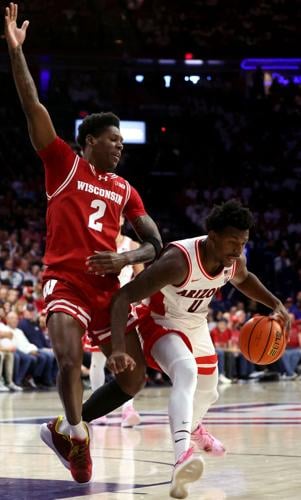
Arizona’s Jaden Bradley (0) runs down the court as Wisconsin’s AJ Storr (2) defends him at McKale Center, Dec. 9, 2023. Before Storr became a Badger, he played for St. John's. After Wisconsin, he transferred to Kansas, then Ole Miss.
University presidents and athletic directors in conferences across the country are slowly becoming comfortable with the move, which is seen by many as the best way to address vexing issues like player compensation, the transfer portal and a competition calendar spinning out of control. (Next season, the College Football Playoff will span 39 days, from the opening round on Dec. 18 to the championship game on Jan. 25.)
And it's worth noting that the Pac-12 has not been afraid to take a proactive stance on key issues.
In the fall of 2015, the conference called for the NCAA to change its rules and allow athletes to be compensated for the use of their name, image and likeness. The concept didn't generate the needed support.
Six years later, NIL became the law of the land.
Gould's testimony included the following additional comments:
– She noted that, "Like much of college athletics, the Pac-12 has faced unprecedented disruption through conference realignment and the loss of longstanding members, rivalries and traditions.
"Yet throughout periods of change, the conference has remained resilient, innovative, willing to challenge convention, while at all times being guided by our North Star, which is to support our student-athletes."
– Gould called for "innovative approaches to conference alignment and scheduling that reduce travel burden and time away from campus."
She referenced the Pac-12's men's soccer partnership with the Big West as "the type of creative solutions that can preserve competitive opportunities while reducing the strain on student-athletes."
– She said the rebuilt Pac-12, which becomes official July 1 with eight football schools and nine members for basketball, is "undertaking a reimagination of what a modern athletic conference can be ... The goal is not simply to preserve a legacy but to build a new model that connects institutions, student-athletes and fans."