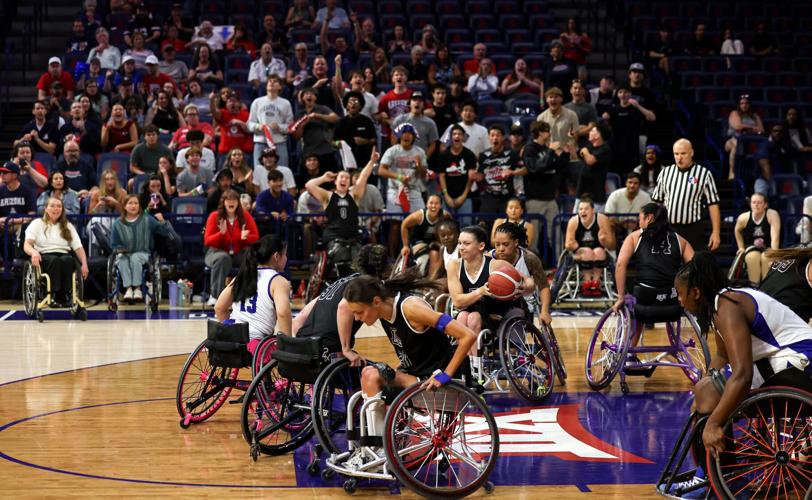
University of Arizona students took advantage of a chance to pack McKale Center before basketball season came to a close. Fraternities and other school organizations turned out en masse to produce a raucous environment of screaming students. It included kids whom the event organizers hope will be the next generation of wheelchair basketball stars.
The attraction was Game 1 for the Wildcats' women's wheelchair basketball team against the University of Texas at Arlington, part of the men’s and women’s National Wheelchair Basketball Association’s Intercollegiate National Championships, which took place at McKale April 1-4.
“I was scared they were going to give us a tech,” Arizona graduate guard Abby Dunn said of the noise.

Arizona fans go wild after a turnover during the first half against UTA in the NIWBT semifinals at McKale Center, April 2, 2026.
Same sport. Same court. Same arena.
But the attention normally reserved for Arizona’s men’s and women’s Division I teams made all the difference for a sport looking for increased exposure. The tournament, which featured teams representing 12 American universities, did just that, allowing players to compete for a national championship while raising awareness for adaptive athletics on a big stage.
People are also reading…
”(This event), it’s not just put on by the school, it's supported by the community,” NWBA CEO Brandon McBeain said. “Awesome event overall, and I know our members are really appreciative of that support. It heightens the energy around what already is amazing competition on the court.”
Bringing more eyeballs to the sport of wheelchair basketball was the biggest benefit of bringing this year’s NWBA Intercollegiate National Championships not only to the Arizona campus but to the McKale Center stage.
“Adaptive sports and the Paralympic movement still has an awareness problem here in the U.S.,” McBeain said. “Having more eyeballs on our sports will only further advance the exposure of adaptive sports and hopefully create more opportunities for individuals to become involved, not just playing our sport, but involved in a volunteer capacity.”
Playing in the same arena where Koa Peat and the rest of the men's and women's Wildcats basketball players are featured on national television is an opportunity that wheelchair basketball players don’t take for granted. Thrills such as seeing a replay from the backboard camera on the Jumbotron became surreal moments.
“It’s huge to have an event like this at McKale,” University of Arizona sophomore Carlos Reynoso said. “This is the first time that we’ve ever hosted the national tournament here. It’s been great to see the cameras we get to use, the same cameras that the able bodies get to use. To see a transition over to our game, that's been amazing.”
Leveling up

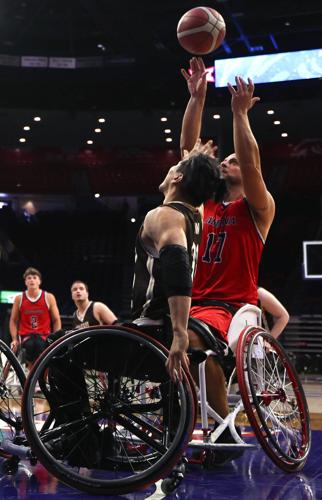
Arizona’s Carlos Reynoso (17) shoots the ball over SMSU’s Robert Lew (32) in the quarterfinals of the men’s intercollegiate wheelchair basketball national championships at McKale Center, April 2, 2026.
Reynoso started playing wheelchair basketball over 10 years ago. Originally from the Bay Area, the sport has given him the chance to compete while coming back to school to finish his college education as an adult. Not only that, it has allowed him to be a part of a larger community of adaptive athletes, an experience unique to Tucson.
“There’s such a big wheelchair community out here,” Reynoso said, referencing the fact Tucson is home to junior and adult wheelchair basketball teams, in addition to the collegiate team. “I’ve gotten to see how tight-knit this community is. Everyone knows who everyone is.”
The University of Arizona takes supporting its adaptive athletes seriously, having six sports represented in the adapted athletics department: men's and women's wheelchair basketball, track, tennis, swimming, golf and paratriathlon.
“Most of us players have some sort of scholarship, some sort of way that we are getting help towards our school," Reynoso said. "Just being able to be a student-athlete again has been great.
“There (aren’t) a lot of colleges out there that have these kinds of programs in place. This is a great opportunity for anyone who’s able to come out here and continue to grow. Even at my age, I’ve gotten so much better in two years.”
Growth is not unique to Reynoso. Dunn is looking at opportunities to play professional wheelchair basketball overseas. It’s an opportunity that she said would not be possible if not for her time playing wheelchair basketball at the collegiate level.
“It means everything, honestly," Dunn said. "I’m really happy that we have a community that lets us be here and just experience what it’s like to play on a DI court.
“My goal is to be a Paralympian and I’m going to do everything in my power to get to that. I’m looking to play overseas and just continue to grow my game. Without my coaches and my teammates I would not be going on that path. I’m just thankful for all of them.”
The professional opportunities to play wheelchair in Europe far exceed those in the U.S. for Dunn. The U.S. has no professional wheelchair basketball league, while Europe has the Spanish Wheelchair Basketball League, Germany’s RBBL, Italy’s Serie A, and the British National League.
Even so, the adaptive athletics program at the University of Arizona has taken major strides since its inception.
Alana Nichols, a Wildcat alum who has her name in the Paralympic history books, got her start in adaptive athletics at the university. The five-time Paralympian and six-time medalist is the first American woman to ever earn a gold medal in a summer and winter Olympics or Paralympics. She won gold in wheelchair basketball at the 2008 Summer Games and two golds at the 2010 Winter Games in downhill and giant slalom skiing.
“This (event) is really important for the overall awareness of wheelchair basketball. I played from 2003 to 2006 and at the time we could only dream of coming to the McKale Center,” Nichols said. “It’s just come a long way. For McKale and the University of Arizona to support wheelchair basketball the way that they are is really leveling up the whole team. … It's really big for the program.”
Opening doors

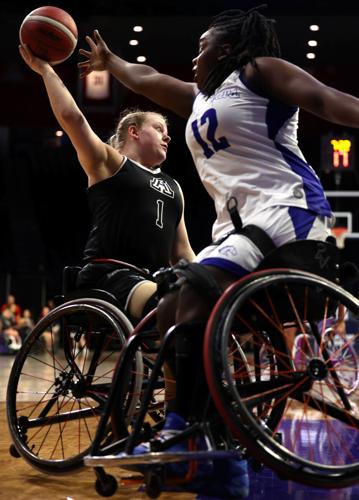
Arizona’s Lily Lautenschlager (1) looks to pass the ball over UTA’s Harmonee Ruetes (12) in the NIWBT semifinals at McKale Center, April 2, 2026.
The event highlights the importance of adaptive sports for those with disabilities on and off the court. Nichols suffered a spinal injury after attempting a backflip on a snowboard when she was 17. An athlete all her life, Nichols admits she lost her sense of self when sports were taken from her.
“Wheelchair basketball and adaptive sports in general really changed my life,” she said. “Adaptive sports came into my life and it helped me regain a sense of myself.. So much of what makes me a happy person is moving my body and adaptive sports creates an opportunity for me to do that.”
Nichols says she appreciates the records and getting to travel the world, but adaptive sports have given her something better: They’ve made life exciting again.
“When you are excited about life, all the other doors start to open, your education starts to thrive, life just opens up to you when you are a happy person and sports did that for me,” she said.
Nichols is now a role model for the next generation of adaptive athletes. The university held a “Pizza with Paralympians” panel where younger athletes could ask questions of six Paralympians across a variety of different sports.
“I hope as a role model, people see me enjoying the process of what I’m doing,” Nichols said. “It’s the chase for me. Not everyone is going to win a gold medal. Less than 1% of the population gets an opportunity to receive an Olympic or Paralympic medal but if you are present and enjoy the process of what you are doing, that's where it all matters.”
Alabama won the women's tournament, and the Auburn Tigers took home the men's crown at McKale. Far more than the results, the weekend illustrated the power of sports and what can happen when you give an event or people a platform.
“We’re basketball,” McBeain said. “A wheelchair should just be a mechanism or equipment for them to participate in wheelchair basketball.”
The NWBA will return to Arizona in a year's time for its junior and adult national championships at the Arizona Athletic Grounds in Mesa in early April 2027. McBeain wants the support of the community and for people to come out and see what these athletes can do.
“We’re an organization that creates access to sport for individuals with disabilities, but beyond that we make an impact on individuals’ lives,” he said. “I really share that with anyone that wants to learn more about wheelchair basketball. There’s endless opportunities for what we are doing and how we are impacting lives for those who become involved in our organization.”
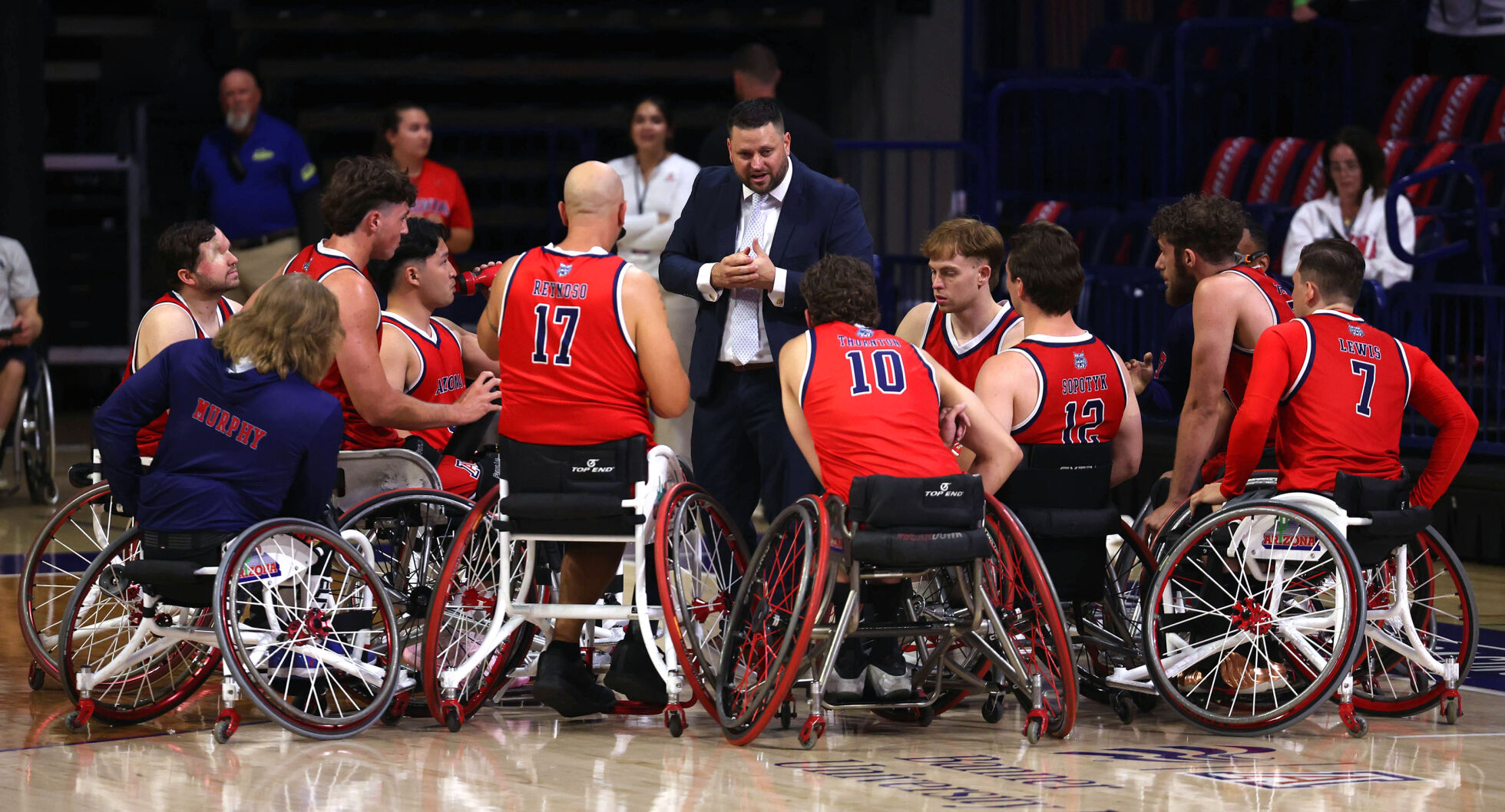
Mike Beardsley, Arizona wheelchair basketball head coach, talks to his team during a timeout in the quarterfinals of the men’s intercollegiate wheelchair basketball national championships against SMSU on April 2, 2026.
The sport is something you have to see to believe. Chairs flipping are a regular occurrence, the sound of crashing metal wheelchair frames and the smell of burned rubber go together like the crack of a bat and the smell of grass at a baseball game.
“The game’s really fast. There’s so much hitting and smashing into each other, falling over,” Nichols said. “This is a really intense sport and it’s really fun to watch. I would tell people if they haven’t seen it to come check it out and watch your mind be blown.”


 Tanque Verde Hawks baseball takes flight behind three-sport senior standout