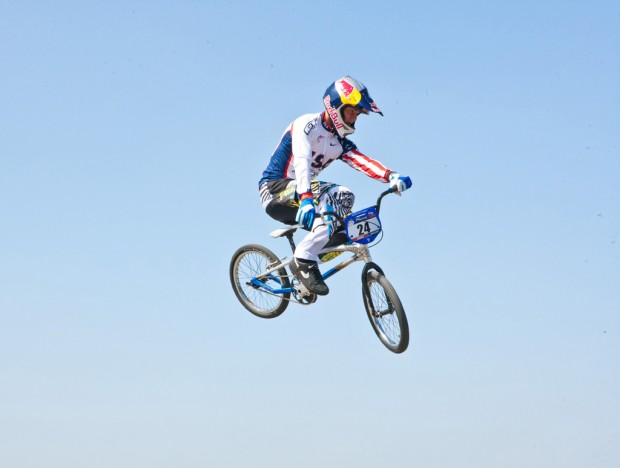
The acre of dirt adjacent to 302 E. Smoot Place is a boyhood BMX heaven, a daredevil's delight of step-ups, tabletops, rollers and ramps that is as much a Field of Dreams as any Iowa cornfield.
It is the beginning of Corben Sharrah's Road to the Olympics, the most unlikely place you would expect to discover a world-class athlete.
East Smoot Place is a few hundred yards from Amphitheater Middle School and a few steps from the modest home of Jack and Karen Sharrah, working-class parents, nurses, whose son has grown up to be The Next Big Thing in American BMX racing.
As much as the homemade BMX course on East Smoot Place is in the middle of nowhere, it is the center of one of the most compelling stories in advance of the 2012 Olympics.
"Sometimes I can't comprehend that this is my life, that I make money doing this," says 20-year-old Corben Sharrah. "Basically, my hobby turned into my career."
People are also reading…
While other neighborhood kids played video games and Little League baseball, Sharrah rode his bike. He started at 3 and never got off. Sharrah has a 38-inch vertical jump yet he's never played basketball or rushed a quarterback. "I never tried anything else," he says.
By the time Sharrah was 9, the director of the American Bicycle Association, Matt Eggimann accurately predicted, "If he sticks with it, he could be one of the greats; he's got massive talent."
He stuck with it.
Today, Sharrah is in London, part of Team USA at the ongoing world championships. It is essentially a test run for the Summer Olympics, to be held on the same course. Sharrah is one of five fully funded American BMX riders; three will make the Olympic team next month.
His BMX coach, Greg Romero, who has coached two Olympic medalists, told ESPN that "I'm blessed" to be working with Sharrah.
The elements to this story aren't much different from many would-be Olympians.
Tucsonan Anthony Sanders started catching a baseball in his back yard as a 4-year-old and wound up a gold medalist on America's 2000 Sydney Olympics team. Tucsonan Kerri Strug was turning cartwheels in her parents' living room at 5. She became a gold medalist gymnast at the 1996 Atlanta Olympics.
At 4, Sharrah began jumping over obstacles in his front yard. At 5, piqued by TV commercials, he personally phoned Tucson's Manzanita Raceway and was soon a regular. At 6, his BMX ranking soared from novice to intermediate and to expert. No one had even come close to that.
"My older brother, Jake, always rode with me; he raced basically every race I did and was very good," Corben says. "My whole family tried it - until they tasted the dirt. My dad and mom always took me to the track, always supportive. They saw something in me before anyone else."
About 10 years ago, Jack Sharrah built a BMX course on the vacant lot adjacent to his house. As Corben's ability grew, Jack bought a tractor so that he could shape the East Smoot Place BMX track into a worthy practice facility. Even though Corben does most of his training at the USA Olympic Center in Chula Vista, Calif., the family track remains operable.
Corben returned to it in January to film a popular YouTube video. It could be titled "See Sharrah Fly."
"I try to stop by every month or so," he says. "I definitely look forward to bringing the bike home and doing a couple of laps. That course was my life.''
Sharrah graduated from Amphi and has attended Pima College but is currently training full time. He has raced in Norway, South Africa, Spain, the Netherlands, Denmark and at many of the big BMX parks of America. He has become so hot, so trendy, that he endorses and represents Red Bull, Troy Lee Designs, ODI, SDG, Shimano, Tioga Tires, Alienation and Alpinestars.
A few weeks ago, a two-page ad for McDonald's fruit smoothies in Sports Illustrated was built around a Q&A session with Corben. The hook paragraph: "I've never really been scared of getting scratched or falling on my head."
Isn't that part of the appeal? The daredevil, devil-may-care lifestyle of a BMX racer?
Sharrah has spilled more than his share of blood: He broke his femur trying to avoid a collision at the 2011 world championships in Copenhagen. Initially, doctors (and Corben) feared it would knock him out of the 2012 Olympics. But typical of his fifth-gear approach to cycling, he cut the recovery time in half.
He barely mentions that he dislocated his hip a few months ago, that he tore the meniscus in his knee at 16, and that he has broken fingers, pinkies and long ago lost count of his face-plants.
"This is a young man's game, and I'm a young man," he says. "I've been hurt enough to know that I'm not superhuman. But I look at the next 10 years as my prime. It seems like I've been racing forever, but now I'm just getting started."
Contact Greg Hansen at 573-4362 or ghansen@azstarnet.com

 Chip Hale among Arizona baseball coaching legends to fall on hard times | Greg Hansen