

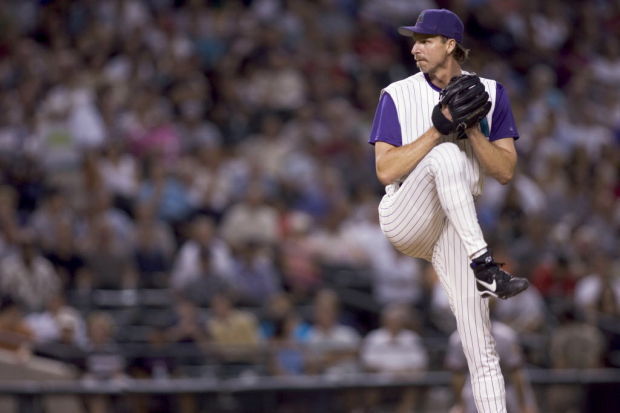
For years, I’ve been telling people I was in the press box at Tucson Electric Park on March 24, 2001, the day a Randy Johnson fastball pulverized a dove between the pitcher’s mound and home plate.
The dove was all but vaporized — poof! — making me shake my head in wonder: Why did that sort of thing happen to a Hall of Famer like the Big Unit, and not, say, a knuckleballer like Tom Candiotti?
Maybe the bird would have survived.
But when Johnson was elected to the baseball Hall of Fame this week, I looked through the files and discovered that I wasn’t at Tucson Electric Park that day at all. I was in San Antonio. It was a day before Arizona beat Illinois to advance to the 2001 Final Four.
There goes one of my best stories; nothing but feathers.
As the Big Unit grew in fame, I shared with friends that I was at Sancet Field in March of 1985 when Johnson, then a USC junior, was taken apart by an Arizona team that continually shouted “Ichabod!” from the dugout, getting into his head.
People are also reading…
Long before Johnson was called Big Unit, he was razzed, a victim of the UA’s old-school bench-jockeying.
Ichabod.
I would tell people that the better prospect was UA lefty Joe Magrane, not Johnson, and that on that night in 1985, Magrane pitched himself into the first round of the draft.
So I looked that one up, too.
Magrane didn’t pitch that night at all, March 8, 1985.
Arizona indeed beat USC 8-6, and Johnson was the losing pitcher, giving up eight runs in four innings, walking seven, throwing three wild pitches and being called for a balk.
Maybe he should have been called “Wild Thing.” That game occurred four years before “Major League” was released and Charlie Sheen’s character became the famous fictional “Wild Thing.”
About the only thing I remembered accurately is that, in 1985, Arizona’s Magrane was indeed a superior prospect. In that June’s baseball draft, Magrane was the No. 18 overall selection; Johnson was a second-round choice of Montreal, No. 36 overall, a few picks behind the Yankees’ Rick Balabon, a Pennsylvania high school pitcher who never reached the big leagues.
Sometimes your memory is about as accurate as the evaluation of a ballplayer.
The Magrane vs. Johnson showdown of 1985 occurred April 20 at USC. Magrane, a 6-foot-5-inch lefty, was the winner, pitching a complete game, striking out 10.
Typical of his “Ichabod” days, Johnson struggled. He gave up 13 hits, walked six and gave up the losing run when he fielded a Gar Millay bunt and threw it wildly into right field.
“Johnson had all the tools,” former UA baseball coach Jerry Stitt remembers. “But I don’t remember him doing well against us.”
Johnson didn’t put it together anytime soon.
Traded by the Montreal Expos to Seattle in May of 1989, Johnson was paired with the Mariners’ first-year pitching coach Mike Paul. A former UA standout, Paul also a lefty, was a veteran of 228 games for the Indians, Cubs and Rangers.
“Randy had a very special arm that was always No. 1,” says Paul, now an advance scout for the Colorado Rockies who lives in Tucson and has been a baseball coach/scout since 1983. “But if someone tells you now they thought he was going to be a Hall of Famer, they were blowing smoke.”
In the three seasons Johnson and Paul worked together at Seattle, Johnson twice led the American League in walks. He went 34-30.
Being Johnson’s pitching coach from 1989-91 was much different than it would be by 1999-2001, and later.
“I had my own eyes, and that was about it,” says Paul. “We didn’t rely on video then; we didn’t have much of it.”
So Johnson and Paul worked day to day on mechanics, which was a slow process because a baseball pitcher, especially a power pitcher, only has one bullpen session between starts.
Unlike golf, you can’t go to the driving range and hit a few buckets of balls, staying until you understand and command a certain pitch.
Johnson didn’t become a star, consistently dominant, until 1993, when he first led the American League in strikeouts. By then, Mike Paul was coaching for the Oakland A’s.
“All the credit in the world goes to Randy,” says Paul. “He had help from a lot of people along the way, but when push came to shove, Randy figured it out by himself.”
In 1990, when he was just 26, Joe Magrane suffered a career-altering arm injury. He was never able to recapture his magic of 1989, when he went 18-9.
Magrane threw his last pitch in 1996. He won 57 games.
Johnson pitched until 2009, winning 303 games.
In July, when Johnson is formally inducted into the Hall of Fame in Cooperstown, N.Y., Magrane is expected to be part of the MLB Network crew that broadcasts the event.
The days of dead doves of Ichabod are long gone.