

Instant reaction to Week 3 developments on the field …
1. The showdown approaches
For the better part of three hours, it appeared USC might blow it: Lose to Rutgers, despite being heavy favorites, and ruin the anticipation for the Oregon game next weekend.
But the Trojans escaped Piscataway, N.J., with a 42-35 victory on Saturday, thus ensuring their Week 4 date with the Ducks (4:30 p.m. on NBC) will carry lofty stakes and colossal hype.
In our view, it stands as the biggest regular-season game between West Coast teams since the epic Oregon-Washington collision in Husky Stadium in October 2023, the last season of the old Pac-12.
If the Sept. 26 script comes close to matching UW’s pulsating 36-33 victory over the Ducks three years ago, it would be a win for the sport and for the region and for the sport within the region.
People are also reading…
Granted, the Ducks and Trojans dueled last year in Eugene, with plenty of pomp and circumstance. But the game wasn’t particularly close — Oregon won 42-27 — and it didn’t carry the same now-or-never vibe.
Oregon has owned the series with USC on the field (four consecutive wins) just like it has owned the competition with USC on the recruiting trail for the better part of the past decade.
But the Ducks, who lost at unranked Oklahoma State on Sept. 12, are more vulnerable than they have been in years. If the Trojans cannot slay Oregon now, when will they?

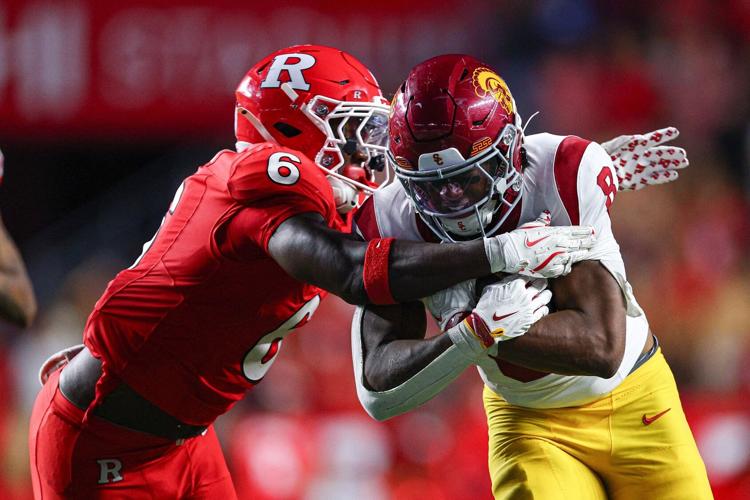
USC running back King Miller carries the ball as Rutgers linebacker Abram Wright tackles him during the second half in Piscataway, N.J., on Sept. 19, 2026.
It’s hardly a stretch to view the duel as a referendum on USC coach Lincoln Riley, who has been given every resource needed to remake the Trojans into the premier program in the West.
Meanwhile, Oregon’s Dan Lanning needs to show the $40 million plowed into his roster is generating the desired returns.
What’s more, the loser will face an exceedingly narrow path to the playoff.
The Ducks, with two losses, would have zero margin for error.
While a loss would be USC’s first of the season, the remaining schedule is tough enough (Penn State and Indiana on the road, Ohio State at home) that any cushion would be effectively removed.
Combine the playoff math with the mounting pressure on both coaches — not to mention the implications for recruiting — and the matchup has more at stake than any intra-regional game in the post-realignment era.
Saturday can’t come soon enough.
2. Week 3 was weak
Mark this in ink: The third Saturday of September will be remembered as the least interesting, most forgettable of the regular season.
The Week 1 schedule wasn’t stocked with marquee games but offered several instances of drama (the Michigan-Western Michigan Hail Mary controversy, for example) and generally warranted undivided attention because everything was new.
Week 2 offered up what might be the game of the year (Texas 24, Ohio State 23) and a slew of intriguing matchups between power conference teams.
But aside from the LSU-Mississippi thriller on Saturday evening — that was Lane Kiffin’s hotly anticipated return to Oxford — there was not much meat to the Week 3 lineup.
Half the teams in the AP Top 25 poll faced opponents from the Group of Six or the FCS, with no upsets and a plethora of blowouts produced.
Only one ranked team lost a nonconference game: No. 25 Virginia was beaten by West Virginia and second-year coach (and former UA coach) Rich Rodriguez.
The Big Ten was the largest consumer of cupcakes, with 11 of 16 games against non-power conference opponents. Predictably, its teams were 11-0 in those games, with an average victory margin of 44.1 points.
Put another way: If you had to skip one Saturday in the fall for a family engagement — or a kid’s birthday party — this was the one to miss.
3. The SEC’s world
Conference play begins in earnest Sept. 26, meaning there are only a handful of games remaining between the Power Four leagues — and those will come on rivalry weekend at the end of the season.
We can use the results to this point to frame the Power Four hierarchy, and it’s not close, folks. The SEC has dominated inter-conference play to a greater degree than we could have imagined.
Here are the records in matchups between teams from the ACC, Big 12, Big Ten and SEC (and Notre Dame):
SEC: 10-2
ACC: 6-9
Big 12: 5-7
Big Ten: 4-9.
That’s right, the SEC has won 10 of 12, and the Big Ten has won four of 13.
All in all, it has been a ghastly start for the conference that owns the past three national championships.
The top tier of the Big Ten is as strong as the top tier of the SEC and undoubtedly stronger than the top of the ACC and Big 12.
But there is no indication the teams on the middle and bottom tiers are close to their counterparts in the SEC, and that lack of depth (more fat, less meat) could be reflected in the distribution of College Football Playoff bids come the first Sunday in December.
4. The price of arrogance
Call it cosmic justice or the football gods rendering judgment, but the Hotline believes that teams, coaches and players ultimately pay for instances of egregious hubris.
Three examples come immediately to mind.
The most glaring unfolded Saturday night in the SEC, where Mississippi slayed its former coach, Kiffin, who quit on the Rebels last year during their playoff run. This summer, the Petulant One tried to wreck one of the sport’s golden rules by putting former NFL players on LSU’s roster. (He eventually caved when the SEC threatened severe sanctions.) Kiffin deserved every morsel of the loss.

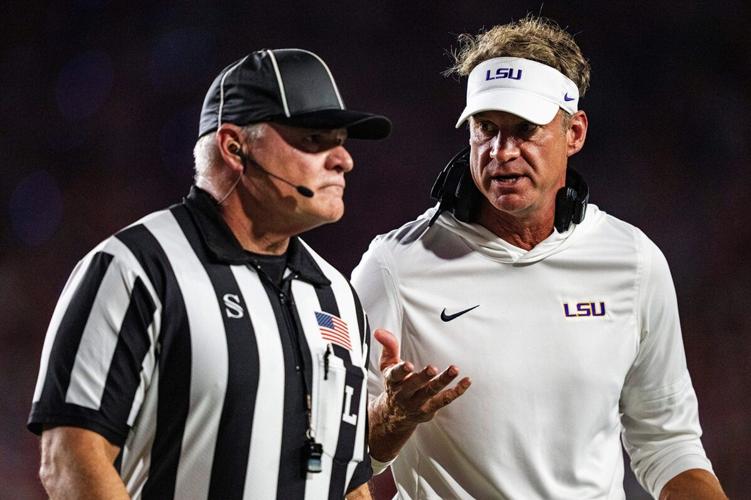
LSU head coach Lane Kiffin talks with an official during the 32-24 loss to Ole Miss in Oxford, Miss., on Sept. 19, 2026.
Another example: Texas Tech.
The Red Raiders acted like rules didn’t apply to them during the offseason, particularly when they tried to roster quarterback Brendan Sorsby, who gambled on his own team.
It was quite the display from a program that has never won a game, or even scored a point in the CFP. Like LSU with the former NFL players, the Red Raiders eventually backed down on SorsbyGate.
After struggling to beat Oregon State in Week 2, they edged Houston by two points at home on Friday night. The combination of results provides clear evidence that Texas Tech isn’t as good as the school and its fans expected.
Could it be the football gods have lost patience with the arrogance in Lubbock?
Our final example came from a predictable source: Colorado, which has often been all talk and no walk under Deion Sanders.
The latest case came Saturday, when players were caught on video disparaging Northwestern’s makeshift home venue prior to kickoff in Evanston. (The Wildcats are moving into a new $875 million stadium next month.)
After cackling and mocking the facility, the Buffaloes got blown off the field 41-7 by an opponent that will finish in the bottom half of the Big Ten. Serves them right.
Clearly, the football gods prefer humility.
5. Five for the Heisman
The Hotline maintains a working list of Heisman Trophy candidates, which we update throughout the season prior to submitting the official ballot on the first Monday in December.
Our top five as of now:
1. Mississippi QB Trinidad Chambliss. The former Ferris State transfer was tremendous in the victory over LSU. If we needed one quarterback to direct a game-winning drive, Chambliss would be the pick, without hesitation.
2. Ohio State WR Jeremiah Smith. The best player in the country regardless of position, but his impact depends entirely on the frequency with which the Buckeyes deliver him the ball. In the 59-3 blowout of Kent State, Smith only had five catches.
3. Miami QB Darian Mensah. Sure, the Hurricanes’ competition has largely been second- and third-rate. But it’s difficult to argue with 11 touchdowns, zero interceptions and a completion percentage of … wait for it … 89.9. Mensah has missed on just eight of his 79 attempts. Unreal.
4. Mississippi State QB Kamario Taylor. The little-known sophomore has 11 touchdown passes and one interception and just might be the most physically gifted quarterback in the country. His next five opponents: Missouri, Alabama, LSU, Oklahoma and Texas. We wish him the best.
5. Texas QB Arch Manning. For 11 of the Longhorns’ 12 quarters, Manning has been perfectly serviceable. But in the most pressure-packed quarter anyone has played this season — the fourth against Ohio State — he was phenomenal.