

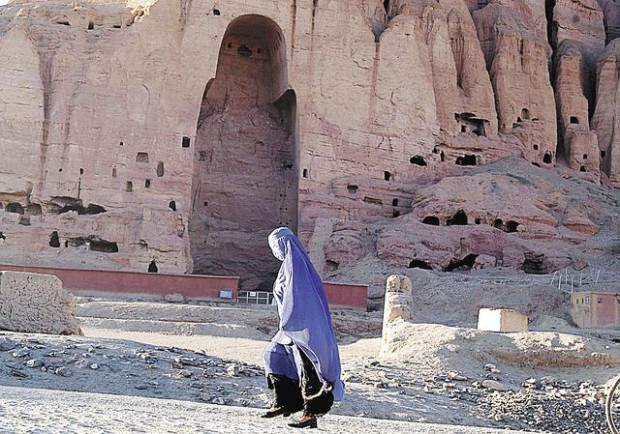
KABUL, Afghanistan — Like many people, my image of Afghanistan has been shaped by what I read and see in the media. Women in blue burqas, fields of opium poppies, fierce-looking turbaned men, and tanks churning through dust.
That may well be true, but what I found on a weeklong trip was a surprisingly green country with welcoming people.
Often peeping from beneath those enveloping burqas, I saw strappy high-heeled sandals and crimson-colored toenails.
I climbed the ruins of 12th-century citadels sacked by Genghis Khan, sat in sunlight beneath a canopy of apricot and apple trees in the Panjshir Valley drinking cardamom tea, and explored the empty niches of fifth-century Buddhas famously blown up by the Taliban in Bamiyan.
The U.S. State Department warns of "an ongoing threat to kidnap and assassinate U.S. citizens . . . throughout the country." Still, a few travel agencies, many run by former backpackers, will arrange trips there.
People are also reading…
After e-mails with friends who lived there, security agencies and, by chance, the son of a former Afghan diplomat, I had a loose itinerary: Kabul, Bamiyan and the Panjshir Valley.
A friend recommended her driver, Shahabudin Sultani, a soft-spoken Bamiyan native dressed impeccably in a traditional cream Afghan tunic and trousers. And so at 6:30 a.m., we loaded bottles of water and bags of almonds and apricots into a minivan for the journey.
Although it's only 150 miles from Kabul, the drive to Bamiyan takes more than 10 hours along a dirt path that winds high up into the snowcapped Koh-i-Baba mountains before dipping down into a verdant valley. Dotted along the red craggy cliffs are dozens of fortresslike mud and brick houses with high walls pockmarked by rocket and bullet holes, ubiquitous reminders of war.
Children run along the path, switching at donkeys loaded up with bails of wheat or herding goats past rusting Soviet tanks.
War has been a constant in Afghanistan, as regional powers battled for control of the territory often described as the cockpit of Asia, and the Bamiyan Buddhas were silent witness to much of it.
The two statues, nearly 175 feet and 125 feet tall, were hewn out of the red cliffs when Bamiyan, on the fabled Silk Road that linked Rome to China, was a thriving center of Buddhism and culture.
They survived the violent introduction of Islam in the seventh century and escaped the murderous rage of Genghis Khan in the 13th. During the decade-long resistance against the Soviets, the honeycomb network of 2,000 caves that surround the statues housed thousands of war refugees. Then came the Taliban, which initially promised to preserve the Buddhas, then blew them up in 2001 to an international outcry.
I stayed at the Roof of Bamiyan hotel in a yurt — small round huts made of mud and straw and covered inside with Afghan carpets.
The next morning, my birthday, after a breakfast of warm flaky Afghan bread, scrambled eggs and scented black tea, I headed to the village for a better look. Although Bamiyan is one of the safest places in Afghanistan, I was careful to wrap up, covering my arms and legs and twisting a scarf around my head. I picked my way down the hill and through the dusty pathways of the village, drawing few stares and the occasional smile.
The towering niches, although empty, are more impressive close up. It's still possible to see the outline of the statues, and some parts remain, as if in bas-relief, although most is in rubble. UNESCO and Afghan archaeologists have spent years collecting and cataloging fragments of the statues and stabilizing the cliff side.
For $3 — plus a negotiable "tax" — it's possible to explore the caves, which are awesome.
Most people leave after seeing the Buddhas, but there are other sites worth seeing, including the lakes of Band-i-Amir, five pools of sapphire blue set amid desert canyons, and the ruins of the Red City and the City of Screams, which were built in the 12th century and razed by Genghis Khan a century later. Both were heavily mined during decades of war, although most have been cleared.
For my last adventure in Bamiyan, we head to Dragon's Valley, a mountain ridge in a valley of undulating, anonymous gray sand dunes. Legend has it that a dragon terrorized locals, demanding each day a young girl and the occasional camel to eat. Until, that is, Islam's dragon slayer, Hazrat Ali, split the beast in two with his sword, leaving a fissure 3 feet wide at some points, and sparking a mass conversion to Islam.
The ribbed mountain does look like a dragon's scaly back. Inside the chasm you can hear the dragon's mournful rumbling — bubbling spring water streaming like tears from the dragon's eyes.
Over the next few days, I pack in a day trip to the Panjshir Valley, visiting the marble and stone tomb of Ahmad Shah Masood, a resistance hero who was assassinated by al-Qaida a few days before the attacks of Sept. 11, 2001. The tomb is perched high on a hill with a commanding view of the valley he defended from Soviet troops.
I'm picked up early the next day by Great Game Travel company for a daylong tour of Kabul, the capital, that jumps between the fifth-century city wall, the 16th-century Babur Gardens and the buzzing Kabul market. Here women in sky-blue burqas teeter on high heels as they jostle to buy tea and spices.
Standing on a hill looking over the city, our guide points out the Kabul stadium, where the Taliban once carried out public executions.
What happens there now? "Oh," he said, "now, they just play soccer."
If you go
Afghanistan: Travel warning from the U.S. State Department (travel.state.gov/travel/ cis_pa_tw/tw/tw_2121.html).
Kabul travel agencies: Great Game Travel (www.greatgametravel.com). Afghan Logistics and Tours (www.afghan logisticstours.com).
Guide: "Afghanistan" by Paul Clammer (Lonely Planet, $25.99).
Tips from travelers for offbeat places: thorntree.lonely planet.com.


