

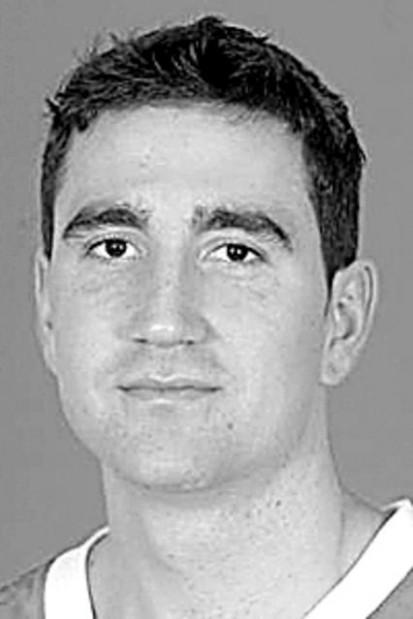
Oregon State senior Nick DeWitz was a standout at Dobson High School in Mesa. He led the Mustangs to a 28-3 mark and a Class 5A state semifinal appearance in his senior season (2001).
But before the 6-foot-8-inch forward became a Beaver, he took a journey that saw him attend four schools and spend numerous chunks of his life sitting on a sideline waiting to become eligible to play.
DeWitz, because of academic issues and transferring, has played only 56 Division I games. He makes his final swing through his home state when OSU visits Arizona State on Thursday and the UA on Saturday.
Q: Most college athletes end up spending their entire careers at one school, but you have been all over the map. Would you say you've been through a lot more in your college career than you would have expected?
A: Definitely. It's been a long road traveled. I don't think anyone who's going to college thinks they're going to go to four different colleges. No one wants to do that.
People are also reading…
Q: It goes without saying that Arizona State could have used your abilities. Was ASU under consideration?
A: A little bit. Being in my back yard, it would have been fun to go play there, but academics were an issue for me, so I really couldn't go to a Division I school.
Q: Instead, you ended up at Utah Valley State, where you averaged 9.3 points and 4.7 rebounds in 2001-02 playing for current OSU assistant Jeff Reinert. Did you know UVS was going to become a four-year program?
A: I think they were talking about that, but I had no idea.
Q: From Utah Valley you returned home and spent a semester at Mesa Community College, but did not play basketball. What was the reason?
A: Coach Reinert pointed out that I had (completed) a year and a half of junior college (classes) in only a year, so he advised me to go to Mesa just for school, so I could finish up my degree, but sit out (from basketball) so I could save my eligibility. I'd have three years left to play.
Q: Next stop was Iowa City, where you played for Steve Alford at Iowa. You played in the Hawkeyes' first eight games, averaging 5.1 points and 3.8 rebounds, before electing to transfer. What went wrong?
A: I had some academic issues. And me and Coach Alford weren't seeing eye to eye at the time. I decided to go back to the West Coast where I could be closer to home.
Q: Your last stop was Corvallis to play for Jay John at OSU. Did you have a previous relationship with John when he was an assistant at the UA?
A: He and my head coach in high school (Rick McConnell, son of Sahuaro coach Dick McConnell) were good friends. Coach McConnell told Coach John I'd never (qualify out of high school), so (John) kind of advised me on where I should go. And when I got out of Utah Valley, he was back in the recruiting process as coach at Oregon State. We'd known each other for a while, so that made it an easier decision to leave Iowa.
Q: Before you could play for OSU, you had to sit out an entire year. That meant you missed the Beavers' first six games of the 2004-05 season. How hard was that to handle?
A: I wished I could have helped the team right away, but I couldn't do it. It was tough just sitting there.
Q: When you finally got to play for OSU, you stepped in immediately and contributed, averaging 14.0 points and 5.8 rebounds to help your team to its best record in more than a decade. Did it feel like all of the moving around was worth it?
A: I think everything happens for a reason. That's the way I look at things.
Q: Your team last year went 17-15, the program's first winning season since the early 1990s, and you got to play in the NIT. How proud were you to be a part of that resurgence?
A: I didn't know much about what they'd done in the (past), but it's great to be able to help with that. We're getting people into us, and we're close to selling out (at Gill Coliseum). The Beaver Dam, our student section, it's getting loud.
Q: At 6 feet 8 inches, the first thought is that you are a post player. But last season, you had the rare combination of being third in the Pac-10 in blocked shots and second in three-point shooting percentage. Do you consider yourself an inside guy or an outside guy?
A: Definitely an outside. I'm a lot more comfortable with my face to the basket than my back to it.
— Brian J. Pedersen