Under a landmark agreement, Arizona is negotiating to buy Colorado River water now owned by a San Diego-area agency, and experts say the first of that water could be headed to the state in four to six months.
The goal of the new agreement, signed by federal officials and leaders of water agencies in Arizona, California and Nevada, is to eventually transfer potentially large amounts of Colorado River water between states.
The first step is to negotiate how actual sales would be consummated, legally and financially.
The plan is to start small, with a pilot program. At first, it would transfer maybe one-tenth the amount of Tucson's annual drinking water demand from the San Diego County Water Authority to Arizona, Nevada or other water agencies in Southern California, then ramp up the transfers by up to 10 times as much or more.
People are also reading…
The purpose of these sales would be twofold, backers say. One is to bring what one expert calls a "buffer" to Arizona and other Western states facing a very real possibility of losing substantial amounts of their Colorado River supplies in the next few years due to continuing extreme drought and a changing climate.
This year, the river is slated to carry its lowest spring-summer runoff into Lake Powell on record, due to record-low winter snowpack and record-setting warm spring temperatures. That comes as the seven Colorado River Basin states have tried with no success to negotiate a long-term agreement to manage the river, forcing the U.S. Bureau of Reclamation to come up with its own, almost certainly unpopular fix.
The second purpose, from San Diego's viewpoint, would be to take some financial pressure off the water authority, which a decade ago built and has since operated a hugely expensive desalination plant in the coastal city of Carlsbad north of San Diego.
It costs almost 10 times as much to produce its desalted water as the agency running the Central Arizona Project pays to pump its share of Colorado River water uphill from the river to Phoenix and Tucson.
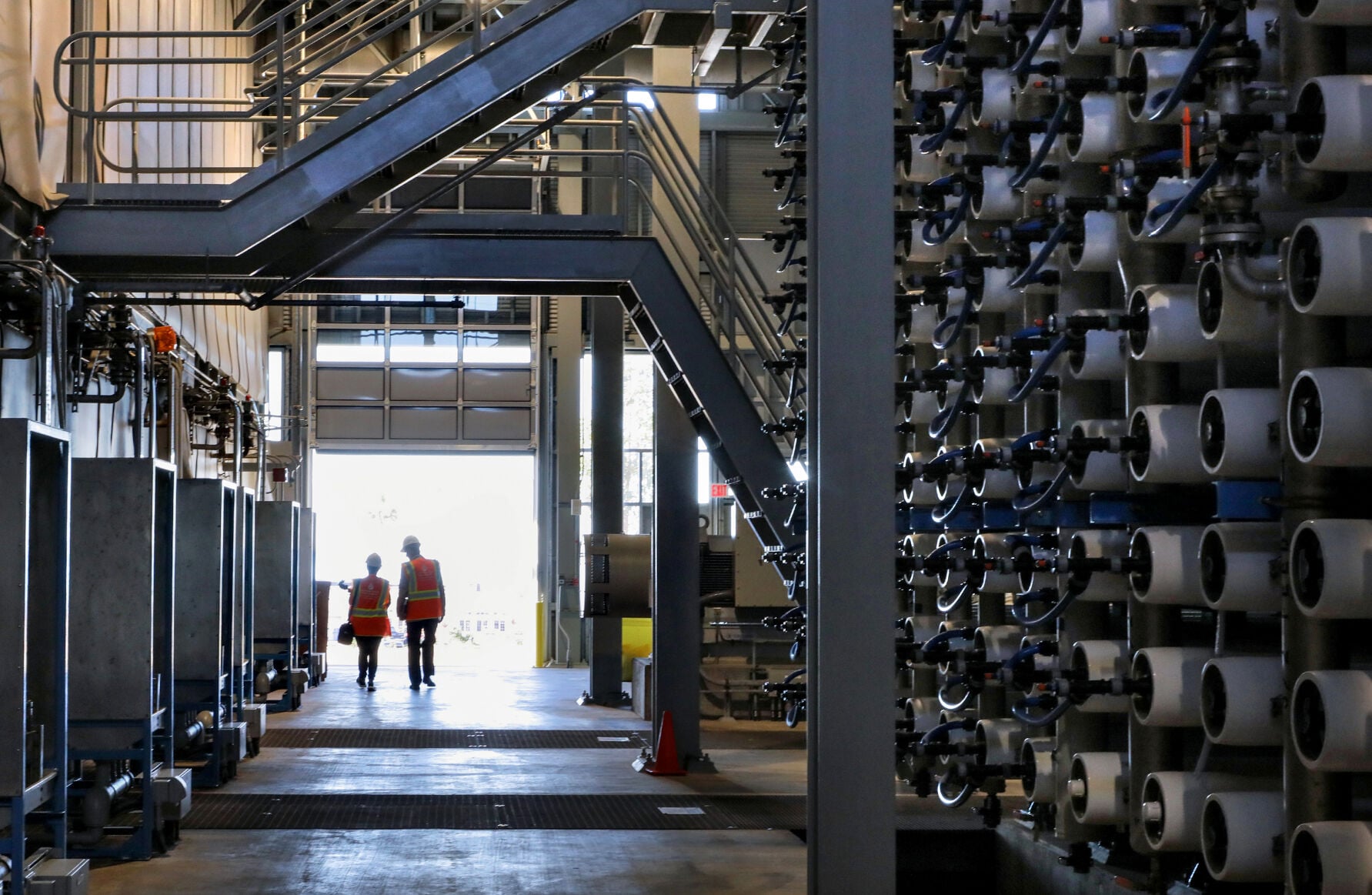
Under pending negotiations between the San Diego County Water Authority and officials of Arizona and other states, the authority will sell some of its Colorado River water rights and use the revenue to hold down rates to its customers, which have spiked due to operations of an expensive desalination plant, shown here, in Carlsbad, California.
One result is that water demand in the San Diego area has plummeted, by as much as 50% in per-person use, since the 1990s, the San Diego County authority has said. Another is that the desalination plant and construction of other new water facilities have triggered major water rate increases in the area, to the point where the San Diego area has some of the highest water rates of any U.S. metro area.
The plant also, at times, runs well below its operating capacity of 50,000 acre-feet a year, averaging about 40,000 acre-feet over time but at times running at as low as 25% to 33% of total capacity. The utility's hope is that selling off some of its river water will raise enough revenue to pay off much of the debt it has incurred to build the desal plant and other facilities.
Those cost disparities will set the stage for potentially divisive negotiations between Arizona and the San Diego water agency over how much this state would pay the water authority for its water.
The San Diego agency would not be selling the desalted water directly to Arizona or other states — it would be allowing some of its river water supplies to stay in the river. These water supplies would be placed into the 336-mile-long concrete canal used by the CAP. But the agency would want to charge enough for the water it does sell to help reduce some of its debts and cover some of the desal plant's costs.
Nobody at this point can say how much Arizona will pay for San Diego's share of river water. But the San Diego authority's general manager, Dan Denham, said Arizona will have to pay more than the $365 an acre-foot it now pays for delivering CAP water. CAP board President Terry Goddard, however, said selling river water to Arizona at the $3,500 an acre-foot it costs to run the desal plant is unacceptable.
The plan, as outlined by Denham, would be to start by transplanting maybe 10,000 acre-feet a year.
Over time, authority officials hope to expand the amount of water sold, first to 25,000, then 50,000 and ultimately more than 100,000 acre-feet a year, said Denham. The 100,000 acre-feet is about how much drinking water Tucsonans consume annually.
How much the authority will sell really depends on the duration of the deal, Denham said.
"One thing the water authority is not necessarily interested in doing is to sell a one-time slug of water," he said. "The Colorado River Basin is in bad shape. What we want is a long-term contract for larger volumes of water."
As for the timing of a first-round deal, "depending on how quickly the lawyers work," it could be four to six months before the first water from San Diego comes to Arizona, said David Wegner, a former Bureau of Reclamation official who remains active in water issues.
Arizona State University water researcher Sarah Porter agrees that the parties to the negotiations could jump through all the legal and administrative hoops quickly. CAP officials, for instance, have already agreed on a program to allow other agencies' water supplies to flow into their canal, after years of discussion and haggling over how to deal with water quality from the outside sources.
And because the entire Colorado River Basin is in an urgent situation, "I expect people would find ways of getting through the process as fast as possible," said Porter, director of ASU's Kyl Center for Water Policy.
Goddard is less certain about the region's ability to draft and put into effect an agreement in six months.
"That would be very good if we could, but I'm not sure it's realistic," said Goddard. "Both legal and regulatory curbs have to be overcome first. Obviously Reclamation has to bless it. Also, there are issues within California that have not been resolved."
Still, he notes that times have changed in Arizona's attitude toward interstate water transfers since he was growing up in the 1960s.
"If interstate transfers were not illegal then, they were highly discouraged, because everybody knew that California would dominate the market if we did them," he said.
Now, he sees the new agreement, signed June 3, as opening the door to many opportunities for Arizona, although the concern about California's dominance "has still gotta be dealt with."
More desalination plants envisioned
Beyond that, Denham and Acting Bureau of Reclamation Commissioner Scott Cameron say they hope the success of these negotiations will inspire other California officials to build a string of desalination plants along the state's coast to provide even more water to replace lost Colorado River water.
Other than the Carlsbad plant and another one approved for southern Orange County, efforts to build more desal plants in California have generally run aground in the face of determined environmentalists due to its escalating water costs, its generation of greenhouse gases, and concerns about the impact of its brine wastewater on marine life.
Cameron, in San Diego on June 3 to sign the interstate agreement, said as he stood in front of the Carlsbad plant, "Imagine a future where a string of six, or even a dozen desalination plants are operating along the California coast providing ample amounts of beautiful, clean, clear fresh water in an environmentally benign way to serve not just California communities, but to be be shared at a reasonable price with ... sister states to the east."

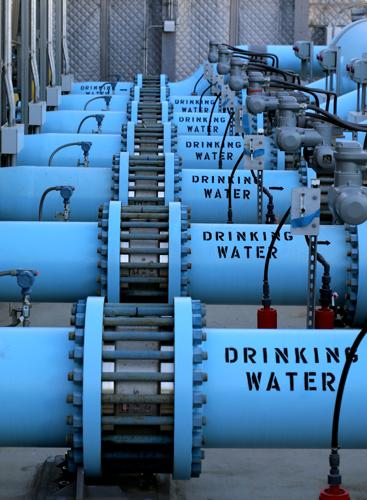
Pipes labeled with drinking water at a desalination plant in Carlsbad, California. Acting U.S. Bureau of Reclamation Commissioner Scott Cameron says he hopes the success of current negotiations to have San Diego sell some of its Colorado River water to Arizona and other states will inspire other California officials to build a string of desalination plants, to provide even more water to replace lost Colorado River water.
But longtime Southern California environmental activist Conner Everts, who has been fighting desalination plants for more than 20 years, countered that most of the environmental issues swirling around desalination haven't yet been resolved, making its long-term prospects uncertain at best.
"Desal is the last thing you do after you try all other solutions;" said Everts, whose efforts failed to stop approval of the Carlsbad plant during the 2000s but did help kill a similar plant from being approved in Orange County in 2022. "Why would someone want the more expensive water? It takes years and years to build. It's not like you can start to build a plant and quickly be done."
But Wegner and water authority general manager Denham say continued declines in river water supplies could bolster support for additional desalination plants.
"Step back and say, California is getting x amount of river water," Denham said. "How much of that can be left in the river, and instead continue to develop desalination and water reuse up and down the coast? I think there is somewhat of an equilibrium in that."
Not enough water to replace potential losses
What's abundantly clear to everyone involved in these negotiations is that the amount of water Arizona or Nevada could get from this deal is nowhere near enough to replace the Colorado River water they could lose, particularly Arizona, once Reclamation issues its final decision on the river by the end of this summer. One alternative that seems to have a good chance of being approved would cut CAP supplies by 77%.
"The amount of water contemplated in the agreement compared to the problem of overallocation (of water) in the Colorado River is very small. It’s less than 1%. But if that 1% could be directed to where it is most needed it could make a material difference," said Kathryn Sorensen, the Kyl Center's research director.
"It's a great example of collaboration and innovation, but it's not going to make a material difference to the resiliency of the Colorado River," Sorensen said of the new agreement.
As the feds continue to diminish the amount of CAP water Arizona can divert from the river, a deal with San Diego County "would give us a viable buffer," said Wegner. "Any water is going to be valuable water. It's not everything, but it was never intended to be everything.
"There is no silver bullet that is going to replace all the Colorado River water," he said.
Concerns about affordability
The idea of interstate water transfers has its critics, for sure.
In Arizona, Sandy Bahr of the Sierra Club says if interstate water transfers to Arizona "become an excuse or makes people feel that we can just continue with business as usual, just keep sprawling and slapping up data centers, then it won't be helpful in the long run."
"Who will be able to afford that pricey water? Data centers?" said Bahr, president of the club's Grand Canyon chapter.
Between such transfers and the efforts by big companies to privatize water by buying up water rights in agricultural valleys west of Phoenix to import supplies into urban areas, "we are concerned about affordability for the average person," Bahr said.
In California, activist Everts said he wonders how long the river water Arizona buys from the San Diego authority will last before it, too, is cut off due to continuing drought. While Wegner notes that California's river water will hold out longer because that state holds a much higher priority by law for delivery during shortages than Arizona, Everts notes that how Reclamation will ultimately divvy up the river water remains completely unknown.
"The feds have a decision between the river's Upper and Lower Basin states. I don’t think anything has been resolved.
"This is not a deal I would make. It's a good deal for water agencies in a death spiral due to economics and falling demand," he said. "It’s pretty hard to run a business when demand keeps going down and your costs keep going up."
And while authority officials say their water sales will lower rates for customers by bringing in more revenue to cover expenses and debts, Suzanne Till, president of a suburban San Diego water district board, said she fears this sale will have the opposite effect. The sale will boost local rates because the water authority will sell larger shares of its less expensive river water to Arizona while forcing San Diego residents to take a larger percentage of the much more expensive desalinated water, she said.
But Sharon Megdal, director of the University of Arizona's Water Resources Research Center, said she doesn't foresee Till's scenario coming to pass.
"I don’t believe the San Diego Water Authority, as a responsible government water authority, will act in a way that harms its members," Megdal said.
"I like the idea, of coming up with hugely beneficial exchanges that are mutually beneficial," she said. "Let's go forward. Let’s show we can do this. Let’s test it and see what happens."
Contact Tony Davis at 520-349-0350 or tdavis@tucson.com. Follow Davis on Twitter@tonydavis987.

Tony Davis
Reporter


 Tucson, Phoenix create water-sharing plan as Colorado River shrinks