

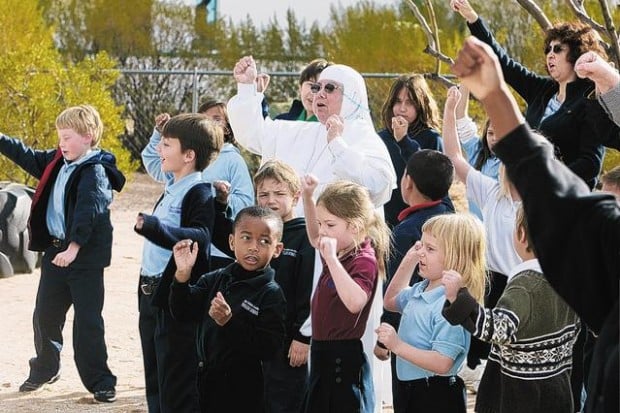
A lot of people don't even know it's there.
Just south of Park Place mall, backing up to Tucson Unified School District's Rogers Elementary, a seven-acre private-school campus has quietly taught hundreds — perhaps thousands — of Tucson-area children since it opened there in 1955.
The Abbie Loveland Tuller School, 5870 E. 14th St., was a boarding school when Tuller opened it in Providence, R.I., in 1927, said Leslie Zimmerman, school development director.
Tuller — "Mother Abbie" to those who knew her before her death in 1972 — went on to open about a dozen of her schools across the country, Zimmerman said. In 1934, she established an order of Episcopal nuns — the Order of the Teachers of the Children of God — to help her staff them.
Tuller's health forced a move to Tucson in the 1950s, and she opened her institution on what was then the far East Side of town. The Tucson location is the only remaining Tuller school.
People are also reading…
In honor of the school's 80-year tradition of education, the staff and students are holding an open house 4 to 6 p.m. Thursday to show off how far they've come.
They also hope to rekindle community interest in the place, which is down to an enrollment of about 30 students total in pre-kindergarten through eighth grade.
The campus once had a high school, but Tuller graduated its last class in 2002 after closing its boarding school the previous year, Zimmerman said.
The enrollment was more than 200 students less than 10 years ago.
The administration suspects the public at large heard about the high school closing and thought the whole school ceased to exist, Zimmerman said.
School director Nanette Akins — who attended the school with her sisters and whose son attended for a time — said she wonders the same thing.
With the school's religious order down to two nuns — Mother Alicia Torres, who prefers to be called "Sister Alicia" instead of "Mother," and Sister Mary Clare Jackson — Akins said she doesn't envision the school retaining its status as a religious private school.
That change is probably several years off, she said.
Zimmerman and Akins both said there's a possibility of reinstating the high school if enough people were interested.
In the boarding school's final years, the sisters were confronted more and more with young women who were considered problem children at home and needed discipline, Akins said.
That was fine when the order had more sisters and all of them were about 20 years younger than the sisters now, she said.
Closing the boarding school ate into the high-school population, and the high school closed.
Now the staff is wondering how to increase visibility in a not-very-visible location.
The decline in enrollment has left the school with an improvement in that class sizes are very small — less than 10 students each — allowing for a lot of individualized attention for its students.
"Students who may not be challenged enough in public schools or who need extra support will find that here," Zimmerman said.
Because the average family nowadays is much different from when the school opened — more children are being raised by grandparents and single parents than in the 1950s — the school works with each family to determine how best to serve a child, based on the home situation, she said.
That attitude fits Mother Abbie's original vision, said Sister Jackson, who has worked at the school since 1962 and knew Mother Abbie for the last decade of her life.
Mother Abbie's "arms were open to anyone who needed help," said Sister Jackson. "She always wanted you to see the child with its potential and use that to focus in on."
Though it's an Episcopal school, children of all faiths are welcome, Zimmerman said.
And tuition remains competitive with other private schools in the area, running between $4,000 and $5,000 a year. Scholarships are available, thanks in large part to a recent $100,000 donation from Tucson Electric Power.
Zimmerman said the school staff has faith that the school will continue serving children as it has for all these decades.
"We have really open doors, and it seems like kids and teachers and people find us," she said.
central

 Japanese company invests in mine near Mount Lemmon

