TRUMP: "As a candidate for President, I promised I would fix this crisis, and I intend to keep that promise one way or the other. ... To physically secure our border, the plan includes $5.7 billion for a strategic deployment of physical barriers, or a wall. This is not a 2,000-mile concrete structure from sea to sea. These are steel barriers in high-priority locations." — remarks Saturday.
THE FACTS: His campaign promise to build a concrete border wall continues to evolve.
During the 2016 campaign, Trump pledged to build a "big, beautiful wall" made of concrete, rebar and steel across the length of the southern border with Mexico. Back then, he lashed out at the suggestion that what he was proposing had anything in common with mere fencing.
"Jeb Bush just talked about my border proposal to build a 'fence,' he tweeted in 2015. "It's not a fence, Jeb, it's a WALL, and there's a BIG difference!"
People are also reading…
Jeb Bush just talked about my border proposal to build a "fence." It's not a fence, Jeb, it's a WALL, and there's a BIG difference!
— Donald J. Trump (@realDonaldTrump) August 25, 2015
And as recently as Dec. 31, he tweeted, "An all concrete Wall was NEVER ABANDONED."
An all concrete Wall was NEVER ABANDONED, as has been reported by the media. Some areas will be all concrete but the experts at Border Patrol prefer a Wall that is see through (thereby making it possible to see what is happening on both sides). Makes sense to me!
— Donald J. Trump (@realDonaldTrump) December 31, 2018
He now commonly refers to the wall as "steel slats" and "steel barriers."
TRUMP: "If we build a powerful and fully designed see-through steel barrier on our southern border, the crime rate and drug problem in our country would be quickly and greatly reduced. Some say it could be cut in half." — remarks from White House on Saturday.
TRUMP, on the virtues of a wall: "We can stop heroin." — White House remarks Saturday.
THE FACTS: His comments fly in the face of findings by his government about how drugs get into the county. Drugs from Mexico are primarily smuggled into the U.S. at official border crossings, not remote lands that can be walled off. His proposal Saturday to end the government shutdown implicitly recognizes that reality by proposing money to improve drug-detection technology specifically at land ports of entry.

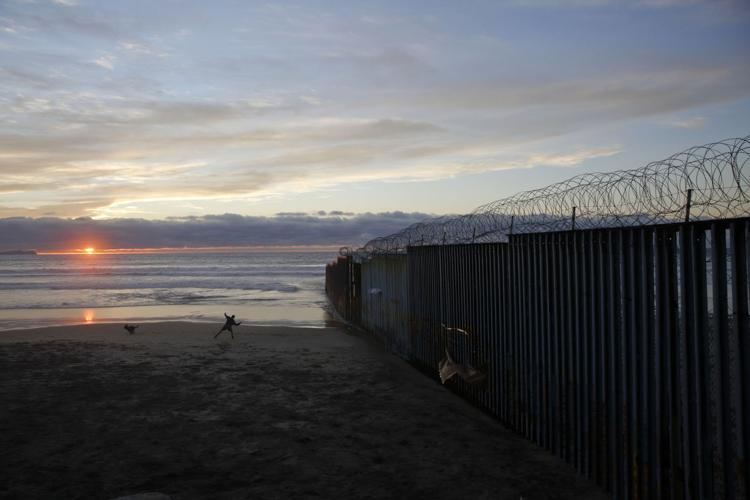
FILE - In this Jan. 9, 2019, file photo, a man throws a ball for his dog next to the border wall topped with razor wire in Tijuana, Mexico. In his demands that Congress set aside $5.7 billion for a border wall, President Donald Trump insists a physical barrier would stop heroin entering the U.S. from Mexico. But U.S. statistics, analysts and testimony at the trial of drug kingpin Joaquin "El Chapo" Guzman in New York show that most hard drugs entering the U.S. from Mexico come through land ports of entry staffed by agents, not open sections of the border. (AP Photo/Gregory Bull, File)
Even so, Trump pitched a wall as a solution to drugs and crime.
The Drug Enforcement Administration says "only a small percentage" of heroin seized by U.S. authorities comes across on territory between ports of entry. It says the same is true of drugs overall.
Even if a wall could stop all drugs from Mexico, America's drug problem would be far from over. For example, the government says about 40 percent of opioid deaths in 2016 involved prescription painkillers, made by pharmaceutical companies. Some feed the addiction of people who have prescriptions; others are stolen and sold on the black market. Moreover, illicit versions of powerful synthetic opioids such as fentanyl have come to the U.S. from China.
On crime, many researchers have found that people in the U.S. illegally are less likely to commit violence than U.S. citizens.
TRUMP: "Nancy Pelosi's in Hawaii over the holidays, now she's in Puerto Rico with a bunch of Democrats and lobbyists, you know, enjoying the sun and partying down there." — Fox News interview on Jan. 12.
TRUMP: "I'd rather see the Democrats come back from their vacation and act. ... I'm in the White House, and most of them are in different locations. They're watching a certain musical in a very nice location." — Fox News interview.
TRUMP: "A lot of the Democrats were in Puerto Rico celebrating something. I don't know, maybe they're celebrating the shutdown." — comments Jan. 14.

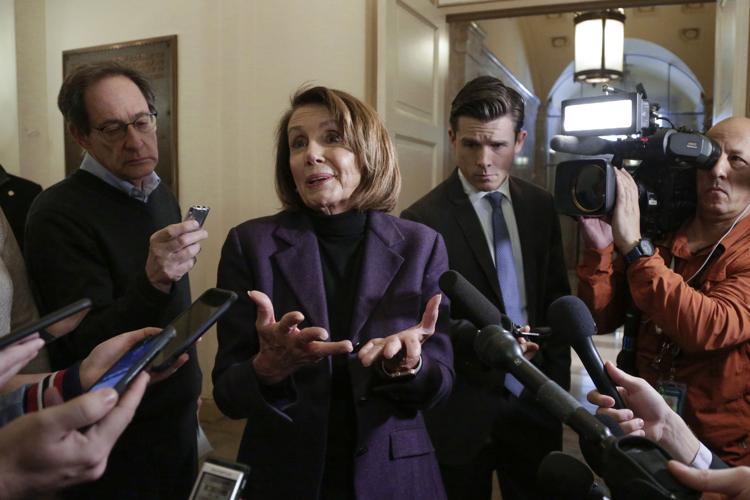
In this Jan, 18, 2019, photo, Speaker of the House Nancy Pelosi, D-Calif., takes questions from reporters on Capitol Hill in Washington. (AP Photo/J. Scott Applewhite)
THE FACTS: Far from "enjoying the sun" in Puerto Rico, Pelosi stayed in Washington, which got a big snowfall. She spent that weekend working at the Capitol, said Drew Hammill, her deputy chief of staff.
Senate Democratic leader Chuck Schumer did not go to Puerto Rico, either. The senator from New York spent that weekend in New York, said spokesman Justin Goodman.
Most Democratic lawmakers were somewhere other than Puerto Rico. Most who went are members of the Congressional Hispanic Caucus. They attended the annual winter retreat of the caucus's political and fundraising arm.
Some attended "Hamilton" as the musical opened a two-week run in Puerto Rico expected to raise millions of dollars for artists and cultural groups struggling in the aftermath of Hurricane Maria. Referring to Democrats at the fundraising performance in his Fox News interview, Trump called it "frankly, ridiculous."
During the trip, lawmakers indeed met political contributors but also made several visits to local and federal institutions, said Marieli Padro, spokeswoman for Puerto Rico Resident Commissioner Jenniffer Gonzalez. Last Saturday, a small group visited the veterans' hospital to learn about its needs post-hurricane, while another group met U.S. Coast Guard officials.
Trump is correct that Pelosi visited Hawaii over the Christmas holiday.
TRUMP: "We need strong barriers and walls. Nothing else is going to work." — remarks Thursday at the Pentagon.
TRUMP: "You can have all the people you want dressed in military. You can have ICE. You can have Border Patrol. If you don't have that barrier, there's not a thing you can do. You know, they all say, 'We like technology.' I like technology, too. But we can have all the drones in the world flying around; we can have all the sensors in the world, but if you don't have a strong steel or concrete barrier, there's no way you're going to stop these people from rushing." — remarks Jan. 14 in New Orleans.
THE FACTS: The evidence is inconclusive on the effectiveness of border walls or other barriers.
The Government Accountability Office, Congress' auditing arm, reported in 2017 that the government does not have a way to measure how well barriers work to deter illegal immigration from Mexico. Despite $2.3 billion spent by the government on such construction from 2007 to 2015, GAO found that authorities "cannot measure the contribution of fencing to border security operations along the southwest border because it has not developed metrics for this assessment."
Few people dispute that fences contributed to a sharp drop in crossings in cities such as San Diego and El Paso, Texas. Before fences were built in San Diego, crossers played soccer on U.S. soil as vendors hawked tamales, waiting until night fell to overwhelm agents. But those barriers also pushed people into more remote and less-patrolled areas such as in Arizona, where thousands of migrants have perished in extreme heat.
When barriers were built in the Border Patrol's Yuma, Arizona, sector in the mid-2000s, arrests for illegal crossings plummeted 94 percent in three years to 8,363 from 138,438. When barriers were built in San Diego in the 1990s and early 2000s, arrests fell 80 percent over seven years from 524,231 in 1995 to 100,681 in 2002. But both areas also saw sharp increases in Border Patrol staffing during that time, making it difficult to pinpoint why illegal crossings fell so dramatically.

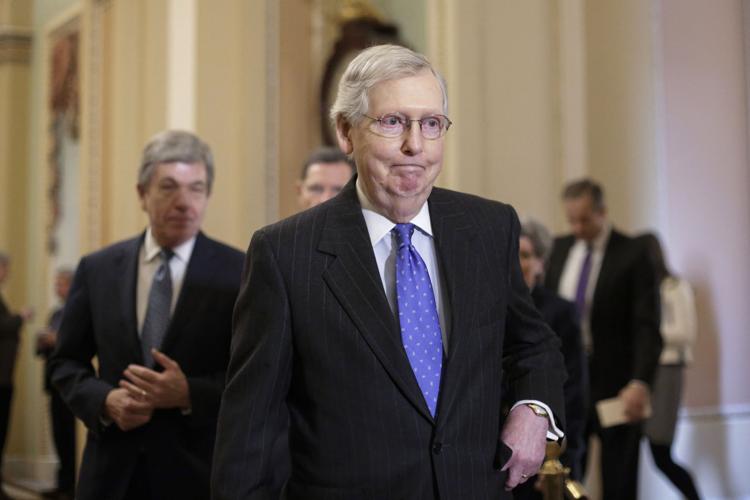
In this Jan. 15, 2019, photo, Senate Majority Leader Mitch McConnell, R-Ky., arrives to speak to reporters following a weekly policy meeting on Capitol Hill in Washington. One of McConnell’s guiding principles is: “There’s no education in the second kick of a mule.” Now, deep in a government shutdown he wanted President Donald Trump to avoid, McConnell is not about to be kicked again. (AP Photo/J. Scott Applewhite)
KEVIN HASSETT, Trump economic adviser: "You know as soon as it's resolved, then people get their paychecks and the government will go back to acting normal and the economy will go back to the 3 percent growth that President Trump's policies have delivered." — interview Tuesday with Fox Business Network.
THE FACTS: It's true the economy probably will get a boost once the shutdown ends, but few independent economists think that boost will be sustained. The economy is facing other headwinds that make it unlikely growth will return to 2018's pace. Before the shutdown, most independent economists already were forecasting that growth would slow this year as the impact of President Trump's tax credit fades and trade tensions and slowing global growth take a toll.
Even if the government shutdown ends up being a wash in economic terms, with strong growth in the second quarter offsetting weakness in the first, the economy is likely to be weaker this year than last. Scott Anderson, an economist at Bank of the West, expects last year's stock market drop will cause many wealthier households to pull back on spending, a drag on growth this year.
He's not alone. A group of 15 economists at major U.S. banks earlier this month projected that growth would slow to just a 2.1 percent pace in 2019, down from roughly 3 percent in 2018.
The economy's current health is difficult to gauge because the partial shutdown means many economic statistics aren't being released. Recent signs are mixed: The job market is strong, with few layoffs in sight, and manufacturing output rose in December. But higher interest rates have also caused home prices and sales to fall.