

PHOENIX - In her native Rwandan village, Allen Joy Mbabazi's surname means kind.
Joy for a middle name. Kind for a last.
The names are fitting for a young woman determined to count her blessings, not her misfortunes, said Laurie Johnson, a Phoenix resident and businesswoman who will spend the next year mentoring Mbabazi.
Johnson is the first metro Phoenix resident to participate in the Institute for Economic Empowerment of Women's Peace Through Business mentorship program.
Since its 2007 launch, the Oklahoma-based program has educated more than 200 Afghan and Rwandan women in leadership and commerce.
The program pairs American businesswomen who specialize in trades similar to those of women they are mentoring.
In July, 15 women from Rwanda and 15 women from Afghanistan visited the U.S. to spend time living and working with their mentors as well as to study leadership at Northwood University near Dallas. The students will participate in a summit and graduate from the program at Georgetown University in Washington, D.C.
People are also reading…
Johnson volunteered to be a last-minute mentor for 27-year-old Mbabazi after the program struggled to find an American woman who specialized in retail merchandising and was willing to accept the yearlong commitment.
Johnson said she has a swamped schedule, but she couldn't say no.
"This is the meaning of purpose," she said.
Johnson and Mbabazi described their recent introduction as fateful, and their friendship as powerful enough to inspire a cultural exchange that will bridge and benefit their native countries.
Johnson owns Miche Bag of Arizona, a budding purse-manufacturing business headquartered in Tempe.
Mbabazi lives in Kigali, Rwanda, and owns East Africa and Beyond, a small shop that sells crafts and arts made by villagers from Rwanda, Kenya, Burundi, Uganda and Tanzania.
In July, Johnson hosted Mbabazi at her Phoenix home. She introduced Mbabazi to American culture and showed her how U.S. female entrepreneurs manage businesses.
The lessons proved to be a two-way street, Johnson said. "It's by far the greatest week of my life," she said, smiling at Mbabazi on the last day of her Phoenix visit. "It's really about the cultural exchange. It's not facts and figures. It's a heartfelt exchange."
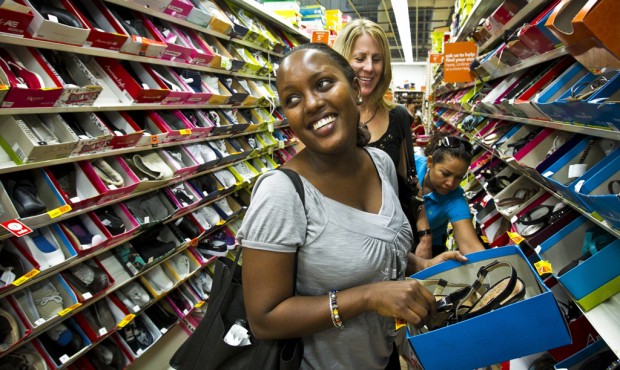
The women spent days working and nights staying up late talking. On July 22, Johnson took Mbabazi on a traditional American shopping trip to Arizona Mills shopping center in Tempe. Mbabazi was floored by the mass of items for sale.
"Here you have a machine to do everything for you," she said.
When Mbabazi returns home, she will share Johnson's tips about merchandising and networking with her co-workers and the crafters she buys from.
She's especially excited to pass her knowledge on to a group of widowed Rwandan villagers who weave Peace Baskets. The baskets have become famous for their detail and for helping to build an economy for villagers.
"They put their money in a cooperative," Mbabazi said. "The women who need it most get (money) first. But the others know it will be there for them when they need it. I think if I can teach them about what I learned here, we can all do better."
Johnson shakes her head, reflecting on Mbabazi's goal.
"See, this is exactly what I'm talking about," she said. "After everything she's been through. I look at her . . . and I think, how can we not stop and look around, and see how we can help others."
Mbabazi's eyes filled with tears when she recalled her family's experience fleeing Rwanda. She will never forget the past, but she'd rather focus on the future.
Mbabazi dreams of a prosperous Rwanda.
Now Johnson does, too.
Johnson and Mbabazi are brainstorming ways to sell East Africa and Beyond products in the U.S.
"It's by far the greatest week of my life. It's really about the cultural exchange. It's not facts and figures. It's a heartfelt exchange."
Laurie Johnson, Phoenix businesswoman