

Knowledge gained from the bidding is so vital during the play that a declarer who neglects to consider it fully is literally not playing with a full deck.
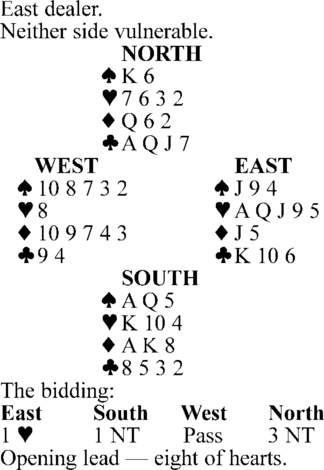
For example, assume you get to three no-trump as shown and West leads a heart. East takes the ace and returns the queen, leaving you with eight sure tricks and in need of a ninth.
With no opposing bidding, the normal line of play would be to win the heart and test your luck with a club finesse, hoping West has the king. In the given situation, though, where East opened the bidding, you can feel very sure the club finesse will fail. Only 12 high-card points are missing, so East cannot have an opening bid without the club king.
To add to this, there's a strong likelihood that if East gains the lead with a club, he can cash three heart tricks to defeat the contract.
People are also reading…
This fear is confirmed when you win the heart queen with the king and West discards a spade. A club finesse at this stage would be sheer folly, so you start looking for a different solution to your problem.
The answer is not long in coming. You cash the A-K-Q of diamonds, East discarding a club, and then the K-Q-A of spades, reducing East to three hearts and the K-x of clubs.
At trick nine, you exit with the ten of hearts. East takes his three hearts, but is then forced to lead into dummy's A-Q of clubs, handing you the contract.
It is not likely you would have played this way had East not opened the bidding (and even more unlikely that West would have led a heart if East had passed originally). But since that's what actually happened, you have no choice but to adapt to the realities of the situation and proceed accordingly.


