

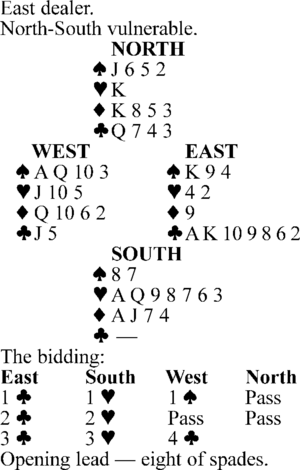
A difference in bidding styles resulted in a big swing on this deal from a team match between England and Holland.
When a British pair held the East-West cards, the bidding went as shown. Against four clubs, the Dutch South, faced with an unpleasant choice of opening leads, chose the eight of spades.
Declarer won with the nine and played the ace of clubs, on which South showed out. Three rounds of spades then enabled East to discard a diamond loser, and he subsequently lost two hearts and a trump to make four clubs and 130 points.
At the second table, with a British pair now holding the North-South cards, the bidding went very differently. East bid one club, and South bid four hearts, which West doubled.
Declarer ruffed the club lead, played a heart to the king and ruffed another club. Two rounds of hearts drew the outstanding trumps. South's sole problem now was to hold himself to one diamond loser.
People are also reading…
If declarer had led a low diamond to the king, intending to finesse the jack on the way back, he would have gone down.
South played the ace of diamonds first. When East produced the nine, the contract became assured. Declarer next led a low diamond. West did as well as he could when he followed with the six, but dummy's eight was played to guarantee the loss of only one diamond trick.
So the British South made four hearts doubled for 790 points to give his team a net gain of 920 points on the deal. His safety play guarded against West holding four diamonds and East the singleton nine or 10, and also assured the contract whenever East had the queen of diamonds or the diamonds broke 3-2.


