

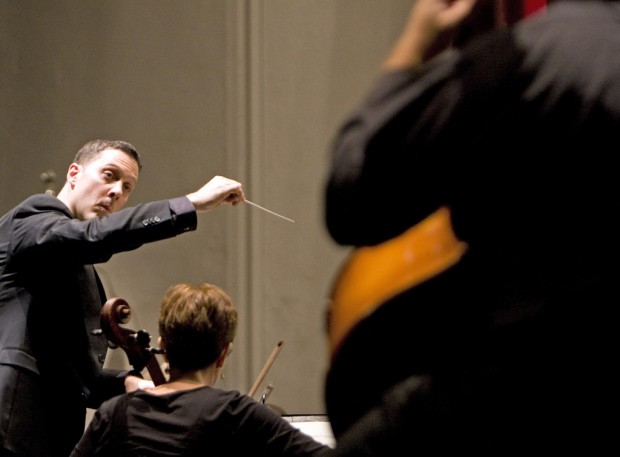
Tucson Chamber Artists has a lofty goal for its eighth season - to promote understanding and coexistence through music.
Their season of "Harmonic Coexistence" kicks off with two performances of "Arise and Sing: Jewish Music Comes Alive" this weekend. But in reality, the season started Sept. 11, when the professional choir mounted its ambitious 9/11 anniversary concert at Centennial Hall.
That concert, which featured a piece composed by Stephen Paulus, gave birth to the idea of examining tolerance and harmony - racial and religious - through music that strives to promote how our differences mirror our similarities.
"The idea that we can come together and celebrate our differences I think helped make a significant impact on the 9/11 concert and I wanted to build on that for the season," said TCA conductor and founder Eric Holtan.
People are also reading…
"Arise and Sing" features Jewish liturgical and folk music spanning 200 years. Works include a Jewish-themed oratorio by Handel, Psalm settings by Mendelssohn, a piece by Copland drawing from the Old Testament and Bernstein's renowned Chichester Psalms.
Holtan recruited Temple Emanu-El Rabbi Samuel M. Cohon, an accomplished cantor, to perform several works, including "Let There Be Love," a modern setting of the Jewish night prayer Hashkiveinu, that was written by Cohon's father, Rabbi Baruch Cohon.
"It's really one of his signature pieces," the younger Cohon said of his 85-year-old father, a renowned cantor, rabbi and composer who lives in Los Angeles. "It was written in the '70s and it's a really terrific setting of the evening prayer."
Cohon said the piece has Israeli melodies and almost a soft rock and pop sound to it. "You wouldn't think it would work, but it is absolutely the most requested piece of music we do," he said. "It's a really interesting mix."
Holtan also recruited Cohon to help the choir pull off the nuances of Jewish liturgical music.
"Musically in terms of pitches and rhythms, it is not a challenge. It's doing the music in the manner and style of the Jewish liturgical way," Holtan said. "Rabbi Sam is the man. He is going to get us to find that Jewish groove."
"The difference in Jewish music is that it has a certain element of personal involvement and heart that go well beyond the printed note," Cohon explained. "You have to put your body into it in a way, allowing it to flow through you."
Cohon said the program for "Arise and Sing" showcases a "really rich and fantastic tradition here that reaches across all religions and cultures."
The choir performs on Saturday and Sunday; Saturday's concert also will feature Cohon's Temple Emanu-El choir.
If you go
• What: Tucson Chamber Artists - "Arise and Sing: Jewish Music Comes Alive."
• When and where: 7:30 p.m. Saturday at Temple Emanu-El, 225 N. Country Club Road; 2 p.m. Sunday at Grace St. Paul's Episcopal Church, 2331 E. Adams St.
• Tickets: $20 to $30 at www.tucsonchamberartists.org or at the door. Season tickets on sale for $99.
• Program: Works include Handel's "Sing Unto God" (from "Judas Maccabeus"); Aaron Copland's Four Motets; Bernstein's Chichester Psalms; Whitacre's "Five Hebrew Love Songs"; and "Amen Shem Nora/Yehalelu Shemo," arranged by Matthew Lazar.
• Et cetera: Cantor Rabbi Sam Cohon and the choir of Temple Emanu-El guest for Saturday's concert. Cohon also will perform Sunday.


