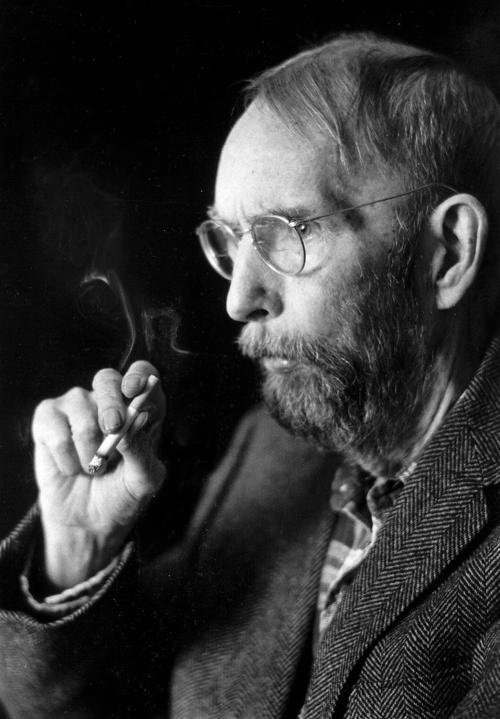
In May 1934, Harper’s rejected a manuscript for a short novella or short novel by a young Tucsonan, a proofreader at The Arizona Daily Star who was then just 28 years old.
But in July 1935, the Viking Press published that first work by Charles G. Finney (1905-1984), and ten months later The Circus of Dr. Lao won one of the first four National Book Awards.
Finney’s inscribed bronze was for 1935’s “Most Original Book,” a category dropped five years later (and perhaps now deserving a revival), but which with Dr. Lao started out about as strong as possible.
Some 80 years later, Dr. Lao endures as a fantasy classic. The book attracts cults that come and go, but has been:
- in print nearly continuously;
- reprinted in large-format limited editions, including one by Janus Press in 1984 of 150 copies in slipcover at $750 each;
- translated into Russian, German, Swedish, and all the major Romance languages.
People are also reading…
Dr. Lao spawned a 1964 film called The 7 Faces of Dr. Lao with Tony Randall and Barbara Eden. The makeup won a special Oscar with Randall in seven roles. But otherwise the movie was rightly derided by the New York Times as a pint-sized adaptation of the book and “laid on with an anvil.”
Dr. Lao’s circus arrives neither by rail nor highway, but simply materializes on an Aug. 3 in dusty Abalone, Arizona.
The morning before, its proprietor had appeared at the Abalone Morning Tribune, paying all cash for a nearly full-page ad.
The ad makes claims that Barnum never imagined, for Dr. Lao isn’t coming with banal lions or tigers, “but real honest-to-goodness freaks … born of hysterical brains rather than diseased wombs.”
His fortuneteller cannot lie, but won’t say anything about finance or politics.
The parade and then the main tent will feature a satyr 2,300 years old captured near the Great Wall; a very young Sonoran medusa; a roc chick; a hound of the hedges with a tail of ferns and fur of green grass; a mermaid; a unicorn, an African hermaphroditic sphinx with breasts like a woman and the voice of a man; and a male chimera with a lion's body, snake's tail, and eagle's wings.
A sea serpent is almost 100 feet long and still untamed, hoping to escape with the mermaid. A werewolf is about to change into a woman, but not the young lass Abalone’s men anticipate.
Finney builds reader anticipation in counting down the time as Main Street Abalone learns of the circus from the ad, from scuttlebutt, and then its parade, while we learn about Main Street:
At 9 a.m. the chief of police sees the ad, says he has heard nothing of any circus, and calls the city clerk, who says a permit was issued to an “old chink” just before closing the day before.
At 9:45 a widow, Mrs. Howard T. Cassan, decides she will ask the fortuneteller about an oil well, but actually has just one interest: when a man will come into her life.
At 10:30 Mr. Etaoin, a Tribune proofreader, admires the ad, then decides to see the show.
At 10:45 Miss Agnes Birdsong, high school English teacher, knows she looks pretty in the shade awaiting the parade, but then feels foolish: she can see that it’s silly and small, but she keeps on watching.
The parade keeps coming.
She recognizes the unicorn, but then corrects herself: the fake unicorn. At last comes the satyr with a gold ring in his nose and grape leaves in his hair. He leers at Miss Agnes, then turns and stares back at her as if she is beyond compare.
Dr. Lao has many voices.
He yells in washerman pidgin to ridicule fools like two know-it-all college kids from back East.
He lectures like a sage and articulate professor about his acts from ancient times and faraway lands.
And then he runs into a vet recently discharged from the 15th Infantry in Tientsin:
“People laughed when Dr. Lao went up to Larry Kamper and addressed him in Chinese, but their laughs turned to stupefaction when Larry replied in the vowel-fluid music of High Mandarin.
"He sang the four-tone monosyllables as shrilly as did the doctor, and they talked as talk two strangers finding themselves in a foreign land.”
Finney deploys direct, plain English for Main Street, but drops in nuggets of sundry learning and precision vocabulary.
Kate, a big fat woman, doesn’t believe a word of Dr. Lao’s lecture on the medusa and her snakes.
Luther, her husband, urges her to keep quiet, and Dr. Lao turns to her, patiently explaining that “the role of skeptic becomes you not; there are things in the world not even the experience of a whole life in Abalone, Arizona, could conceive of.”
Kate doesn’t listen.
“Well I’ll show you!,” she says. “I’ll make a liar out of you in front of all these people,” and barges through the crowd.
Dr. Lao yells for someone to stop her “in the name of the Buddha,” but Kate ducks under the guard rope, turns to stare into the medusa’s canvas cubicle, and freezes into stone.
While the crowd wonders what to do, a geologist from the university examines Kate.
" ‘Solid chalcedony,’ he said. ‘Never saw a prettier variegation of color in all my life. Carnelian chalcedony. Makes mighty fine building stone.’ ”
The show goes on, but as as Clifton Fadiman, Joseph Wood Krutch, and other admirers have written, Dr. Lao is difficult to describe and may be its own genre.
Krutch says the reader moves back and forth between the mostly dull small-town everyday of Abalone, and the mix of “history, legend, fable, and the dark fancies of the human imagination” in and outside Dr. Lao’s circus.
“Principally,” says Krutch, “I think it is a comment on the fact that most people have no imagination and that therefore they have no idea what kind of world they live in.”
* * * * *
The author of Dr. Lao was named after his great-grandfather, Charles Grandison Finney, perhaps the leading revivalist from 1826 into the 1850s; second president of Oberlin College from 1851 to 1866; prolific author; and staunch abolitionist.
The earlier Finney is reported to have converted over 500,000 Americans and British, and says that in 1835, he agreed to be Oberlin’s first professor of theology on condition that blacks be admitted on the same basis as whites.
In Dr. Lao, the younger Finney, with perhaps a nod to his namesake, has his Apollonius of Tyana finally vanquish the devil by pulling out a crucifix.
The evangelist may more likely have been an influence as an apostle of blunt and direct English.
Divines of colleges such as Yale and Princeton, both which he declined to attend (though in part due to the cost), said Finney let down the dignity of the pulpit in preaching like a lawyer at the bar, and citing examples familiar to farmers and mechanics.
The critics preferred examples from the ages, but the Rev. Finney says he “sought to express all my ideas in few words, and in words that were in common use.”
A recent search of abebooks.com for works by Charles G. Finney finds the Tucsonan with just seven of the top 100 entries. His first is at No. 44 behind titles such as Prevailing Prayer, Revival Fire, Guilt of Sin, True Saints, Power from On High, Crystal Christianity, and Sanctification.
In any event, in 1937 Finney produced The Unholy City, a sci-fi short novel set perhaps in an Asia with 90-mile-an-hour streetcars and 700-story skyscrapers.
Vanguard Press, a less prestigious publisher than Viking, cut corners and its 2,000 copies barely sold.
Dr. Lao had been blessed with ten bizarre full-page drawings by Boris Artzybasheff, but Unholy City had no illustrations.
A new issue in 1969 in paperback combined with the year-old Magician Out of Manchuria had a first run of 200,000 copies, so Unholy City was perhaps ahead of its time.
In late 1939 the newly married Finney fared somewhat better with Past the End of the Pavement produced by Henry Holt & Co.
It’s mostly a preteen book. And it’s mostly without literary pretensions despite some deft similes.
In case you didn’t know, the underside of the soft-shell turtle “is as scanty as a brassiére and as little protective.”
The 268-page adventure drawn from Finney’s childhood in Sedalia, Mo., chronicles two brothers growing up obsessed with captured fauna from water beetles, frogs, and a mad drake, to snapping turtles, a hoot owl, and sundry snakes.
Mostly adult adversaries see the animals as just pests or worse. The brothers, on their way to becoming self-taught naturalists, try to enlighten the ignorant, but usually to no avail.
Readers are likely do better: Pavement is in part a how-to guide to caring for wild animals.
The initial chapter on snakes includes a text ‘shout out’ recommending Raymond L. Ditmar’s The Reptile Book even though it wasn’t a Holt title.
Today's econauts might see Pavement as a fine outdoor primer for kids except for parts of the dialogue – as in Dr. Lao -- with Huck Finn lingo.
So: new books in 1935, in 1937, and in 1939. Then 27 years with nothing new in print from age 35 to almost 53.
Marriage and helping happily to attend to daughters born in 1943 and 1947 filled much of the interval, as did work at the Star, where Finney moved up to copy editor and then telegraph or wire editor.
In late March 1956 he suffered two heart attacks, but from 1958 to 1966 he was back in print in a big way.
Harper’s magazine published four Finney short stories, the New Yorker three others, and Paris Review another.
The Magazine of Fantasy & Science Fiction, a pulp monthly still in print with legions of fans, ran four Finney stories set in Manacle, Arizona.
Pulp may seem cheap, but the four issues with Finney stories included works by Robert Heinlein, C.S. Forester, Arthur C. Clarke, Issac Asimov, and an Indianapolis vet named Kurt Vonnegut.
In Phoenix, glossy large-format Point West magazine published two other Finney stories, notably A Sermon at Casa Grande about Bishop Henri Granjon’s 1915 petit tour north in a hand-cranked Studebaker packed with quantities of French cuisine and a fine claret in a brass canteen.
In his flaming scarlet robes and high biretta, the Tucson bishop faces down three mounted men armed and demanding the food, then enters the Casa Grande to recall where Padre Kino 221 years past had supplanted a withered corn god.
In the city of Casa Grande as the sun sets, Granjon confirms a flock of young girls all in white and young boys with hair slicked backed and combed.
In 1961, Doubleday published The Old China Hands, which included the three New Yorker stories and 13 other tales of Finney’s service with the old 15th Infantry Regiment in Tientsin from 1927 through 1929.
Three years later, Pyramid Books brought out in paperback The Ghosts of Manacle, a collection of two of the Harper’s stories, four from Fantasy & Science Fiction, one from Point West, and a new novella – The End of the Rainbow.
Another Finney work was Project No. Six, a comedy of the absurd presented twice at the old Jewish Community Center on North Plummer in May 1962.
Helen Younge, the Star’s reviewer, said it is impossible to “say actually what happens in the play” other than that W.P.A. Piltdown, “a fuss-budget inventor, is building a magical machine to outdo all machines. Strange oddments of humanity gather around him, drink beer and eat asparagus for breakfast, and generally do nothing, lazily but with considerable vocal explosion.”
None of this later writing ever matched Dr. Lao, but one of the Harper’s short stories and The Old China Hands come close.
Both are gems of their genre. And both tell us a lot about Finney.
He was a life-long lover of snakes, and an encyclopedically well-read autodidact always eager to learn -- fascinated by China, and grateful for three years in uniform with most of his days free for reading, exploring Tientsin, and beginning Dr. Lao.
The Harper’s story is The Life and Death of a Western Gladiator, Finney’s biography of Crotalus atrox – the desert diamondback rattler.
At birth at the mouth of a cave on a summer morning Crotalus is about five inches long and thinner than a lead pencil.
Another male and two females are born with him. Their mother departs within a few hours never to return. And the next day the brother and sisters are dead – devoured by a four-foot Sonoran racer and a roadrunner.
Says Finney:
“He was all alone …. He had no arms or legs …. Nearly everything … was his enemy …. the sun could, in a short time, kill him. If the temperature dropped too low he would freeze …. if anything chased him he could run neither very far nor very fast.
“…. to eat he first had to kill; and he was eminently adapted for killing …. [yet] having no ears, he was stone deaf.
"On the other hand, he had a pit, a deep pock mark between eye and nostril.
In pitch blackness, Crotalus … could tell whether another animal was near and judge its size.
"That was better than an ear.
“He had a wonderful tongue. It looked like an exposed nerve and was probably exactly that. It was forked, and Crotalus thrust it in and out as he traveled. It told him things that neither his eyes nor his nose nor his pit told him.”
At 2 he became a father and “attained a length of two feet.”
At 12 he was five feet long with “rippling symmetry … diabolically beautiful and deadly poi-sonous.”
And finally at 20: six feet in length, “as thick in the middle as a motorcycle tire,” and with “a head the size of a man’s clinched fist.”
That summer “he met his first dog,” a German shepherd … and then man – homesteaders new to the desert.
ABC broadcast a documentary on Gladiator in the mid-1970s, and the story has been reprinted in multiple anthologies.
The second notable new work, The Old China Hands, covers the legendary 15th Infantry and its 900 men stationed in north China from 1912 to 1938.
Finney had studied at the University of Missouri for about a year and a half, “then ran out of money, quit, couldn’t find a job, and ended everything by enlisting for China as a private.”
He says he “wasn’t a very good soldier but did finally make Private, 1st Class .…”
Whether China Hands mixes history and embellishments is uncertain. In the acknowledgments, Finney notes that:
“After Gen. William Tecumseh Sherman had published his memoirs, a number of his friends were happy to point out what they assured him were glaring inconsistencies between what he had written and … the historic facts.
"Sherman thought it over for a while, and said something like this: 'Well dammit, they’re my memoirs, and I’m going to let them stand as written.' ”
Finney says he feels the same way.
“Once something has been fixed in one’s mind more or less for 30 years it has taken on for that person the concreteness of truth, and the citation of a lousy, contradictory fact isn’t enough to persuade one to revise his memory.”
Finney admits to saying nothing about venery, “although the old China hands were anything but Boy Scouts.”
Instead, he says, “Let us, … as does the fastidious sundial, only mark the shining hours.”
New recruits had to stay in the American Compound till “the first phases of their … training were finished and until their uniforms had been tailored … military bearing and deportment had to be instilled in a man before he could be judged worthy to be turned loose on the streets.
"Red passes … allowed one to quit the Compound any time one wasn’t on duty, and only required one to be back by midnight.
"After six months, if we had behaved ourselves, blue passes would be issued. These allowed one to stay out all night, and only required one to be back in time for roll call at Reveille."
Even on post, the duties were minimal:
"The 15th "guarded bridges now and then; they set up roadblocks once in a while to keep the troops of some war lord from entering the Foreign Concessions of Tientsin; they manned international trains occasionally in at attempt to keep the Peking-Mukden Railway open … But that was all.
"They never traded bullets and lives with a foe."
Most infractions were overlooked.
“Assessing extra kitchen police duty was impossible … The Chinese mess coolies did it, and got paid for it.
"There weren’t any fatigue details … such as unloading Quartermaster supplies or sweeping the parade ground, because the Compound coolies did all that and got paid for it.
Tientsin, which Marco Polo visited in 1290 as a city of “only 20,000 or 30,000 inhabitants,” had 900,000 by the late 1920s. Today the population is over 15 million.
Finney was to find a city teeming with people from all over the world, and divided into American, British, French, Italian, Soviet, and Japanese concessions.
“It was late in the spring of 1927 on a warm Saturday that we received Hong Kong khaki uniforms, our red passes, and the admonition … to behave.
“Our lapel ornaments were little blue and white shields bearing four acorns, a rampant dragon, and the motto “Can Do.” The dragon represented service in China; the four acorns stood for Murfreesboro, Chickamauga, Chattanooga, and Atlanta.
“[Buddy] Martin Lord and I walked out the main gate, full of military bearing, our red passes in our breast pockets, swagger sticks under our arms … the signs saying “Bar” seemed to stretch into infinity."
The jammed streets lacked sidewalks. Open gutters were “the city’s only sanitary system except for cesspools in the compounds …. the major sources of Tientsin’s smell” were evident and inescapable.
Finney says his general’s Cadillac “was the only motor vehicle we saw. Everything else was either animal-drawn or man-drawn.
"A funeral procession, like a long, gaudy, noisy worm, wriggled its way through everything. An important man was being put to rest; his catafalque was enormous and was borne on the shoulders of 50 men.
"The hired mourners numbered more than a hundred. There were flute players and string players and gong beaters galore …[but] nobody paid any attention.
“A group of Japanese officers came along on the most beautiful horses I had ever seen. Tiny bespectacled men in neat brown uniforms, high leather boots, golden braid on their shoulders, sabers at their waists, they rode their beautiful horses right through the funeral procession, and no one paid any attention to that, either."
Finney served under a galaxy of future generals.
Regimental officers in Tientsin in the late 1920s were mostly company captains and lieutenants in America’s skeleton inter-war military.
Among them were seven who, by 1960, had become brigadier generals; 13 future major generals; two lieutenant generals; two full generals; and a general of the army.
That future five-star general and later Secretary of Defense and then Secretary of State was, in early 1927, a lieutenant colonel and thus the executive officer of the 15th – the No. 2 to the commanding officer.
He was George C. Marshall, an exemplar of gravitas who, years later at the White House, an-other Missouri man named Harry Truman, knew only and always as “General Marshall.”
Two majors who later earned four stars each were “Vinegar Joe” Stilwell, future Allied commander in the China-Burma-India Theater, and Matthew B. Ridgway, future successor to MacArthur in Korea and then Army chief of staff.
Finney several times mentions purchases at the Tientsin Bookstore. In those days, he says, it “was one of the great bookstores of the world; you could get anything there, in any language. It was there that I purchased my first copy of Joyce’s Ulysses, the famed “4th Printing” by Shakespeare & Co. of Paris, dated January 1924.
"The book by then, after suffering burnings in New York and seizures in Folkestone, was universally banned throughout the English-speaking world. But in Tientsin nothing was banned.”
In the summer of 1928 after a coalition of warlords threatened Chiang Kai-shek, Finney witnessed the landing of 4,000 U.S. marines to reinforce Tientsin.
No battles erupted, perhaps because of the reinforcements. But it was clearer than ever that the 15th Infantry, after 16 years in China, enjoyed extraordinary perks and comforts:
“A tug brought up the first three lighters of marines and lodged them, with much banging and clattering, against the concrete rim of the Bund.
"Lines were thrown ashore and made fast. The lighters were aswarm with young Americans in forest-green uniforms, very dirty, very disheveled….
“The … marines emptied onto the Bund .... Out of the bowels of their lighters – which had been previously used for transporting coal, and hence were rather sooty – the landing parties hoisted machine guns, Stokes mortars, and 27mm howitzers …. They brought out sandbags, and in something like ten minutes they threw up a horseshoe-shaped barricade, facing the city.”
Moving closer to get a better look at the newcomers, Finney and another private were wearing their usual street attire -- “roll-collar tunics, white shirts, black ties, Pershing caps with patent-leather visors, gleaming “Can-Do’s’” on our lapels.
"Our slacks were pressed, our leather belts and shoes shiny as mirrors. We carried swagger sticks.
“The operation reminded me of a circus’s arrival, by wagon-load, at its show grounds.
"It seemed at first glance to be nothing but confusion compounded. But it wasn’t that at all. It was a well-planned procedure, economically and beautifully executed …
“We moseyed over to a detail that was putting the finishing touches on a howitzer nest. The corporal in charge looked us over in a rather startled way, then straightened up and saluted.
“Good evening, sirs,” he said. [Finney’s buddy] … saluted him back. “Evening, Cor-poral,” he said. “Nice job you’re doing here. I’ll speak to your colonel about it.”
“ ‘Thank you, sir,’ said the marine” as Finney and friend casually but promptly retired.
The marines, says Finney, “had a general mess, cafeteria style, where you lined up with a mess kit and got it shoveled full of stew or beans.
"We had company mess on tables covered with tablecloths. We were served on china plates by mess coolies, and what we ate, in E Company at least when Anton Frerichs was mess sergeant, would have graced the cuisine of a French ocean liner.”
Near the end of his three years, Finney says “everyone swore up and down that I could make Corporal if I enlisted again, but I didn’t have that much faith in myself."
So in early 1930, he "came to Tucson, Arizona, where my brother was living and in just eight months landed a job as proofreader on Arizona’s second largest newspaper, the Star.”
Whether Finney truly felt fortunate in the first full year of the Depression to find work in just eight months isn’t clear, but it gave him time to keep working on Dr. Lao, a task that he says ran to four years.
He lodged with his brother Leverett at an old adobe at 195 South Main, a few hundred feet south of the Ying On Assn. compound and the heart in those days of the Old Pueblo’s Chinese enclave.
Tucson wasn’t Sedalia.
It was small but comparatively cosmopolitan, and all around were actual mountains, not the flat, monochromatic cornfields of Missouri that Finney had likened to a prison.
In landing an editing job he found what Graham Greene about the same era described as great work for aspiring writers: work with words, and with all duties done at the end of each day.
David Carter worked with Finney on the rim – the copy desk – at the old Star offices downtown from April 1970 into early January 1971.
The night Finney retired from fulltime work, Managing Editor Frank Johnson asked Carter to help carry out the paper’s retirement gift to Finney – his ancient upright Underwood.
Carter was later chewed out for taking out not just the typewriter but also its stand: that wasn’t supposed to have been part of the gift.
Note: Per Finney, it’s “Aw, Baloney!” Arizona. Per his younger daughter and despite the rhyming poem early in the book, “Lao” rhymes with “now,” not “know,” etc.