Tonight the moon is an especially good pointer to Orion the Hunter and to Betelgeuse in the upper easternmost portion of Orion.
The moon will be 14 degrees directly north of Betelgeuse. All you have to do is find the moon and look south until you see a very bright reddish orange star, which is Betelgeuse, the 11th brightest star in the sky.
Betelgeuse is one of the most popular stars, because of its strange name, brightness and enormous size.
Betelgeuse is one of the largest stars known, with a diameter at least 600 times that of the sun. It is a "supergiant" star with luminosity at least 85,000 times the sun.
Its distance is not known with certainly but is in the range of 570 light years. Betelgeuse is perhaps 10 million years old and will "soon" (astronomically speaking) end its life in a supernova explosion. When that will happen, no one knows. It could be tomorrow or hundreds of years from now.
People are also reading…
If Betelgeuse goes supernova, it will not harm us, but it will be a spectacular sight - brighter than the first quarter moon.
After you have pondered on Betelgeuse a while, look at the bottom right hand corner of Orion to see Rigel, the seventh brightest star in the sky. Rigel, a blue-white star, is also a supergiant star with a diameter about 75 times that of the sun and luminosity at least 85,000 times the sun. It's at a distance of 860 light years and someday will probably swell up in size to become a red supergiant star like Betelgeuse.
Both stars have roughly the same mass, somewhat less than 20 times that of the sun. One is "ballooned up" and red, the other more "compact" and blue.
View solar flares
The Sharing the Sky Foundation's annual fundraiser is from 3 to 10 p.m. Saturday on the University of Arizona Mall.
The free event starts with solar observations until sundown.
The Tucson Amateur Astronomy Association will have about 10 solar-filtered telescopes set up to safely view the sun.
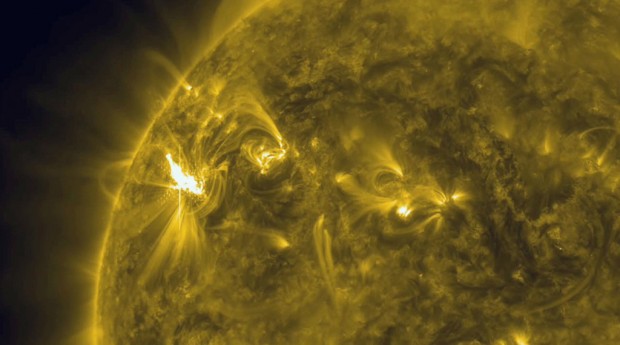
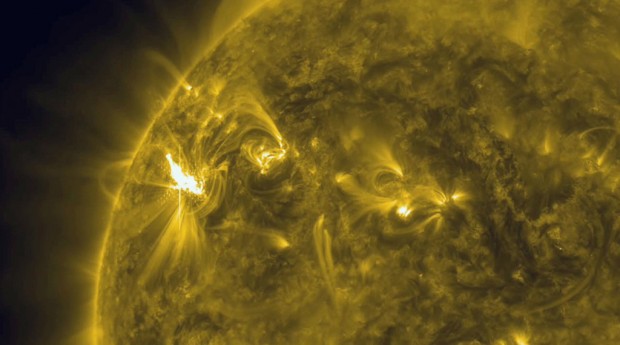
The solar viewing is of special interest because the sun has been very active as it approaches the peak of an 11-year cycle (known as solar maximum). There will almost certainly be sun spots and solar prominences (flares on the edge of the sun) to look at.
In the evening, up to 40 telescopes will be lined up for viewing the stars and planets.
While the event is free, donations are appreciated. Donations earn tickets for door prizes, including small telescopes and other astronomy-related items.
There's also the opportunity to unofficially rename a star for a suggested $10 donation.
A kids corner will include hands-on activities that demonstrate cool science facts - like how gravity works and how craters are made.
The event is hosted by comet hunter and astronomer David H. Levy and his wife, Wendee, the Flandrau Science Center and the Tucson Amateur Astronomy Association.
Did you know?
David Levy launched the National Sharing the Sky Foundation in 2006. The nonprofit is dedicated to inspiring young people to pursue interests in science and engineering.
Contact Tim Hunter at skyspy@azstarnet.com