

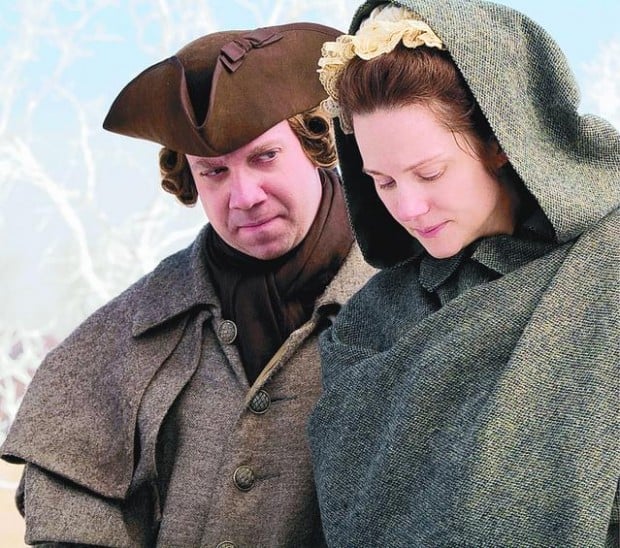
"John Adams," HBO's seven-part miniseries about the Founding Father who became America's second president, begins tonight with back-to-back episodes at 8 and 9:10 p.m.
On one level, it is a lesson in nation-building that no one who sees it will ever forget, even if they are not moved to tears by the opening sight of ancient flags and banners with their slogans — "Join, Or Die" and "Don't Tread on Me" — restored to full glory and significance.
On another level, "John Adams" is a magnificent costume drama teeming with details of dress and furniture, deportment and manners. It is a feast for the eyes as beautiful in the bleak gloaming of a snowy night as it is in the sunlight of a Massachusetts garden in summer bloom. Those so inclined can also embrace it as a love story between John Adams (Paul Giamatti) and his wife, Abigail (Laura Linney), whose letters left a record of deep affection and intellectual vigor.
People are also reading…
Yet it is the small moments more than the soaring themes that are the real triumph here, and that lift "John Adams" out of the realm of ordinary biopics and Birth of Our Nation dramas. Partly, this is because the series, based on David McCullough's 2001 book of the same name, only shows us events in which Adams and/or his wife were involved. That's plenty, since Adams was present for the turmoil of pre-Revolutionary Boston and then was a feisty delegate to the Continental Congress in Philadelphia. There, representatives of the colonies argued bitterly over the issue of declaring independence.
But the years of war against England pass largely unseen, except for some glimpses of lonely Abigail. Adams was abroad for most of it, trying to raise money and support in France and the Netherlands.
That is fortunate for us, because many of the best scenes take place overseas. By the time Adams is dispatched to France, we have come to know him as a cauldron of what, even today, are held up as typical American virtues and sensibilities: He's fun-loving yet sober-living, ambitious yet insecure, passionate about freedom and unafraid to speak his mind; but ill at ease with the dance of diplomacy.
So it is that when Adams joins Ben Franklin (Tom Wilkinson gives him a delicious nasty side) in Paris, the shock of what he sees there cuts us like a knife. As America fights and bleeds to be born, the aristocrats on whose money that birth depends are decadent fops. Amid the repugnant banter and coquettery, lapdogs graze atop dinner tables laden with sweets and pee at will on their owners' silks and satins. With their painted lips and powdered faces (women too), his hosts look like death itself.
More uplifting is the meeting between the first ambassador from the new United States and England's King George III. Oh, to have been there! Again, Adams is forced to behave against his strongest instincts and bow before the monarch (a wonderfully weird cameo by Tom Hollander). But he stands tall verbally and effects a halting reconciliation of almost unbearable poignancy.
Yet soon we are indignant again. The British newspapers make up accounts of a failed meeting to suit their own bitter prejudices. One calls Adams "a vain imposter," and another writes that he ought to be hanged. If Adams had any lingering feelings for the mother country, they are instantly erased by these reminders of why he waged war against Britain, and he shouts in disgust: "God, what a country!"
Giamatti will receive well-deserved kudos for his performance, which is never better than when he gets to abandon the hang-dog look and bridles with passion. Linney fills out her role, even if the Abigail-as-protofeminist stuff sometimes feels canned.
David Morse, who has too often been cast as a demented killer, wears a prosthetic nose and becomes a shyer, if slyer, George Washington than we have seen in the past, taking his oath of presidential office in almost a whisper.
One of the most compelling characters in the series, perhaps because he remains so enigmatic, is Thomas Jefferson. There is more than a hint of tortured soul in Stephen Dillane's depiction, which gives his Jefferson intriguing depth .


