The letter came from a proud mother with a simple question:
Why had her son — an author interviewed by The New York Times, creator of one of publishing’s fastest-growing fantasy series and a Tucson-raised writer whose books have sold more than 10 million copies — never been featured in his hometown newspaper?
With each new milestone in Matt Dinniman’s unlikely career, that question gets harder to answer.
His Dungeon Crawler Carl series has grown from a self-published web serial into a publishing phenomenon, complete with action figures, a tabletop role-playing game, a pinball machine and a television adaptation in development. Fans pack his appearances and approach him with the enthusiasm usually reserved for rock stars.
But his success was neither sudden nor inevitable.
People are also reading…
For decades, Dinniman wrote at night while working day jobs, collecting occasional victories but never landing the breakthrough that would allow him to write full time.
Long before the millions of readers, he was a Sabino High School student who had decided he wanted to tell stories.
“I just kind of settled on the idea that I wasn't going to make a living doing it,” he said, “but I'm still going to do it.”
That determination — and a willingness to bet on himself when traditional publishing failed to open its doors — eventually made Dinniman one of modern fantasy’s biggest independent success stories.
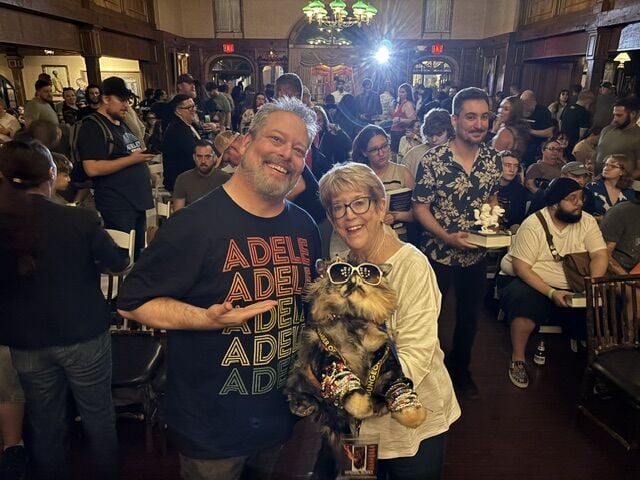
Matt Dinniman and his mom, Judith, pose with a stuffed Princess Donut, the talking cat from his wildly popular Dungeon Crawler Carl series.
The long road
Dinniman’s family moved to Tucson because of his father’s military career. He graduated from Sabino and began taking writing seriously as a teenager.
He attended the University of Arizona for a time, but says the writing program at Pima Community College shaped him most. He joined writing groups, placed work in literary magazines and published through small presses.
He also worked a succession of day jobs, including a stint at the Tucson Citizen, where he admits he padded his résumé to get hired. Through it all, he kept writing, even when it seemed unlikely to become a career.
There were small successes, but no life-changing contract or bestseller. Still, Dinniman kept going.
That long apprenticeship matters because Dungeon Crawler Carl can look, from a distance, like a lucky collision of timing, technology and an unusually charismatic talking cat. In reality, it came after years of practice, rejection and persistence.
Around 2015, Dinniman discovered LitRPG, a fantasy subgenre that weaves the structure of role-playing games into its stories. Characters gain levels, acquire skills and complete quests in ways familiar to video-game players.
He noticed something else: Many of the genre’s most successful writers were publishing their own books.
Self-publishing offered direct access to a growing audience without requiring an agent or traditional publishing deal. For Dinniman, who had spent years on the edges of the industry, it offered another way forward.
In 2017, he independently released Dominion of Blades.
“I made more money on the first day that that book was out than my entire publishing career up until that point,” he said.
It wasn’t enough to change his life. But it taught him something important.
Dinniman began learning the less glamorous parts of being an independent author: packaging books, understanding online retailers and building relationships with readers. Self-publishing didn’t make the work easy. It gave him more control over it.
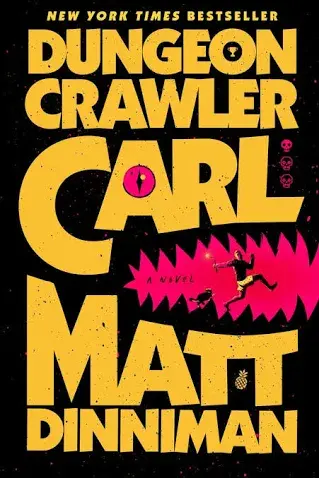
The cover of Matt Dinniman’s first installment of the Dungeon Crawler Carl series.
Enter Carl and Princess Donut
The project that changed everything arrived during the COVID-19 pandemic.
When income from Dinniman’s day job disappeared, he began posting a new story online as a serial. The premise was strange, violent and darkly funny: Earth is transformed into an intergalactic dungeon crawl, and a man named Carl must survive a televised competition alongside his ex-girlfriend’s prize-winning cat, Princess Donut.
The cat can talk and quickly becomes one of the series’ most memorable characters.
Dinniman published Dungeon Crawler Carl independently through Amazon. He couldn’t afford a major advertising campaign, so the book had to find readers another way.
It did, mostly through word of mouth.
Readers recommended it to friends. Online conversations grew. With each installment, more people entered Carl and Donut’s increasingly elaborate — and dangerous — world.
“Every time I put out a new one, the sales would go up and up and up,” Dinniman said.
An audiobook release in 2021 accelerated that growth. The series’ humor, action and distinctive characters translated especially well to audio, reaching people who might not ordinarily pick up a fantasy novel.
The earliest physical editions initially sold poorly. Their scarcity has since turned them into coveted collectors’ items, with some copies commanding thousands of dollars.
It’s one of the many ironies of Dinniman’s career: Books that once struggled to find buyers are now prized artifacts from the beginning of a cultural phenomenon.

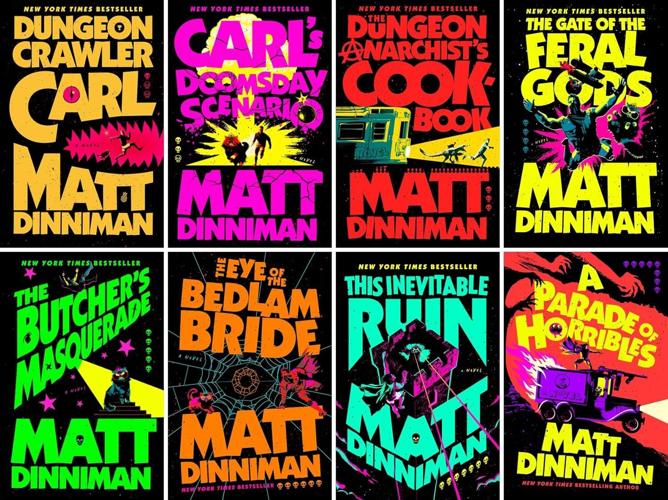
The books in the Dungeon Crawler Carl series.
Making readers out of nonreaders
Dungeon Crawler Carl helped introduce a wider audience to LitRPG, but its appeal goes beyond video-game mechanics.
The series has monsters, battles, upgrades and ever-more-dangerous challenges, but it’s grounded in recognizable emotions. Carl is an ordinary person trapped in a brutal, absurd system, and his relationship with Princess Donut gives the books much of their comedy and heart.
That combination has attracted fantasy fans, gamers, audiobook listeners and people who had stopped reading for pleasure.
Dinniman often hears some version of the same message: “I haven’t read since high school.” Or, “I gave this to my boyfriend.” Or simply, “This made me a reader again.”
“It’s my favorite thing to hear,” he said.
The series has been especially successful with young men and lapsed readers, which happen to be audiences the publishing industry often struggles to reach.

Matt Dinniman
That experience shapes Dinniman’s response to critics who argue that BookTok, romance, fantasy and other forms of popular fiction are weakening literary culture. He believes the opposite is happening.
Online communities have turned reading into a shared experience. People recommend books, debate characters, post reactions and build friendships around the stories they love. A popular fantasy novel doesn’t prevent someone from reading another book, Dinniman argues. It creates another reader.
“Books like this that are popular are doing the exact opposite of what people claim,” he said. “They are bringing more and more readers into the fold.”
One book, in his view, often leads to the next.
A different kind of pressure
Dinniman wrote his earliest books with little assurance that anyone would read them. That anonymity gave him a certain freedom.
Now every creative decision is made under the gaze of an enormous audience.
“I wrote it knowing that literally a million people were going to read it,” he said of his newer work.
Fans have expectations. They develop fierce attachments to characters and strong theories about where the story should go. Each new installment has to serve the larger series while still surprising readers.
The emotional responsibility can be heavier.
Dinniman receives messages every day from people who say the books helped them through cancer treatments, family deaths, grief and other painful periods. For some, Carl and Donut offered a few hours of laughter or escape when both were desperately needed.
Those messages are meaningful, but their volume and emotional weight can take a toll. Dinniman eventually hired an assistant in part to help manage the correspondence.
It’s a strange transformation for someone who once wrote without knowing whether he would have an audience at all. His stories now accompany readers through some of the hardest moments of their lives.
The camera keeps widening
The publishing world has caught up with the audience Dinniman built on his own.
A partnership with Random House brought the series into more bookstores. A television adaptation is in development. There are action figures, a pinball machine and a successfully launched tabletop role-playing game.
The Colorado Avalanche even hosted a special “Carl Night,” bringing the fictional dungeon crawler into professional hockey.
“The action figure surprises me,” Dinniman said.
Each new project pushes Dungeon Crawler Carl beyond the novels. As Dinniman puts it, “The camera keeps widening.”
Still, he remains focused on the work that made everything else possible.
“Writing books is always going to be my number one priority,” he said.
That may be the key to preserving what readers connected with in the first place. The franchise can expand into television, games, collectibles and events, but its center remains the relationship between an author and the people waiting for his next story.
Tucson in the DNA
Although Dinniman has lived away from Tucson for more than a decade, the city and the surrounding desert never entirely left his work.
He wrote a novel set in Tucson, The Grinding, and sees the region’s influence throughout his fiction, even when the story takes place far from Southern Arizona.
“Everything I do has the American Southwest baked into it one way or the other,” he said.
The connection is personal, too. Dinniman still names Mama Louisa’s, El Güero Canelo and Eegee’s among his favorite Tucson stops … the kind of list that reveals a relationship with the city deeper than a line in an author biography.
Now he’s returning permanently.
With his first grandchild due this month, moving home gives Dinniman a chance to reconnect with family and with a literary community that has grown since he left.
The timing has a certain symmetry. He left Tucson as a writer searching for a wider audience. He returns as the creator of an international publishing success — one built without abandoning the stubborn creative instinct he developed here.
For all the millions of copies, adaptation plans, sold-out appearances and collectors searching for rare editions, Dinniman still sounds surprised by the scale of it all.
Perhaps that’s because he remembers how long nothing happened.
He remembers the small presses, the day jobs and the years of writing without any guarantee that writing would love him back. He remembers accepting that he might never make a living from books and deciding to make them anyway.
The Tucson teenager who kept writing because he couldn’t imagine stopping now finds himself at the center of a world that continues to expand around him.
His advice to aspiring writers remains much simpler than his success story:
Read. Write. Repeat.
And keep going, even when success seems unlikely.