

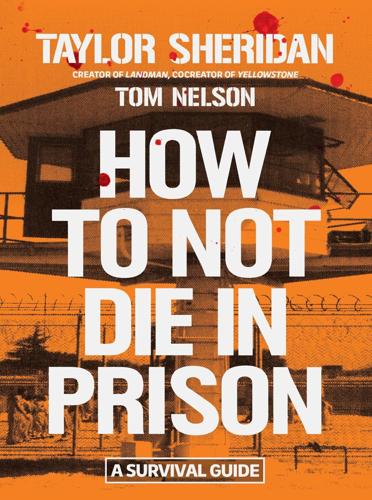

"How to Not Die in Prison" carries two bylines: One (larger font) is Taylor Sheridan, the North Texas show runner who's built a TV empire on rough-and-tumble characters from "Yellowstone" to "Landman"; the other (smaller font) is his friend Tom Nelson, who served 17 years in prison over multiple sentences, starting with juvie at 14. I'll let you guess who wrote the 200-plus pages of a guide to life behind bars — and who wrote the introduction.
Sheridan has entered the brand ambassador phase of his career, which includes not merely a raft of television shows with which he plays a minimal role ("Dutton Ranch," "Marshals") but also a music festival, the purchase of fabled Four Sixes Ranch, the co-ownership of Cattlemen's Steakhouse in Fort Worth — and now, a book with his name, if not much of his voice.
"This is a guidebook for the accidental felon," Sheridan writes in his chummy, f-bomb-laden introduction. Since "accidental felon" is a thin slice of the publishing market, you'd be correct to suspect this book has another purpose, and to Sheridan's credit, he tells us. Long story short: Sheridan's bud, the Los Angeles-based personal trainer Tom Nelson, was struggling with his health and finances after pandemic shutdowns, and Sheridan wanted to help his friend by finding a lucrative joint venture.
People are also reading…
Nelson, now in his 60s, spent his youth slinging drugs, beating up the occasional stranger and doing time in medium- and maximum-security prisons. He turned his life around and hasn't been incarcerated for many years. But he has stories — about prison gangs and making hooch in a plastic bucket and the thin foam mattress of a prison bed, the blanket like sandpaper. Sheridan, whose genius lies in characters that are compelling enough to ignore the uneven dialogue and preposterous plot twists, knows a good protagonist when he sees one. He's also tackled the prison system in the show "Mayor of Kingstown."
"Then it hit me," Sheridan writes in his introduction, about stumbling onto the idea for the book. "What the world needs is a travel guide to the penitentiary. How to survive, navigate the very, very, very sharky waters — where danger lurks — and what mistakes to avoid like the plague."
Does the world need this book? Unclear. Will it get you booked on Joe Rogan? Yes, if your name is Taylor Sheridan. And the book is interesting, if baggy, mostly because the American carceral system is tragic and fascinating, a vast and mysterious (and lucrative) network of well-intentioned ideas about crime and punishment, endlessly fetishized by Hollywood and little understood by outsiders like me.
"How to Not Die in Prison" did teach me a few things. Let me share.
Shivs can be made from toothbrushes, canned food containers and Styrofoam cups
The story of life behind bars is one of creative pragmatism, doing more with less, and according to Nelson, weapons can be made of nearly anything — "pencils, pens, razors, canned food containers," he writes. "A sharpened toothbrush can make a decent knife on its own, or you can heat up the brush and insert an old razor blade into the handle; this kind of blade is used for cutting or slicing, as opposed to stabbing."
Prisoners pick up these materials at vocational schools and work programs, as well as construction sites. "Nails make excellent tips for knives and spears, but tools and metal scraps or parts are regularly pilfered as weapon parts as well," Nelson writes. "Anywhere there's welding and other manufacturing or maintenance work being performed, there is usually metal of some type lying around — and it will be scooped up by enterprising inmates with axes to grind."
Nelson never kept a shiv; not worth the trouble. Punishment can be severe for possessing one, and in a heavily surveilled environment with scant privacy, they're usually discovered. But others make a different calculation, and Nelson describes the menacing experience of lying awake at night and hearing the scrape of metal being sharpened in neighboring cells.
The resourcefulness of these guys is impressive. As Nelson writes, "On yards with metal detectors, knives will generally be made of plastic or other nonmetallic substances. I've known convicts to make shanks out of Styrofoam cups."
This places to-go cups in a whole new light.
Prison hooch is common, and gross
"No matter where you're being held, there will be someone, if not lots of people, making wine and whiskey," writes Nelson, who ran a tidy business making the latter. Homemade wine, sometimes called pruno, is made from fermented fruit served in the dining hall. "In my experience," Nelson writes, "some 50 percent of kitchen workers will smuggle as much fruit and sugar as possible out of the kitchen and into their cells for the noble purpose of making pruno."
Sound gross? It is. But desperate people do desperate things and selling pruno can be a nice side hustle. Nelson preferred turning the homemade wine into high-proof whiskey, which he did using a bucket, a T-shirt, a plastic bag and a heating coil. The section on this includes a recipe. "Four gallons of strong wine should produce between three and four quarts of whiskey," Nelson writes, "and a quart can sell for $75 to $100 on the yard."
However complicated, this seems easier than making smokes, which I was surprised to learn have been banned in many prisons and whose process includes making a spark from pieces of lead pencil or razor blades, and a wick from a tampon or rolled-up toilet paper.
Talk about incentive for quitting.
Showers are dangerous, but not for the reason you think
Nelson doesn't shy away from prison rape, which happens, but in his observation, it's not nearly as common as suggested by movies and TV shows, where sexual violence has become the go-to humiliation for writers reaching for shock. But showers can be dangerous places.
"The same mixture of vulnerability and seclusion that makes the shower a potential stage for sexual abuse," Nelson writes, "also makes it a great place to get shanked."
Nelson never got shanked in a shower, but a female guard did develop a habit of watching the men, though he admits she was pretty, and he didn't mind.
I should mention that How to Not Die in Prison is largely about men's experience in prison. Nelson, for obvious reasons, doesn't have much expertise on women's prisons.
Prison sounds weirdly like a middle-school cafeteria
I was struck by sentences like this: "You will be judged by everyone for everything — your race, your haircut, your build ... what you say, and how you say it."
Prison cliques do not break down, "Breakfast Club"-style, by jocks, brains, beauty queens and hoods, but mostly by gangs: Norteños, Aryan Brotherhood, Bloods. Among other challenges, being a newbie (fish, in prison slang) sounds socially fraught and anxiety-inducing.
"Your body language will be studied," Nelson writes. "It needs to say in no uncertain terms: I ain't looking for trouble, but I am damn sure ready for it."
Like in middle school, a good way to avoid trouble is to seek out people whose company can be a protective shield. "Find a small group of anywhere from three to ten guys that you can hang with on the yard, in the chow hall, and in the dayroom," writes Nelson. "This will be what's known as your car."
Prisoners keep roughly the same schedule I do
Lights up at 5 a.m., lights out at 8:30 p.m. I don't tend to advertise that, as a middle-aged woman, I basically keep the working hours of a farmer and yawn uncontrollably as the hour creeps near 10 p.m. So imagine my surprise to discover prisoners keep a similar schedule, with breakfast at 7 a.m. (check) and dinner at 5 p.m., like senior citizens.
Nelson doesn't explain why, though I'd venture it has to do with minimizing trouble and keeping inmates separated during the potentially volatile hours of darkness, but I found this strangely endearing. Ditto for the passage about art projects made with grass and scraps of bed sheet. As Nelson writes, "One inmate I knew made a pretty good living from the portraits he carved out of bars of soap."
Prison is a terrible story that can be a hopeful one, a chance to turn your life around, find meaning amid suffering, develop your intellect or, as Nelson did, hit the gym and transform your body. I appreciate that some people might read this book for tips on how to throw a punch or survive a knife fight. For me, the best parts of How to Not Die in Prison were about how to live.


