As "digital detoxes" continue to grow in popularity among those looking to curb rising screentime, some young people are interested in "dumber" tech.

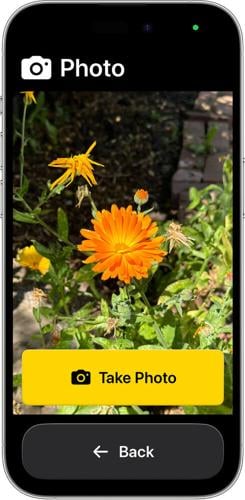
Apps have been designed for Assistive Access to make tasks easier, such as capturing photos.
In recent years, more millennials and Gen Zers have turned to "dumb phones," or phones with only a few features, such as calling, texting, a camera, an alarm, a calendar, music and maps. These devices purposefully hinder mindless hours of social media scrolling and endless access to work emails. In 2023, Apple released an accessibility feature on iPhones that allows users to "dumb down" their high-tech devices.
Over the past decade, several companies released their own "dumb phones." Some of the devices feature touchscreens, but others harken back to the days of flip phones. Though these devices are cheaper than a new iPhone (the iPhone 17 starts at $800), they are still pricey and often sold out, making them exclusive.
People are also reading…
The Light Phone, first released in 2015 and only available for pre-order, ranges between $300 and $700. Techless' Wisephone is $399, and Punkt's sold-out MP02 Minimalist Phone, which functions more like a phone, except with a keyboard instead of a touch screen, is $300.
Other tech companies are creating secondary products that can be paired with a modern smartphone. Devices like the Brick ($60) and Unpluq Tag ($30 for a 3-month subscription) can be wirelessly connected to smartphones to block apps and websites, aiming to limit screentime.
Minimalistic phones and other devices aren't needed for a "dumb phone" experience, as most modern smartphones, including iPhones, can be simplified by changing settings.
Interested in giving it a try? Here's how to make your iPhone a "dumb phone."
Simplifying the iPhone

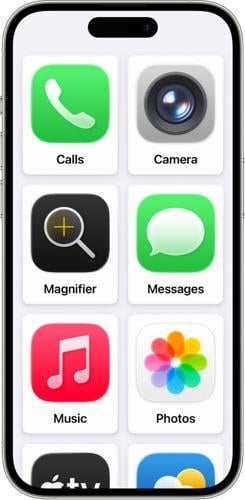
With Assistive Access, onscreen items are bigger and iPhone's features are more focused.
To simplify an iPhone, users should engage Assistive Access, an iOS feature intended for users with cognitive disabilities. Assistive Access strips down the iPhone user interface, prioritizing the most necessary features of selected apps and making on-screen features larger.
1. Open the Settings app.
2. Scroll and click Accessibility.
3. Scroll to the bottom and click Assistive Access.
4. Click Set Up Assistive Access, then Continue.
5. Select an Apple Account. If you are already signed into an Apple Account on your iPhone, you will be prompted to use that account, but you can change it.
6. Select an appearance. Do you want your apps to appear in rows or a grid?
7. Select which apps you would like in Assistive Access. To add an app, click the green plus-sign button. Some apps will ask additional questions for how much (or how little) access you would like.
8. Click Continue through the prompts, which explain how Assistive Access functions.
9. Set a four-digit Assistive Access passcode. This passcode will be used to exit Assistive Access.
10. Click Start Using Assistive Access to begin using your "dumb phone" right away or Enter Later to try at a different time. You will be asked to enter your Assistive Access passcode again.
Changing it back
After a user has enabled Assistive Access to make an iPhone a "dumb phone," the phone can be switched back to a traditional iPhone. Here's how to stop using Assistive Access:
Triple-click the side action button on the right side of the phone.
Click Exit Assistive Access.
Enter your four-digit Assistive Access passcode. If you forgot your four-digit passcode, you can enter your Apple Account email and password.