

SpaceX, the Elon Musk-led aerospace company, wants to build and operate a 747-acre data center campus near the Willcox Playa, a plan the company outlined for nearly 300 people who packed an elementary school auditorium Nov. 4 for a community meeting.
If built, the development would become one of the biggest data centers in the country, and the biggest in Arizona, demanding more than 6 gigawatts of power when completed. The Willcox Playa is about 80 miles east of Tucson.
Some of the people in the crowd opposed the project, skeptical about its use of resources in an area where groundwater supplies have been drawn down by huge dairy farms. But others saw promise in the jobs and the tax revenue.
Cochise County Development Services received an application for a special use authorization permit on Oct. 30 from Tombstone Resources LLC. The company later announced SpaceX as the host of the evening town hall. The county's Planning and Zoning Division will hold a public hearing for the project on Dec. 9.
People are also reading…
According to the permit application, the campus would be "dry-cooled" and pump no groundwater for industrial use. An existing well would pump up to 10 acre-feet of water a year from the aquifer for potable water use, maintenance and equipment cleaning.
The planned supercomputing facility, however, would demand about 2.5 times more power than all data centers in Maricopa County combined, if fully built out, according to a power use analysis by The Arizona Republic. The center would be served electricity through the Sulphur Springs Valley Electric Cooperative and Arizona Electric Power Cooperative and invest $3.6 billion in grid upgrades, the application said.
The project would reduce residents' electricity bills, lower property taxes by 20% and create some 1,000 permanent jobs, said Riley Trettle, SpaceX’s head of energy and supercomputer department at the presentation. It would bring a one-time $250 million sales tax benefit to the county, and some $35 million to $103 million in sales tax revenue, according to the application.
Many in the crowd heckled and shouted to presenters as soon as the 20-minute presentation began, holding "No Data Center" signs; a few clapped.
Dozens of residents told The Republic they heard about the planned data center and SpaceX's involvement less than a week ago. Some residents living less than a mile away from the proposed building site received a letter from Tombstone Resources LLC in mid October, according to the company.
SpaceX stayed longer to answer community questions one-on-one. Employees and company representatives declined to answer any questions from The Republic and other media, referring them to their official public affairs email.
Loud opposition and mixed reactions to mega-project
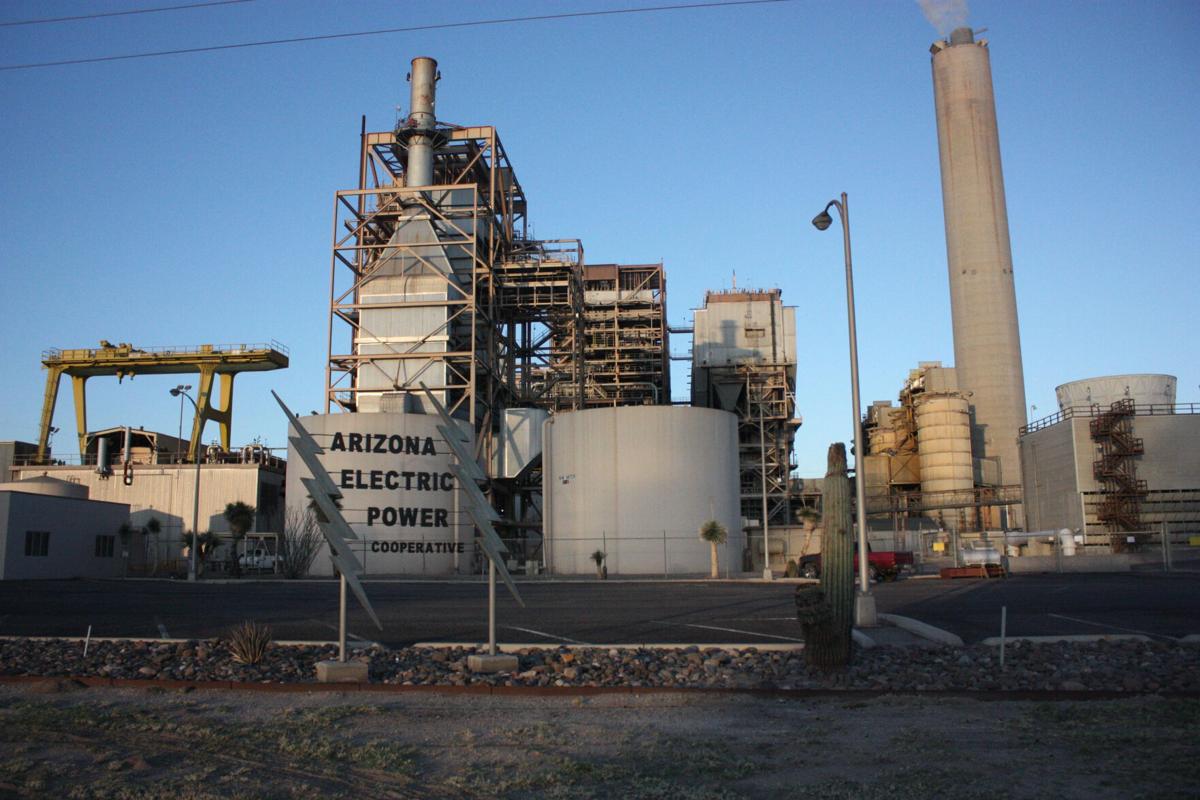
Kathy Shope can see the Apache Generating Station from her home. The proposed SpaceX data center campus would not be next to her "but close enough," she said.
"I was worried about light, noise and sandhill cranes. I wanted to hear the speaker better but it was hard with everyone yelling back there," Shope said. She and her husband had been coming with their horses from Montana every year for the past seven, and recently decided to make the move permanent. She felt optimistic after the presentation.
"Living in this valley, water is a real concern, but the dairy uses more water than everybody. I don't think this is going to be as much impact to the water, specially if they recycle. And I do like the sounds of the revenue tax."
An older woman approached her as she talked to The Republic: "My one and only question is: how do we stop them?"
Alice Hamers, 83, has lived in McNeal, 40 minutes south of the power station, for the past two decades. She was encouraged to see Attorney General Kris Mayes take action against Riverview Dairy and reach a settlement for residents, and believes the environmental impacts from a massive SpaceX project would mean "the end of this Valley."
Her biggest concern are the for-profit interests and big money behind the project, billionaires "who don't give a flipping flying anything for people who live here," she said.
Other new residents were excited that SpaceX was the one behind the massive data center. Shay Stephens, 57, living near the Chiricahua Mountains for the past six years, clapped during the presentation "to counteract the bad behavior of some people."
He follows the company's launches often and, though he has concerns about the desert aquifer's balance, felt reassured by SpaceX claims about the campus dry-cooling technology and water recycling. Job creation makes him supportive of the project."I'm encouraged by that because there is construction work here but, especially during the winter, it dives down. I'm basically part-time, and I think this would be a good opportunity to bring a lot of money into the county," and the company employees assured they would recruit locally, he said. "I see a lot of benefits."
Still, other residents, though they didn't outright oppose the project, were more skeptical.
"I'm in favor of conditions, restrictions and honesty," said James A. Schmidt, a resident from Dragoon and retired wildlife specialist with the U.S. Department of Agriculture who has lived in the county for decades.
The special use permit and any development contract for the project should have stronger stipulations on water use, noise and light mitigation, and language that protects residents in case the builder decides to sell, he told The Republic.
"It should be in there, and it should be for the lifetime of the facility."
The owner, he said, should be forced to renew the permit for any changes in operation, like higher water use. As a close neighbor to the Johnson Mine and a lover of rural lifestyle and the area's dark skies, Schmidt claimed the mine operators did not follow through on the things they promised because it wasn't in the permit.
If the right guardrails are in place and the project is approved, money from the tax revenue should also be spent near Cochise and Dragoon, not in other areas of the county like Bisbee, Sierra Vista and Douglas, he added.
Another newly arrived resident, Jon White from Cascabel, suggested other projects and competing data centers should present their proposals "to bid up the amount of community benefits."
Many in the packed elementary school auditorium held "No Data Center" signs and wore pins, and distributed paper copies listing the negatives of the proposed project. Rural Arizona Engagement, a nonprofit, helped some residents organize since last week after seeing a wave of online activity and a 2,400-signature petition asking the county zoning commission and board of supervisors to deny the project permit.
Some attendees came from Tucson and the edges of Cochise County to voice their concern; others to voice support.
Daniel Martinez, a contractor for Gunnison Copper Project, some six miles west of the proposed building site, drove from Sierra Vista in support.
SpaceX's project would not only bring jobs, but could be very valuable to Fort Huachuca'sU.S. Army Intelligence Center, said Martinez, 39, who attended military intel school at the base.
"If there's cybersecurity issues, the data center would be a great backup," he said. "It's only our base, and the Pentagon, and a few other bases around the country that run all the intel for this country."
A project of unprecedented scale in Arizona
The SpaceX project for rural Cochise County would demand more electrical power than all Maricopa County data centers combined.
In the United States, the biggest operational data centers run on less than 1.5 gigawatts of power, or 1,500 megawatts, and are owned by Google, xAi and Microsoft. Projects still in development, like Fermi in Texas or Delta in Utah, could use 17 gigawatts and over 10 gigawatts of power, respectively.
The Musk-led company told Cochise County residents that its billions of investment could take Apache Generation Station's power capacity from about 1 gigawatt to more than 6 gigawatts. The plant currently runs on a mix of coal and natural gas. The station was planned to retire by 2028, but this summer it was granted nearly $21 million by the Trump administration for upgrades to keep running. The administration also rolled back air quality standards for coal-fired power plants.
The biggest utilities in Arizona don't have enough room to bring new large data centers onto the power grid. That creates a "reasonable question" about whether adequate protections are in place to protect residential ratepayers from the costs of the data center boom, Arizona State University experts told The Republic earlier this year.
Public information is still limited on how SpaceX would build the needed power capacity for the campus. Rate hikes for Sulphur Springs Valley Electric Cooperative and Arizona Electric Power Cooperative must be approved by the Arizona Corporation Commission.
Direct water use for cooling the supercomputer campuses, one of the main concerns from locals, would be minimal because of dry-cooling technologies, SpaceX argued. However, the project would have indirect water use from power generation. The water needed for electricity generation bumps the annual water use of data centers by 60% to 90%, data center experts told The Republic.
In its permit, the company did not have an estimate of how much water it would take to power a fully operating, 6 gigawatt data center — enough power to serve millions of homes.


