Hundreds turned out for a long-awaited meeting in Tubac with a U.S. Customs and Border Protection official Monday, with many hoping for answers about a proposed major expansion of the Border Patrol checkpoint on Interstate 19 between Tubac and Amado.
But the invited CBP representative, Agent Jose "Lu" Maheda, who has been Santa Cruz County officials' contact for the controversial project, over the weekend canceled his appearance at the public meeting, said Santa Cruz Valley Citizens Council leaders who planned the meeting.
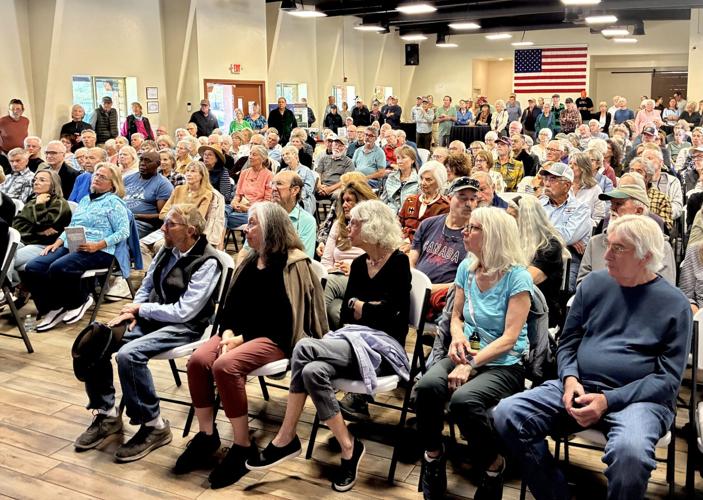
About 250 residents of Southern Arizona, mostly from Tubac, nevertheless filled the Saint Ann's Community Hall on Monday morning, with many presenting the questions they would have asked of Maheda had he attended.
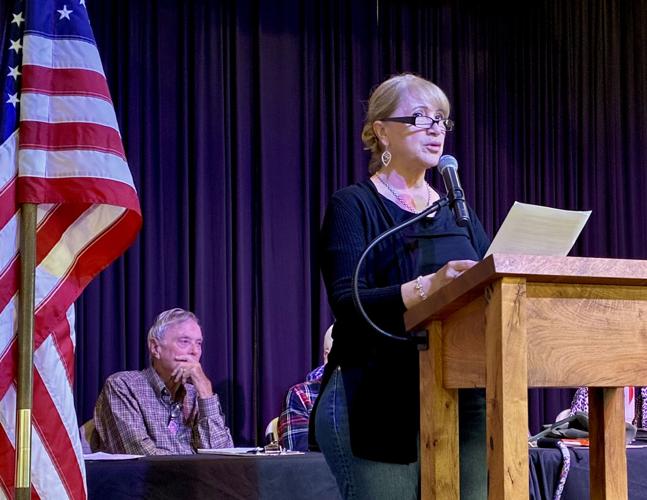
"Our first question is: Why is it so difficult for the public to obtain information about a project of this magnitude?" said Celeste Wisdom, president of the Tubac Chamber of Commerce, speaking to the crowd. "Surely the overall footprint, environmental impacts, traffic projections, construction schedule and justification for spending $63 million are matters of public interest. Secrecy creates speculation; transparency creates trust."
People are also reading…

Celeste Wisdom, president of the Tubac Chamber of Commerce, addressed a crowd of about 250 Southern Arizona residents on Monday, Nov. 9, in a community meeting about the proposed expansion of the Border Patrol checkpoint on Interstate 19. "Our first question is: Why is it so difficult for the public to obtain information about a project of this magnitude?" Wisdom said to the crowd. "Secrecy creates speculation; transparency creates trust."
Maheda told organizers Saturday he couldn't attend Monday's meeting due to a new position with Border Patrol's Tucson Sector, and that no one was available to take his place, said Mary Vanis, president of the Santa Cruz Valley Citizens Council, which has about 450 members.
Maheda had requested news media be restricted from attending the public meeting, but organizers declined that request.
"There's no question that we're frustrated," Vanis told the crowd Monday. "I know you all wanted the opportunity to be able to state your concerns, and we decided as a board that we still wanted to make that opportunity available to all of you."
Speakers questioned how an expanded checkpoint would affect the commercial trucking industry and produce suppliers, who would have just undergone inspections at the U.S.-Mexico border, 25 miles south of the I-19 checkpoint.
CBP officials intend to expand the current temporary checkpoint — a tent structure stretching across northbound I-19 — into a 17-acre facility located off the highway.
While some upgrades and a modest expansion could make sense, some speakers said a sprawling 17-acre complex — with stadium lights, a detention area, multiple additional lanes and dog kennels, according to a CBP document shown to one private property owner in Tubac — appears unjustified.
Despite the public outcry over the lack of transparency about the project, in late September CBP awarded a $63 million contract to Alabama-based Brasfield & Gorrie LLC for the expansion. Contacted by the Star, a company spokesperson said CBP had instructed its office not to speak to the press.
The contract was awarded before CBP sought public comment on the project or conducted an environmental assessment, both steps that are legally required under the National Environmental Policy Act, or NEPA.
Since hearing about the plans earlier this year, locals have also raised concerns that the expansion would undermine Tubac's tourism industry, harm the environment, and threaten Tubac's international "dark skies" designation due to the lighting structures.
The chamber is concerned about impacts on tourism, businesses and community character, Wisdom said at the meeting.
"Tubac and Tumacacori depend on visitors. Our historic sites, galleries, restaurants, shops, natural beauties and dark skies are the foundation of our tourism economy," she said. "A large highly illuminated federal complex at the northern entrance to our communities could change the visitor experience considerably."
Several residents also expressed concern for non-white residents and tourists potentially having to deal with racial profiling at the checkpoint. An expanded checkpoint would also significantly affect locals who pass through the checkpoint on a daily basis.
Lee Blackwell, a resident of Tubac for more than 40 years, said he's concerned about the community getting stuck with the bigger checkpoint, even if it's clear it's unnecessary in the future.

About 250 people attended Monday's meeting at Saint Ann's Community Hall in Tubac, despite the cancelation of a U.S. Customs and Border Protection official, who was supposed to attend to address questions on the proposed I-19 checkpoint expansion.
"When you have a great big, expensive facility that has a bureaucracy connected with it, it is harder than ever to get rid of it," he said.
More checkpoint projects
Flush with cash earmarked for Border Patrol checkpoint facility expansions, under the 2025 "One Big Beautiful Bill," CBP has embarked on an effort to rapidly spend millions on several planned checkpoint expansions and new facility projects in the borderlands, including at least $500 million on projects planned in Arizona, the Star has reported.
That includes a planned new checkpoint near Three Points and plans to expand an existing checkpoint on West Arivaca Road, west of I-19, which locals say is often unmanned.
The Star reported on the unusual lack of detail and public communication about the expansion project in August. Nearly three months later, CBP still has not shared details of the project with the Star or local residents.
CBP officials also declined to answer reporters' questions on the I-19 checkpoint expansion during an October press conference at Border Patrol's Tucson Sector headquarters.
At the event, Tucson Sector Acting Deputy Chief Patrol Agent Stephen Cristinzio said the public's questions would be addressed at the meeting planned Monday in Tubac.
That was before Maheda's cancellation.
Citing northbound traffic increasing out of Nogales, Cristinzio said the I-19 checkpoint "needs to be revamped, it needs to be modernized. We need to get the traffic off the highway, we need the space to operate, we need to put the NII (non-intrusive inspection) technology out there."
Checkpoint underutilized
Locals say they've repeatedly requested CBP share any data demonstrating the need for such a massive expansion, without response from the agency.
Several speakers Monday said the existing lanes at the checkpoint aren't even fully utilized.
"I'd like to see us request of the Border Patrol that they open the third lane they already have, before they spend millions of dollars increasing the number of lanes that they're not going to staff," said Roy Farrell, a Tubac resident of 20 years and former chief medical officer at Holy Cross Hospital in Nogales.
"I request that they show goodwill toward the community by opening that third lane when traffic gets backed up," Ferrell said. "It's hard to convince the community they're going to work with us, if they won't staff the infrastructure that they currently have."
Wisdom also asked, to applause from the crowd: "Before investing $63 million in additional infrastructure, shouldn't we determine whether fully utilizing the infrastructure we already have could address some of these concerns?
"These aren't unreasonable questions," Wisdom said. "They are precisely the questions that should be answered before making a permanent infrastructure investment."
Santa Cruz County Sheriff David Hathaway, who grew up in Nogales, also spoke before the crowd, emphasizing his belief that interior immigration checkpoints, miles from the international border, are fundamentally "un-America."
At school as a child, "we were told there are other totalitarian governments in the world where you have checkpoints, where you have to show your papers," Hathaway said. "I was told we don't have that in the U.S."
Lawyer hired
The Santa Cruz Valley Citizens Council has hired a Washington, D.C.-based law firm to try to secure more information from CBP on the project, and to be prepared to fight efforts to seize public or private land through eminent domain.
Lawyers could potentially file a complaint under the National Environmental Policy Act, if CBP moves forward with the project before carrying out required environmental studies, said Vanis, of the citizens council.
In an October statement to the Star, CBP said it will comply with NEPA requirements and "other applicable environmental requirements." The Department of Homeland Security has not waived environmental laws for the project, so "no construction will begin until the environmental review process is complete," CBP said.
Landowner Laurinda Oswald previously told the Star that CBP officials tried unsuccessfully to purchase 18 acres of her land east of the existing checkpoint. While she was open to selling a couple of acres for a small expansion, Oswald said she saw no justification for such a massive footprint.
Oswald said she's prepared to fight any efforts by federal officials to seize her land through eminent domain. Santa Cruz County officials have also refused to sell their land to CBP for the project.
Santa Cruz County Manager Jesus Valdez said at the meeting that CBP has not taken steps yet to seize county or private land through eminent domain or condemnation.
Tubac residents said their game plan will now focus on reaching out again to Arizona's members of Congress, as well as state lawmakers and leaders, to try to pressure CBP to be more transparent about the project.
U.S. Rep. Adelita Grijalva, an Arizona Democrat, has been vocal in her criticism of the planned spending on checkpoint projects "with no demonstrated need."
"CBP has provided no data to justify claims of increased traffic, and checkpoint lanes routinely sit closed. This is a massive waste of taxpayer dollars, plain and simple," Grijalva said in an October statement. "The reality is that Congressional Republicans have handed DHS and CBP more money than they know what to do with, and now they’re looking for ways to spend it, whether these projects are necessary or not. Southern Arizonans deserve better than wasteful spending that puts their communities on the sidelines."
On Monday, some residents also emphasized the community's overall support for Border Patrol agents and their safety as they man the checkpoint.
"Our communities have lived and worked alongside the Border Patrol for decades," said Wisdom, adding that four generations of her family have lived in the border region. "This isn't about being against Border Patrol. It's about asking whether a $63 million expansion is necessary, justified and appropriate for our community."
Contact reporter Emily Bregel at ebregel@tucson.com. On X, formerly Twitter: @EmilyBregel

Emily Bregel
Border reporter


 Flush with cash, CBP plans more Border Patrol stations, expanded checkpoints in AZ