

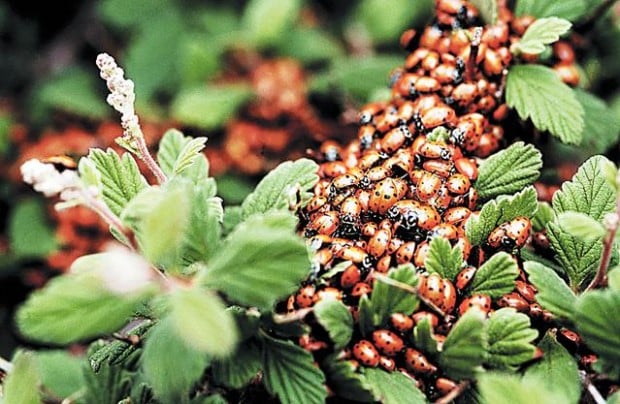
Ladybugs are among the luckiest of all bugs in Southern Arizona: they winter in the lush desert and as the mercury rises, so do they, taking flight for the cooler mountain tops.
They're there right now, basking in the warm — but not too warm — sun, congregating with millions of their friends on tree branches, rocks and grass tufts, getting their fill of yummy pollen.
Come summertime, it's a veritable ladybug picnic above 7,000 feet.
Ladybugs — also known as ladybirds, ladybeetles and ladybird beetles — are familiar parts of the Tucson landscape. But as summer approaches, the local variety, officially called Hippodamia convergens, leave us and migrate to the Santa Catalinas, Santa Ritas, Chiricauhaus, Pinalenos and other Arizona ranges.
Scientists don't quite know how the grand migration happens, but there is no doubt that it does, said Carl Olson, associate curator at the University of Arizona's Department of Entomology.
People are also reading…
"We've never seen them just all say 'Oh, it's time,' but there's something that triggers this massive movement of them into the mountain tops of California, Mexico, New Mexico, Nevada, Utah, Colorado," he said.
We might not recognize them as ladybugs during their desert childhoods, or more accurately, larvaehoods. As youngsters, they're on the creepy-crawly end of bugdom. They're dark blue-black with red or orange markings, ridged and wiggly.
"They look like baby gila monsters, they have that same texture," Olson said.
The ladybugs-in-waiting hatch from eggs carefully laid in early spring on new annual plants sprouting up in the desert and in yards. Just about the time aphids hatch, ready to devour fresh young leaves, the larval ladybugs hatch and they're anxious to get munching.
Aphids eat the new plants, ladybugs eat the aphids and everyone is happy (except the consumed aphids, of course). Especially the human gardener, who gets a hand — six, actually — in the fight against aphid investation. Aphids are tiny, but they work in hordes and can do a number on roses, vegetables, wildflowers and just about anything with chlorophyll.
The ladybugs eat their fill, packing away hundreds of aphids, before finding a nice leaf to hide under and attach to. They pupate around the last week of April, Olson said.
"They go through the same type of metamorphosis as butterflies," he said. "They come out as adult ladybugs and they're real hungry and it's the first part of May. The desert dries up, the aphids are gone."
There is no easy way to tell the genders apart — for humans anyway.
And yes, the males are called ladybugs, too. "They're O.K. with their sexuality," Olson joked. "They're new millenium bugs."
But once they've emerged as cute round red beetles, it's time to pack up and head for the highest ground around. Ladybugs have long sheetlike wings tucked under their snazzy polka-dotted front wings.
No one knows exactly how long the ladybug migration takes, or how the millions decide where to cluster. But it's evident that the tiny travelers are hungry after their long trip. They gorge themselves on pollen in the mountains in massive bug clumps, filling up what's known as their fat bodies until they can't cram any more in, Olson said.
The ladybugs eat and eat, but their already round waistlines don't expand. "That's what's good about having an exoskeleton and being an adult bug," he said.
When they arrive on the mountains, they're so intent on finding food, they'll give you a little pinch if they land on you. "They're alighting and testing, using their mandibles, testing to see if you're food or not," Olson said.
And when their fat bodies are full, the ladybugs go into diapause, kind of a hibernation state where they no longer need to eat.
"It's like they say, 'I'm fat and sassy now and there's enough here to keep me going, keep me alive in this low metabolic state for the rest of the year,' " Olson said.
Because we don't know where or how ladybugs choose their gathering spots, there's no guarantee you'll see them on a mountain hike, said Joshua Taiz, district biologist for the Santa Catalina Ranger District of the U.S. Forest Service. The best place he's seen for ladybugs is the aptly named Ladybug Saddle in the Pinaleno Mountains, but he said there are fine ladybug spots in the Catalinas, too.
"It's almost like the tree becomes iced with ladybugs like a cake," Taiz said. "It's a thick layer of ladybugs on ladybugs, down to the finer branches inside the trees.
"They all sort of crawl around on each other," he said. "There doesn't seem to be a lot of flying going on."
The ladybugs generally congregate at elevations 7,000 feet and above. Summerhaven on Mount Lemmon is at 8,800 feet and the top of the mountain is 9,100 feet. Don't expect to see throngs of busy beetles from your car, however.
"If you want to see the natural world you have to get out and get into it," Taiz said. "It doesn't generally cooperate from a windshield."
Come February or March, the ladybugs will heed nature's call again, Olson said. They migrate back to the desert, find a mate, lay their eggs and then their year-long life cycle is complete.
And it's time for the next generation of ladybugs to take flight.
● Because ladybugs don't always return to the same places every year, there's no guarantee you'll see the cavorting bugs in these areas, but here are a few spots to check. Ladybugs migrate to elevations above 7,000, so you can also find them in other nearby mountains, like the Santa Ritas and Huachucas.
● From Tucson, take Tanque Verde Road to the Catalina Highway and follow the highway to Mount Lemmon. The Forest Service charges a $5-per-vehicle fee on the Catalina Highway.
l Check around Summerhaven on Mount Lemmon, and continue up the highway to Ski Valley.
l Lemmon Meadow: Continue on a road that winds uphill from Ski Valley 1.8 miles to a parking lot at the dead end. The trailhead is at the parking lot. The meadow is about a 0.3 mile hike up the trail.
● Ladybug Trail: When we checked this trail in May, the ladybugs were scarce. Perhaps they've gathered by now: Take Interstate 10 east 12 miles past Willcox, then U.S. 191 north for 25 miles. Turn left onto U.S. 366 and go 17 miles to the trailhead near Ladybug Peak. The entire Ladybug Trail is either 5.9 or 6.5 miles. The trail begins at about 8,700 feet elevation and descends to about 5,200 feet.