
For years it was a staple of Western decorating. One might even call it the howling coyote of its time.
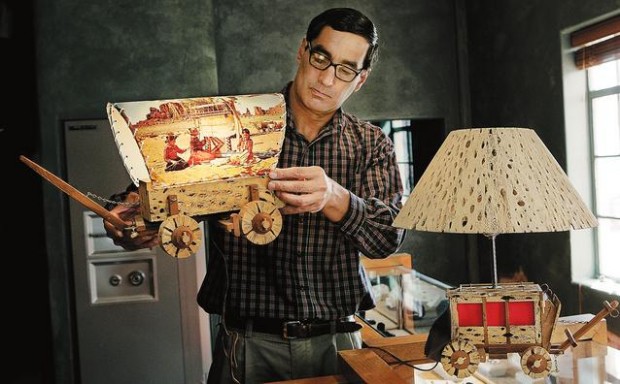
It was, of course, the cholla wood lamp, topped with a pictorial shade flaunting everything from Western scenes to Niagara Falls.
Niagara Falls?
"We did scenes for where people lived," says Vicki Velasco, whose father, Carlos Velasco, would, starting in the late '40s, parlay the simple cholla wood lamp into a business that would rack up $1 million in annual sales by 1978, its last year in business.
One-fourth of those sales came from jewelry, the rest from lamps and novelties. Think scorpions encased in bola ties, and do-it-yourself cactus gardens.
And all of it originating right here in Tucson under the name Cactus Craft of Arizona.
People are also reading…
Fact is, there was a time back in the early '50s when you could hardly walk into a Woolworth's without seeing those cholla lamps, some featuring Carlos Velasco dressed up like Daniel Boone or Davy Crockett on the lampshade.
Later, the lamps were marketed mainly as kits, sold everywhere from curio shops to truck stops. "It made easy packing for travelers," says Jeff Velasco, Vicki's brother.
Born in Tucson and reared in Nogales, Ariz., Carlos Velasco met his future bride, Barbara Leppelman, while both were enrolled at Stanford University.
It was after the newlyweds moved to Arizona in 1948 that Barbara spied her first cactus lamp, shaped like a wagon, at a gift shop in Tucson.
Soon, Carlos had quit his job with a local engineering firm and the couple drove around Arizona to see who else was making this sort of lamp.
Finding little in the way of competition, they bought their first business, a tin shack with dirt floors on North Oracle Road near Grant Road. In 1950, they moved to a new location just blocks away.
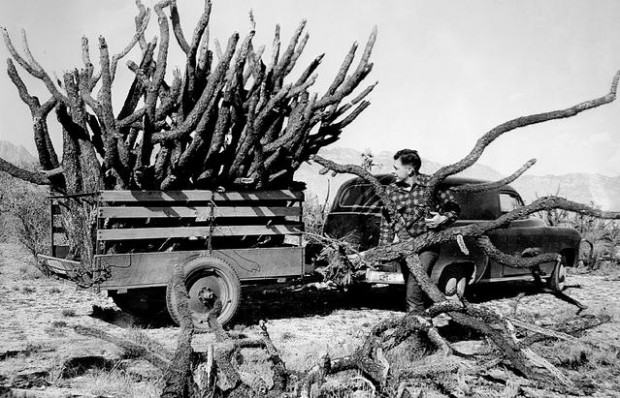
To get the raw materials for his lamps, Carlos collected cactus around town, getting permission from ranchers, and even harvested dead cholla as far away as San Manuel.
"Dad had an old truck. Later on, he would have three big cattle trucks to haul the wood," says Vicki.
After the wood was delivered, it was cleaned inside a huge tumbler, soaked in chlorine and water, then put on racks to dry outside.
In 1955, the Velascos' second shop burned after the cafe next door caught on fire.
At the time, they were already planning a move to a third location, this time on East Hardy Drive, near East Fort Lowell Road and North Alvernon Way.
It was here, says Jeff, where the business really took off. This was also where Carlos, ever the engineer, developed the kits.
"We sold tens of thousands of them," says Vicki, who like Jeff, their grandmother and great-aunt, all worked on the assembly line.
Every kit display sold in stores also featured one assembled lamp, possibly for inspiration. "When I was 4 and Jeff was 5, we laced shades," says Vicki.
Both parents also worked in the business. "My dad's philosophy was hands-on," says Jeff. "He would do everything from work the drill press to pack the boxes."
More than mere pedestals, many of the lamps were designed to become stagecoaches, water wells, and wagons with Conestoga shades, with prices ranging from $3 to $20.
Meanwhile, smaller pieces of cholla were turned into everything from ashtrays to pencil holders.
A core group of 25 or so employees stuck with the business throughout most of its existence. "There were also national sales reps all over the country," says Vicki.
"Dad's territory was Las Vegas," says Jeff, who remembers stopping at all the curio shops on the old Route 66.
As a student at the University of Arizona, Jeff also served about 50 accounts in Tucson, ranging from Indian Village Trading Post to the Arizona-Sonora Desert Museum.
"I sold kits and jewelry," says Jeff, who now owns Viir Jewelers in Tucson.
In later years, Cactus Craft got into jewelry, particularly tumbled stones. "I still see people wearing it," says Vicki.
In 1978 the Velascos sold the business. It burned just a year later. Carlos died in 1982.
Today, you can find cholla lamps on the Internet, plain, simple things selling for $80 or so.
Jeff has also spotted his father's lamps in old movies, as well as the 1970s television series "Petrocelli," which was filmed in Tucson.
Finding one you can hold in your hand is another matter.
"Once in a while, I'll see one in a curio or antique store," says Jeff. "But I know it's not Dad's. His were refined."
collectible cactus