

Monday, May 25, 2020. The internet exploded with a viral video of an African American man lying on the ground, hands cuffed behind his back, a police officer with his knee on his neck, and the man saying “I can’t breathe.” I couldn’t believe what I was seeing. This man was begging for his life, and the man killing him looked as though it really didn’t matter. Worse yet, three other police officers not only witnessed the killing but did nothing to preserve the life of another human being. He cried for his mother and I heard Mr. Floyd say “I’m through.” He probably knew that he would die on that street. What an image. As the nation awakened to the horror, people all over the country began to protest. Please understand that no pastor condones the rioting and looting that accompanied the protests, and neither does the family of Mr. George Floyd. This tragedy ripped the bandage off a wound not yet healed. Our nation is increasingly divided, racism is still an issue. Today, Jesus tells us a parable (Luke 10:30-37) that addresses the issue of how to treat people. Parables are stories (that the hearer would understand) that reveal a previously hidden mystery of the kingdom of God. In this parable, a man was robbed and left half-dead by the roadside.
People are also reading…
The Religious Rejection
The first to pass by was a priest. He was the religious representative. He ministered to God and served the people. It was his job to share the word of God with the people and to explain God’s principles to man. He should have been concerned. Maybe he was afraid, maybe he didn’t want to get involved. Maybe he just did not care. The Apostle John says that love is of God and God is love, yet the representative of God did not demonstrate love. Today the people of God cannot remain silent when we see evil. When we see injustice, when we see inhumanity, we must speak up.
Protesters laid in the road for 8 minutes and 46 seconds in symbolic protest of the death of George Floyd.
The Family Failure
The man was Jewish. Jesus makes sure that the hearers understand the ethnicity of the man. He is Jewish. Jesus is making a point. The first passerby neglected his religious obligation to be concerned about his brother. The second was a Levite. This man should have been concerned because of his relationship. The tragedy that has plagued this nation for hundreds of years is (from my perspective getting worse). It is not just a racial problem anymore, it is a crisis. Like the priest and the Levite, far too many are content to watch injustice and refuse to get involved. The church should be on the front line, fighting for justice, fighting for equality, fighting for humanity.
Finally
Jesus used a Samaritan (the most despised type of person to Jews). He intervened, helped the man, and took responsibility for the man. The church, the people of God, must see every man regardless of race, religion or creed as our neighbor. We are all part of the same race, the human race. After the funeral, after the protests, remember I’m still your neighbor.
Photos: Sunshine Mile (Broadway) in Tucson
Sunshine Mile in Tucson

Hirsh’s Shoes was built in 1954 and is one of 29 buildings in the district designed by architect Bernard Friedman’s firm.
Sunshine Mile in Tucson

Hirsh's Shoes, 1954, on the Sunshine Mile (Broadway Road) in Tucson.
Sunshine Mile in Tucson

Hirsh’s Shoes at 2934 E. Broadway, in Tucson, circa late 1950s (courtesy Hirsh’s Shoes) and in 2016 (Mike Christy / Arizona Daily Star).
Sunshine Mile in Tucson

The distinctive Chase Bank at Broadway and Country Club was once a Valley National Bank. It was designed by Don Smith of Friedman and Jobusch Architects in 1971.
Sunshine Mile in Tucson

Construction workers build the Valley National Bank on the northwest corner of East Broadway Boulevard and North Country Club, on March 18, 1971.
Sunshine Mile in Tucson

Valley National Bank, 1973, on the Sunshine Mile (Broadway Road) in Tucson.
Sunshine Mile in Tucson

The Welcome Diner, built in 1964 as Sambo’s Pancake House, is on the western end of Tucson’s historic Sunshine Mile.
Sunshine Mile in Tucson

Solot Plaza on the Sunshine Mile (Broadway Road) in Tucson.
Sunshine Mile in Tucson

Kelly Building, built in 1964-65, on the Sunshine Mile (Broadway Road) in Tucson. Architect: Nicholas Sakellar
Sunshine Mile in Tucson

View from Country Club Road on the Sunshine Mile (Broadway Road) in Tucson.
Sunshine Mile in Tucson

Store in the Solot Plaza, built in 1958, on the Sunshine Mile (Broadway Road) in Tucson. Architect: Nicholas Sakellar
Sunshine Mile in Tucson
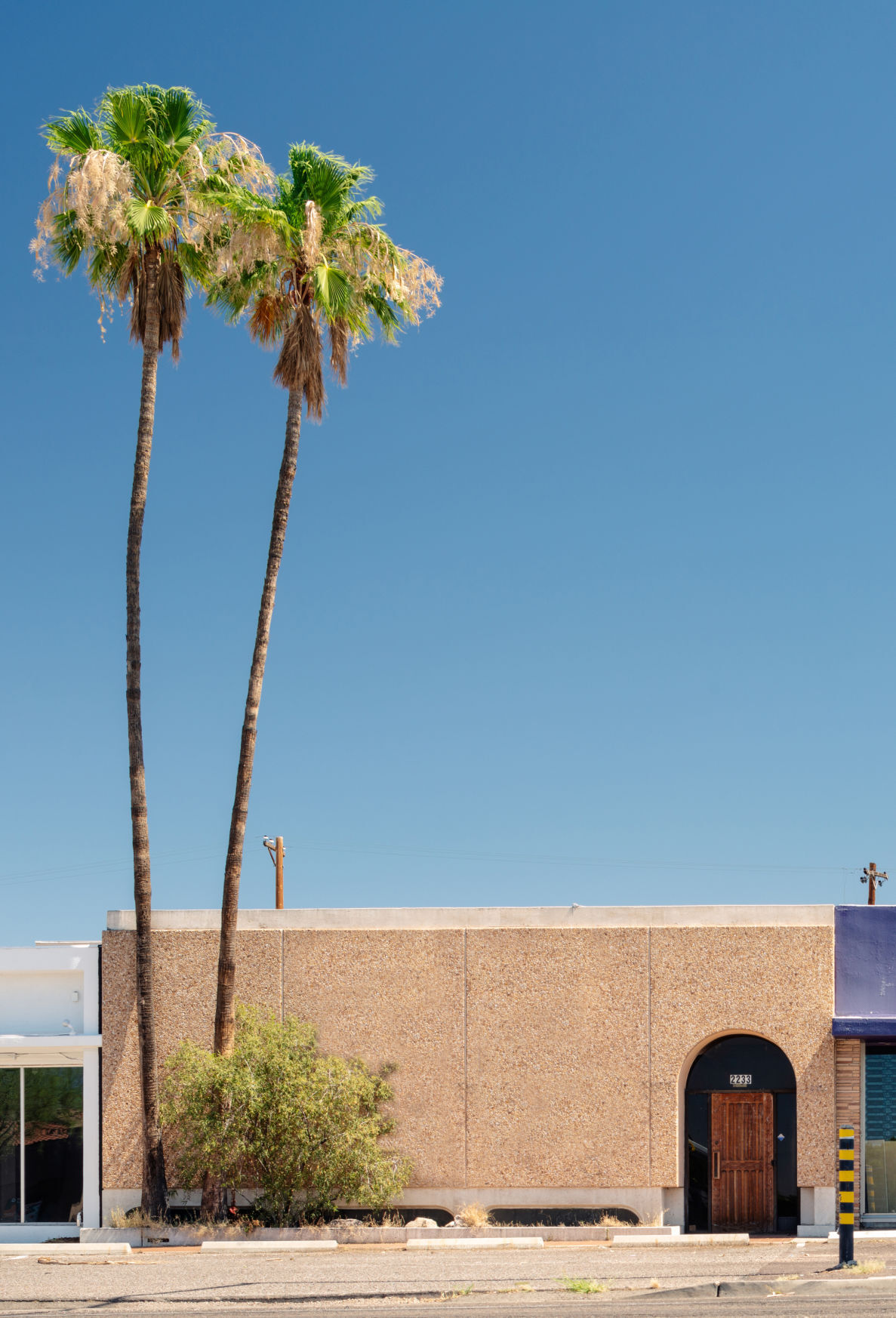
Friedman and Jobusch Office, built in 1950, on the Sunshine Mile (Broadway Road) in Tucson. Architects: Friedman and Jobusch
Sunshine Mile in Tucson

Old Pueblo Medical Group, built in 1965, on the Sunshine Mile (Broadway Road) in Tucson. Architect: Cain, Nelson and Ware
Sunshine Mile in Tucson

American Evangelical Lutheran Church, built in 1954, on the Sunshine Mile (Broadway Road) in Tucson. Architects: Jaastad and Knipe
Sunshine Mile in Tucson

Arizona Auto Refrigeration, built in 1951, on the Sunshine Mile (Broadway Road) in Tucson.
Sunshine Mile in Tucson

Old Tucson Jewish Community Center, built in 1953, on the Sunshine Mile (Broadway Road) in Tucson. Architect: Bernard Friedman
Sunshine Mile in Tucson

Anne Rysdale was Arizona’s only female registered architect when she developed and built the Haas Building in 1957.
Sunshine Mile in Tucson

A public workshop will be held May 18 from 9 a.m. to noon at First Assembly of God church, 1749 E. Broadway, to gather public reaction to a report on transforming the Broadway corridor into a public space as the city widens a portion of the street to six lanes.
Sunshine Mile in Tucson

The Chase Bank at 3033 E. Broadway Blvd. is one of several architectural distinctive buildings along the Sunshine Mile.

The Reverend D. Grady Scott
