

When new students pepper Mary Catherine Habeck-Leighou with questions about her wheelchair, she gives them a choice: the fun story or the serious story.
In the fun story, she is a “National Geographic” photographer snapping photos of the crocodiles in Africa. “Dang it!,” she exclaims. “I got too close.” A croc chomped her legs.
The serious story — the true story — gets glossed over. It’s too scary. Too close to home.
“I say, ‘Germs got on my legs, and they wanted to be my friends, and I didn’t want them to be my friends,’” Mary Catherine, 54, says. “All the medicines wouldn’t make them go away, and the doctors finally said, ‘If we want to save your life, we have to amputate.’”
For 15 years, she has refused to let the amputation of her legs stop her life. In May 2007, the Star’s Bonnie Henry shared her story with readers. Now a part-time Spanish teacher at Khalsa Montessori School, Mary Catherine is busier than ever.
People are also reading…
“I have chosen to rise to the occasion, because, darn, I’ve got a lot of years left,” she says. “OK, I can’t do everything, but I’m not always sitting at home eating bonbons and watching the soap opera.”
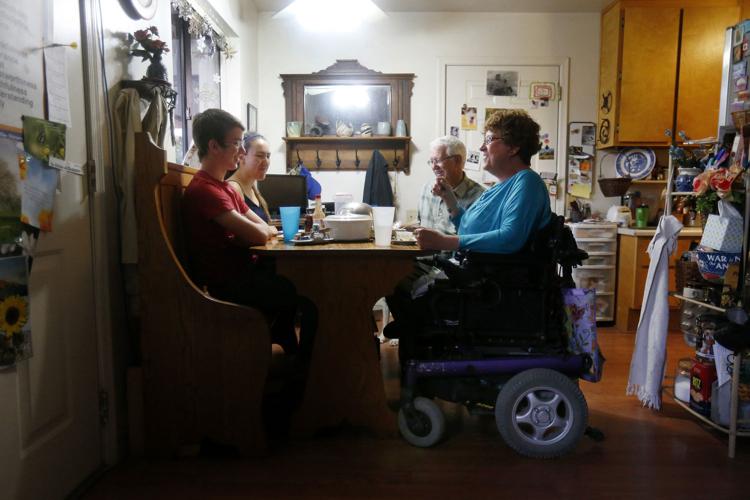
Besides teaching first- through third-graders at both Khalsa campuses, Mary Catherine sings in the choir at the Unitarian Universalism Church of Tucson, mothers her two teens, gardens, takes 5- to 10-mile rides on her handcycle, swims, sews and camps with her family almost every summer.
“Considering she is in a wheelchair, she comes across as, ‘It’s there, but it’s not my whole life,’ ” says Denyse Matthews, Mary Catherine’s older sister, who lives in Indiana. “She has a zest for life.”
•••
Last summer, Mary Catherine, her dog Snoopy and her daughter Clarissa Leighou took a 7,000-mile, seven-week road trip to visit family — she is one of nine children — in Michigan and Montana. They camped along the way, Clarissa in a pup tent and Mary Catherine in the family’s 1997 GMC Safari.
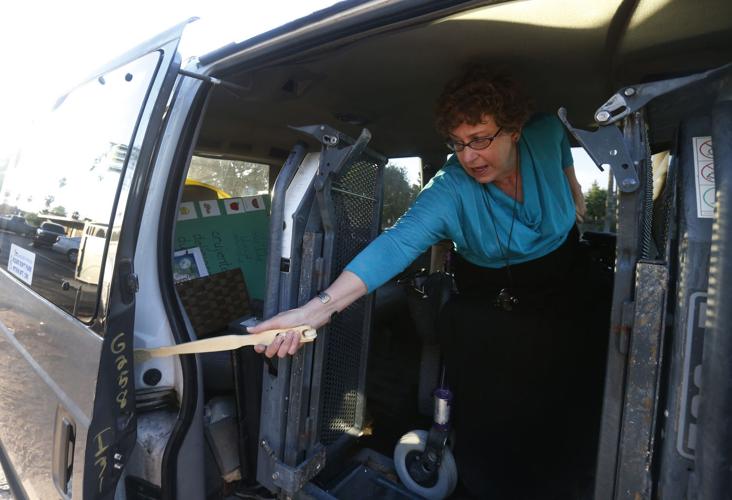
That van, with its wheelchair lift, hand controls and other custom features, has been Mary Catherine’s ticket to freedom since 2004, when the family got it used.
“It is her legs, it is her mobility,” says Toni Jo Mataczynski, an occupational therapist and friend of Mary Catherine’s.
On the cross-country trip, the van — with 214,000 miles behind it — needed multiple alignment fixes. The motorized door burned out and was secured with a bungee cord for the trek back to Tucson. The low ceiling forces her to bend her neck, a strain since she broke part of her back in a college car crash.
“I have to save the integrity of my body, and what’s left,” she says.
To accommodate both her disability and her adventure-loving spirit, one of her brothers started a Fundly.com campaign to raise money for a new van. He recently put in the order. They estimate the cost to be at least $45,000 — $35,000 for the vehicle and about $10,000 for the custom features. So far, the campaign has raised more than $29,000.
Mary Catherine calls her family’s income the “Medicaid and Medicare dance.” They balance that income with her husband David Leighou‘s adjunct faculty position at Pima Community College and her own teaching job to ensure that David and their children have health insurance.
•••
For months, Mary Catherine couldn’t even pronounce the name of the Group A Strep bacteria — or “flesh-eating bacteria” — that claimed her legs and almost her life. Necrotizing fasciitis.
“I was one in a million to get it, and 10 to 20 percent to survive it,” she says.
At the time, the family was living in Flagstaff. The bacteria entered her body when she got a splinter. She remembers one drop of blood. Days later, she was in a local hospital and then flying through a snowstorm to Phoenix on a jet. In six weeks, she had 24 surgeries. She was away from her family for seven months.
Clarissa, now 18 and headed to Northern Arizona University in the fall, was 2. Colten Leighou, now 16 and a student at The Gregory School, was just 8 months old. For them, she fought for life and squashed brief thoughts of suicide.
Clarissa has little memory of her mother with legs: “She has always been that way to me,” she says. “Oh yeah, my mom, my normal, legless mother. It’s not like super weird.”
But David remembers. He remembers caring for their children while his wife was in a coma. He remembers his fears about quality of life when he thought she would lose arms and legs.
“It’s never been easy and never will be easy,” he says. “We don’t know what it’s like being in a wheelchair ... but there are so many things that she has done, like swimming and riding a bike.”
•••
Being an inspiration is exhausting.
Sometimes, Mary Catherine drops something she can’t reach or slams her head against the car ceiling. Getting into her car takes multiple steps.
“Life in a wheelchair has not been kind to my body,” she says.
Sitting all day means her back is starting to curve. A recent bone density test “was not good news,” especially for her hips, she says. Her shoulder hurts constantly, compensating for an elbow that doesn’t work properly. She fears surgery, adding, “This is how I move around.”
And yet she still laughs.
Wheelchair mishaps become comedy fodder. She grins as she relays a bit she did on her skirt catching in her wheelchair at a wedding. Instead of tearing the skirt, she shimmied out. The minister walked by. Together, the women saved the skirt.
“I have unusual things happen to me that you wouldn’t normally have happen in your life,” she says. “At the time, they’re extremely frustrating, but then I can laugh about
it, because I was safe, I
got through it, and somebody else had a good laugh, too.”
•••
Mary Catherine has her eyes on another summer road trip, and if the kids don’t find jobs, they’re coming with her. Otherwise, she hopes to travel with Snoopy.
“I was definitely roped into it,” Clarissa says of last year’s trip. She made a Powerpoint outlining the reasons she should stay home. “My mother was like, ‘That’s so cute. That’s funny that you would try and get out of this.’ ”
Mary Catherine dreams of a trip to Alaska when she and David celebrate their 25th wedding anniversary next year. She calls the outdoors her “spiritual temple” and has ridden 36 miles in El Tour de Tucson three times. About five years ago, a disabilities nonprofit helped her go on a ski trip.
“She was always very free-spirited,” sister Denyse Matthews says. “Now I think she strives to be even more so because she is limited to a wheelchair.”
To Sally Withers, a friend she knew before she lost her legs, Mary Catherine once suggested teaching together at a South American Montessori school in the summer, exploring wheelchair-accessible beaches.
She and friend Mataczynski have mulled over opening a bed-and-breakfast or travel agency for people with disabilities.
For now, she’ll stick to her adventures as a road warrior.
She laughs: “It doesn’t cost anything to dream.”
Contact reporter Johanna Willett at jwillett@tucson.com or 573-4357. On Twitter: @JohannaWillett

Johanna Willett | This Is Tucson
Reporter
