

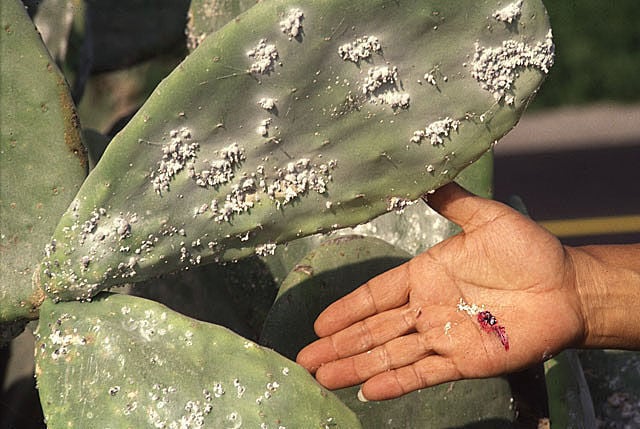


Q: I have a prickly pear with an increasing number of chalky-white splotches forming on the pads. Is this a fungus? Can it be treated? Should I just get rid of the plant? (It isn’t very big).
A: What you are seeing is signs of cochineal-scale insects (Dactylopius coccus) on your prickly pear cactus (Opuntia species). These insects produce a white waxy covering where they feed to protect themselves from predators and the environment. It can be treated with insecticides including a 1 percent solution of horticultural oil, but treating it is optional. Depending on how bad the infestation has grown, you can also leave it alone, hose it off, or in extreme cases remove infested pads. It may spread to nearby prickly pear cacti so doing nothing has its risks but the damage is usually minor.
These insects are endemic to our region and fairly commonly seen on these cacti. The interesting use of these scale insects to produce a red dye might make you think twice about keeping them around. The traditional use by indigenous people was for dying fabric. Other enterprising people later used it as a dye in things such as cosmetics and food. For some reason, not everyone likes the idea of eating insects, so they don’t usually call it that on the food or lipstick labels.
People are also reading…
Q: Tiny black insects are making lace out of the leaves of my Yellow Bells. I spray with Sevin twice a day but it has had no effect.
A: The tiny black insects are actually the frass (aka poop) from tiny caterpillars. These caterpillars are sometimes called the Tecoma leaf tiers or sesame leaf tiers (Antigastra catalaunalis) due to the way they wrap themselves in leaves with their silk when ready to pupate. Before that happens they chew on the top leaves, the new growth, of Tecoma stans (yellow bells). Sevin should work on these caterpillars although applying it twice a day seems like way too much. Please check the label to see how often they recommend spraying. I am surprised it isn’t working. You might be spraying at a time when they aren’t active or in the line of fire. Sevin is a nerve poison that works when contacted or eaten so the caterpillars need to be present at the time you spray or soon after.
The unfortunate thing about Sevin is that it is toxic to beneficial insects including honeybees. Another insecticide you can use instead is Bt (Bacillus thuringiensis). This insecticide, sometimes sold as Dipel, can be sprayed on the leaves in the area where they are feeding.
The nice thing about Bt is it won’t harm other insects that might help you by eating the caterpillars.
Q: Attached is a picture of a barrel cactus in our yard that has begun to turn brown in recent weeks. This is the third one to do this in the last six to 12 months. What might be causing this and what can be done to prevent it? Is there any hope of salvaging a barrel once this begins?
A: It looks like an internal soft rot caused by species of Pythium, a soil borne pathogen that is favored by moist conditions. Pythium species can cause root and/or crown rot if plants are placed in the ground too deeply when transplanted or are wounded and then over-watered.
If a wound occurs before or during monsoon season, it could become infected through exposure to rain water carrying the pathogen. If you plan to replace this barrel with another, please keep in mind that barrel cacti should be planted so that the roots are placed firmly in the soil but no soil is placed around the base of the plant. Since the rot is internal, it is often too late to treat cacti once disease is detected. The best prevention is proper planting and watering.
Q: My neighbor and I planted an ash tree about a year and a half ago and it appears to have done well. However, now I’m noticing that its leaves are browning distally. Can you tell us what may be occurring here and thoughts on a remedy?
A: The symptom you are seeing is often due to lack of water and salt buildup in the root zone. Since the tree was planted fairly recently, you also need to consider that the roots are still getting established in the new location. Trees lose a majority of their roots when harvested and transplanted, so it can take a couple three years for the roots to grow back and for the tree to resume normal growth. The therapy for both of these situations is infrequent deep watering.
Ash trees naturally grow near water and in a desert landscape they need a good soak to a depth of 24 to 36 inches every two weeks during the summer and every three weeks in the spring, fall, and winter. If it hasn’t been getting this much irrigation, that is likely the problem.
Peter L. Warren is the urban horticulture agent for the Pima County Cooperative Extension and the University of Arizona. Questions may be emailed to


