

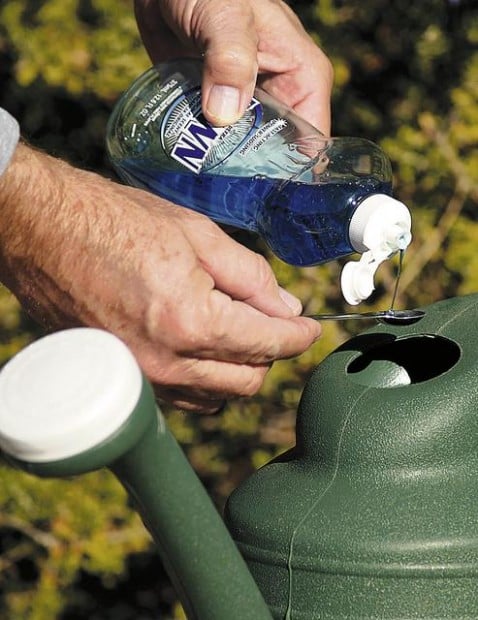
Soap isn't just for washing dishes anymore.
It's a very important tool for gardeners — one of the best controls for a number of common plant and garden pests. It also can be used to make water "wetter," thereby improving the effectiveness of herbicide sprays and overcoming the water-shedding properties of hydrophobic soils.
Controlling garden pests
As an insecticide, soap's properties are well-known.
Commercial insecticidal soaps such as Safer have been developed specifically as a biorational control for a number of bad bugs, including aphids, mites, white flies, thrips, lace bugs and mealy bugs.
(Biorational pesticides have little or no adverse effects on the environment or beneficial organisms.)
Although insecticidal soaps are designed specifically for insect control, household dish-washing soaps also are very effective in controlling the same pests.
People are also reading…
Of all the household dish-washing detergent brands, Dawn is said to have the best insecticidal properties. Other brands also will be effective, but avoid lemon-scented soaps because, potentially, they could injure plant leaves and flowers.
A mild soap solution is all that's needed to take care of pesky bugs.
Mix one tablespoon of liquid dish-washing soap in one gallon of water. Or, for smaller jobs, mix a half teaspoon of soap in a pint spray bottle of water.
Be sure to spray both the top and bottom sides of the leaves. Repeat spraying weekly until your insect problem is under control.
In addition to controlling many pest insects, soap sprays also will remove the varnishlike honeydew secretions aphids, mealybugs and whiteflies deposit on leaves. After the affected leaves have been sprayed and dried, wash off the secretions with a strong spray of water, using your garden hose attachment.
The soap loosens the honeydew coating, and the water floats it off the leaf surface.
Making water wetter
Soap also is a surfactant — a wetting agent that helps water spread out evenly over the leaf surface. As a result, a small amount of soap mixed into herbicide or fungicide sprays increases their effectiveness.
In the case of herbicides, that means more of the active ingredient is absorbed by the weed, enhancing the killing action.
With fungicides, better coverage increases the effective shield created to prevent fungal spores from penetrating the leaf surface.
Only a few drops of liquid dish-washing detergent are needed in a gallon of herbicide or fungicide sprays.
To reduce foaming, add the soap after filling the sprayer with water. Then, gently agitate the sprayer to disperse the soap.
Hydrophobic soils
The wetting properties of soap also are useful for soils that become hydrophobic. That is, they shed water and are difficult to thoroughly wet.
This often occurs in mostly peat container potting soils. If the peat gets too dry, it tends to repel water and shrink.
So, when these soils are watered, they may look like they're absorbing the water, but in reality the water is just running down the gap between the pot edge and the shrinking soil.
To wet hydrophobic soils, add several drops of liquid dish-washing soap to a watering can filled with water and slowly apply to the soil.
The soap breaks the dried soil's surface tension and allows the water to be absorbed. If the hydrophobic condition redevelops, treat it again.
Hydrophobic soils also develop in lawns, and the solution is the same: Use household dish-washing soap.
See video of John P. Begeman demonstrating how to tell if your plants need to be repotted at azstarnet.com/athome.