


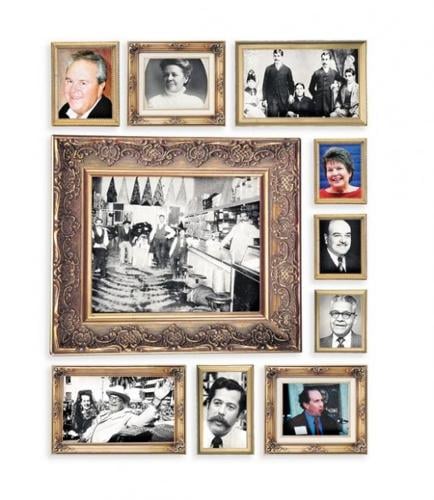
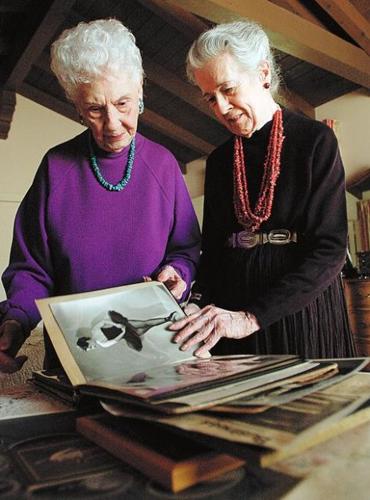
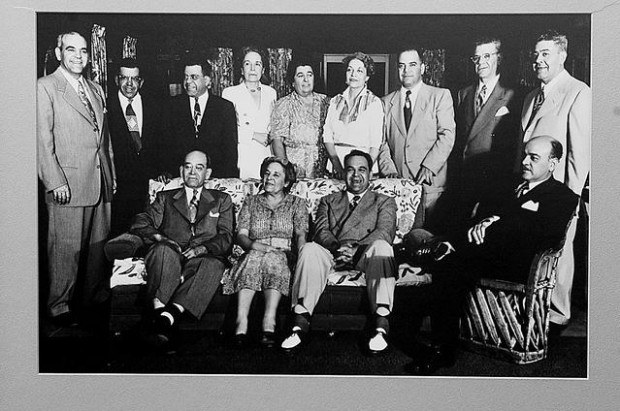
The Jácome family connects with Tucson through thousands of one-on-one relationships — one reason the family's influence endures, a generation after its namesake department store closed Downtown.
In its heydey, Jácome's Department Store was the place to shop Downtown for beautiful clothes and one-of-a-kind imports. Movie stars, politicians from Arizona and Mexico, prominent families and regular folks patronized the store, all welcomed at the door by founder Don Carlos Jácome and his family.
The Jácomes evolved as Tucson grew up from a desert trading post to a city of almost a million residents. The clan now numbers around 145 and stretches across the country.
In Tucson, the Jácomes were, and still are, active in the Roman Catholic Church, the arts and civic affairs. Family members helped form the volunteer auxiliaries at St. Joseph's and St. Mary's hospitals, as well as the Catholic Newman Student Center at the University of Arizona.
People are also reading…
The Joel D. Valdez Main Library now stands where the family department store operated for so many years. The nearby plaza, now known as Jácome (HAH-coh-meh) Plaza, is a gathering place for community events.
"My parents were of the philosophy that the city shouldn't be thanking us, we should be thanking the city for being so supporting of us," said Tina Jácome, granddaughter of Carlos Jácome, who opened the original store 110 years ago.
The family's history in Tucson begins more than a century ago when a young Carlos Jácome moved with his mother to the small Arizona territorial town after the death of his father in Magdalena, Sonora.
With that decision in 1879, Mariana Corella Jácome sowed the seeds of a relationship that would span the two countries and help strengthen Tucson, the family's new home. Generations later, the Jácomes continue to build on those ties.
Carlos Corella Jácome was born April 8, 1870, in Ures, Sonora, to Mariana and Ramón Jácome.
Mariana, who'd lost three husbands, decided to leave Mexico and in 1879 headed to Tucson in the hope of better opportunities.
Carlos attended grade school in Tucson but left after just three years. Mariana needed him to help support the family. He took a job ferrying mud at the construction site for one of the adobe buildings going up. He quickly caught the notice of Isadore Mayer of the Mayer and Brothers store, who hired him to be the business' cash boy. Instead of mud, Carlos would ferry money between customers and cashiers. It was there, by observing the business from the inside, that he began to learn the art and trade of retail.
After two years, he went to work with L. Zeckendorf and Company — the predecessor of his later competitor, Steinfeld's Department Store — as a clerk. He stayed for 15 years.
Back in Ures, Sonora, a self-sufficient woman named Trinidad Montijo Germán decided to leave her home for the gold of California. When she returned, she wasn't rich, but she brought home enough money to make a new start in a town she'd visited as a girl, Tucson. She took her daughter, Dionicia Germán, named after the baby's grandmother, and moved north to the United States.
In Tucson, she bought the best land she could afford and paid with 20 gold pieces worth $20 apiece.
"It was outside the Presidio wall and across the street from the cemetery," said Estela Jácome, widow of Alex G. Jácome, the president of the department store for much of the last century. "People told her it wasn't safe because the Indians were raiding. It was what she could buy."
The land, on Stone Avenue, proved to be a good investment. Dionicia married Carlos Jácome, and the family eventually built a home on the land. The building still stands, now an office at 271 N. Stone Ave.
Carlos Jácome and Dionicia Germán, the two branches of the family that would become the Tucson Jácomes, had taken root. Carlos and Dionicia started a family that would grow to include four girls and nine boys: Anita, Sara, Josephine, Rose, Carlos Jr., Henry, Ramón, Juan, Frank, Alex, Arthur, Richard and Augustine.
By 1896, Carlos had become business partners with his good friend Loreto Carrillo. They opened La Bonanza dry goods store on Congress Street.
After the turn of the century, Carrillo sold his interest to Genaro S. Manzo — also a native son of Ures, Sonora — who soon after sold his share to Carlos. It was the beginning of what would become Jácome's Stores Inc.
Carlos prized the personal touch. He learned English and Pagago, as the Tohono O'odam were known then, so he could communicate with all of his customers, said granddaughter Tina Jácome.
"Don Carlos was a very courtly gentleman," said Estela. She married Alex, the 10th child, in 1934 when she was 18. Her family, the Valles, who moved to Tucson from Argentina via California, were customers and friends of the Jácome family long before she and Alex fell in love.
"He would greet customers at the door," she said. "It was like he was bringing them into his home. He was a tall, very handsome man with blue eyes."
Photos of Don Carlos show his full mustache, a trademark carried on by his grandson, Alex Jácome Jr., Estela's son.
Many of the customers were ranchers and miners, families who relied on Jácome's and paid their bills twice a year.
"Back when my grandfather started the store, there were tough times," said Henry Jácome Jr., a grandson who eventually ran the store with his cousin Alex Jr. "He let people buy things on a handshake."
Often, especially during the Great Depression, customers couldn't pay for their purchases in cash. Jácome's carried them. Don Carlos knew that when things improved, as they did, those customers would be customers for life — and they were.
Don Carlos was more than a retailer. He was a confidant to many of his customers, who sought his counsel on personal matters. He was active in Arizona's formation as a member of the committee that in 1910 drafted the state Constitution. When he died in 1932, flags across Arizona flew at half-staff. Don Carlos was mourned by friends on both sides of the border.
In 1926, Don Carlos' wife, Dionicia, died while playing cards with friends. Dionicia's mother, known then as Doña Trini, stepped in to help raise 13 grandchildren.
Doña Trini wasn't one to be trifled with, said Margot Jácome, who married Carlos and Dionicia's son Augustine, known as Teen, in 1934. Margot and Teen were both students at the University of Arizona when they eloped to Phoenix.
"She was very tiny," Margot said. "She kept all her booze in her steamer trunk so the boys wouldn't get it."
In a family with so many sons, Doña Trini had her own way of keeping track of everyone, especially new girlfriends and boyfriends.
"She never did learn to speak English really fluently, but she had the cutest way," Estela said. "She never asked who you were; she asked whose you were. It rather put us in our places, too."
Back when the family was still growing up, the Jácomes moved to a house on Seventh Avenue, where the children lived until they married. The boys occupied the second floor.
"All the boys lived at home and they all lived in the 'lion's den,' " said Henry Jr., recounting stories he heard from his father and uncles. "All the beds were up there.
"You get a lot of boys, they're going to find trouble wherever they could," he said. Space was so tight that the boys would lay out their trousers on their bed frames and put the mattresses on top, storing the clothing and keeping it flat and pressed for the next day, said Margot. The boys were proud of dressing smart and knew it was a reflection on the family business.
"They were meticulous," Tina said. "They all dressed like Beau Brummel, with hats and gloves."
The Jácome women held their own. The four sisters helped care for their brothers and were "all very strong characters" who set the bar quite high, Estela said.
"When you joined this family, you did a lot of apologizing for your cooking," she said, laughing.
Many of the Jácome women volunteered with church organizations and other civic groups while raising their families. One sister, Sara Jácome Parker, played the organ for years at Holy Family Catholic Church Downtown and led family singalongs. They were involved in the Catholic Church and schools, in the Newman Catholic Student Center at the UA, the Arizona Historical Society, the Arizona State Museum and local hospitals.
After Don Carlos' death in 1932, the family voted Alex as president, partly because he was the only one with a college degree, said his nephew, Henry Jr.
As a little boy, Alex followed his father Carlos around so closely that he earned the nickname "the Shadow." But he didn't plan to follow his father into the family business. "He was interested in the diplomatic service," said wife Estela, now 91.
Alex took the responsibility seriously. "He carried the weight of the family on his shoulders — and the store," said Alex Jr. "You can imagine the politics that occurred at the store, let alone in the family."
Each brother contributed something to the store. Henry ran the menswear department, and Teen took over ladies wear. Richard ran the store operations. All of the children worked at the store at some point in their lives. Some left retailing, but they remained stockholders in the company.
The melding of family and business led to some ground rules. "One of the rules was that no in-laws could work there," Alex Jr. said. "Dealing with blood relatives is hard enough."
In 1951, Jácome's moved to a large property Downtown at Stone Avenue and Pennington Street. The family made sure the new store reflected its community, commissioning Mexican artist and bullfighter Salvador Corona to paint beautiful framed murals. Artist Edith Hamlin Dixon Dale created two large art pieces to hang on the outside of the new store, and the image became the trademark for the store. Tina Jácome donated the pieces to the city, and they now hang at the Tucson Convention Center, one at the west entrance and the other outside the Leo Rich Theatre.
The 1951 move made national news because Harold Steinfeld, who also owned a department store Downtown, built the store and leased it to the Jácomes. The idea, which was revolutionary at the time, was that clustering similar businesses together was good for them all. And it was, for a time.
Jácome's catered to Tucsonans, but also to wealthy Mexicans, customers who could travel anywhere in the world to shop. Alex made sure it was easy for the Mexican nationals to do business at the department store. Customers could exchange pesos for dollars at every cash register at the daily rate, and every department had at least one bilingual employee, he said.
"He was Tucson's unofficial ambassador to Mexico," said Alex Jr. of his father. The elder Alex was officially named an honorary vice counsel to Mexico and represented the United States at an international conference on Indians of the Americas held in Bolivia. He also represented the State Department on a trade mission to Spain.
Like his father, Alex Jácome cultivated personal ties and eventually became the person Mexican families told their children at the University of Arizona to call if they needed help. "We took them to doctor's appointments, lent them money, arranged weddings," Estela said. "It evolved. He became a godfather to all of the Mexican students at the University of Arizona."
But as Tucson grew up and out, Downtown began to fade. The retail cluster, which had been so revolutionary in 1951, began to break apart. Stores left the city center for new shopping centers like El Con Mall. Politicians pledged again and again to help Downtown revitalize, producing a stack of plans that never delivered.
The real beginning of the end came in December 1970 when the Pioneer Hotel caught fire and killed more than two dozen people. The Pioneer was the place to be for much of the 20th century in Tucson. It's where Estela Valles and Alex Jácome went on their first date and where most of Jácome's Mexican customers stayed when in town.
Henry Jr. and Alex Jr., who took over the store from their fathers, said many of those killed were friends, not just customers. Friends and business competitors Peggy and Harold Steinfeld, who lived in the hotel penthouse, also died.
The Pioneer Hotel closed in 1974. "Jácome's never quite recovered," Henry Jr. said.
In 1980, Alex Jr. and Henry Jr. made the difficult decision to close the family store. The peso had been greatly devalued, and the financial loss cost Jácome's dearly. The store hung on, but eventually the cousins decided it didn't make sense to fight to stay open. The decision hit the family hard.
Today, Tucson realizes the value of the commercial connections to Mexico, said Augie Garcia, director of the city's Puerta Nuevo office, which until January was the Tucson-Mexico Trade Office with the city.
Several of the Jácome grandchildren, including Tina and Alex Jr., continue to build relationships across the border through the Tucson-Mexico Sister Cities organization.
"You had people like the Jácomes who had an appreciation for the value of the relationship with Mexico, and the new leadership in the community didn't have an understanding of that relationship," Garcia said. Studies show that efforts to market Tucson as a shopping hub are attracting Mexican customers.
Garcia said Tucson is relearning lessons that the Jácome family knew instinctively: that personal relationships take time and effort, but they're worth it. Mexican customers generate $1 million in revenue each day in Pima County, he said.
"This was validating what the Jácomes knew for years," he said.
As Tucson spread out, so have the Jácomes. Family members have gone into teaching, nonprofits, business, sports, music, real estate, finance and public service. They continue to volunteer and strengthen Tucson.
"It's just that way, a love of community," said Ruth Jácome, who married into the clan when she wed Carlos' grandson John Jácome in 1956. He was a firefighter for almost 30 years and now puts on arts and crafts shows, sometimes at Jácome Plaza. Ruth organized the docent program at the St. Augustine Cathedral Downtown.
"I think it was ingrained by Carlos that this is what you do," Ruth said. "And it went down from generation to generation."
Tucson Family histories