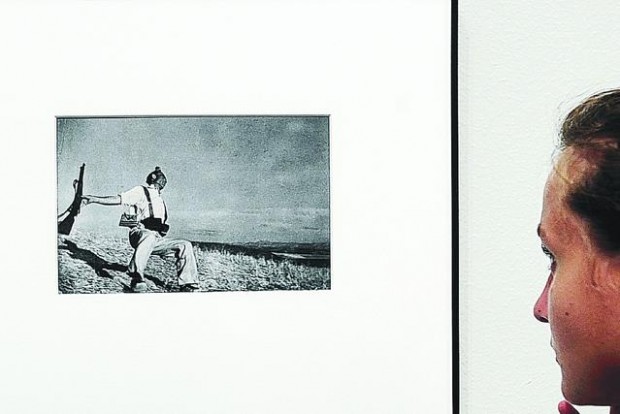
MADRID, Spain — Robert Capa's photograph of a falling Spanish Civil War militiaman became one of the most famous and enduring images of conflict in the 20th century. Now, Spanish researchers who have studied events surrounding the picture believe it may have been staged.
When first published in September 1936 by the French magazine Vu, and later in Life magazine, the caption on the legendary photojournalist's "Falling Militiaman" said it depicted the moment a Republican rifleman was mortally wounded.
The location was given as Cerro Muriano on the Córdoba front, where forces backing Gen. Francisco Franco were engaged in fierce fighting with soldiers loyal to the elected Republican government.
Now, Spanish researchers say that not only was the photograph not taken where Capa said it was, but that the militiaman was most likely not shot, either.
People are also reading…
After studying the photograph and new images released as part of a traveling exhibition called "This Is War" now at Barcelona's art museum, four researchers say the photographs were shot 34 miles away in an area where there was no fighting the day they were taken.
"It quickly became obvious to us that among the new photographs — 34 attributed to Capa, six to his companion, Gerda Taro — there were four that revealed the exact place where Capa had taken the shots," filmmaker Raúl Riebenbauer told the AP. (Riebenbauer made "The Shadow of the Iceberg," a 2007 documentary on the famed photograph.)
Historian Francisco Moreno has taken geographical information in the photographs — the shape of seven hills, the location of two farmhouses and several roads — and found it matched exactly a hillside just east of the town of Espejo.
For Spaniards, "Falling Militiaman" is a searing reminder of a 1936-39 conflict that divided a nation along political lines and cost at least 500,000 lives
Taro was killed in Spain by a tank in 1937. She was 26.
Capa died in 1954 when he stepped on a land mine in Vietnam. He was 42.