

GUARIBAS, Brazil — For generations, the women of this town would trudge more than a mile a day to a spring, wait hours in line, occasionally quarrel when the flow dropped to a trickle, then head home balancing buckets of water on their heads for drinking, cooking and bathing.
That ended two years ago when a water tower went up on a hill overlooking this remote outpost in Brazil's arid and destitute northeast. Now the water flows from taps outside people's homes, and the only line is the one that forms at the town's ATM, to collect about $30 per family for food, courtesy of President Luiz Inacio Lula da Silva.
Small but telling changes such as these, replicated across Brazil's worst poverty belt, are the gains of a "Zero Hunger" revolution promised by Silva — known to all as Lula — and they are helping to drive his likely re-election Oct. 1.
It was promises like Zero Hunger that had investors worried when Silva, a former radical union leader, was seeking to become Brazil's first elected leftist president in 2002. Yet he is managing to deliver while embracing fiscal conservatism and without raising taxes.
People are also reading…
"Thank God for Lula," said Isaias Conrado Alves, a rail-thin bean farmer who lost his crop to bad weather this year but was able to feed his wife, son and two grandchildren with money from the food-stamp-like program. "The harvest was a total loss, and we'd be starving if it wasn't for Zero Hunger."
Shortly after Silva took office, The Associated Press traveled 1,000 miles from Sao Paulo's urban sprawl to this town just beyond the Mountains of Confusion, one of two places Silva chose to launch his anti-poverty program.
Improvements evident
A return visit 3 1/2 years later to Guaribas and towns along the way reveals improvements financed by government largesse and nonprofit groups working with Silva's administration: new squat, brick homes for the poor, and concrete cisterns next to ramshackle houses outfitted with new gutters to collect rain from rooftops for use during the six-month dry season.
Analysts predict Silva could win more than 70 percent of the vote across northeastern Brazil, and his strength is evident along the entire route into Guaribas and throughout the town in campaign signs with his smiling face plastered on houses and businesses. Posters for his opponent, Geraldo Alckmin, barely figure.
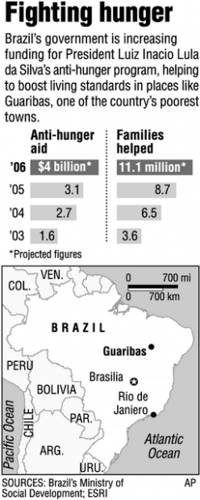
Zero Hunger, a big expansion of a program started by Silva's predecessor, Fernando Henrique Cardoso, is distributing $325 million a month to 45 million of Brazil's 185 million citizens, the government says. The main requirement is that families pledge to keep their children in school.
Alckmin, the center-left former governor of Sao Paulo state, attacks Silva over slower economic growth in Brazil than elsewhere in Latin America and a corruption scandal last year that forced members of his inner circle to resign.
High interest rates to check inflation have indeed suppressed the economy, but even at 4.9 percent in 2004, 2.3 percent in 2005 and a projected 3.2 percent for this year, growth has been strong enough to enable Silva to boost Zero Hunger spending.
The program is so popular among Brazil's legions of poor voters that all Alckmin can do is promise to maintain it if elected.
The World Bank, which loaned Brazil $572 million for anti-hunger efforts, reported in December that "Although the program is relatively young, some results are already apparent, including: efficiency gains, positive impacts on local economies, strong targeting to the poorest, contributions to improved education outcomes, and impacts on children's growth, food consumption, and diet quality."
Program has critics, too
Critics complain the program isn't reaching all who need it, and Marilia Leao, a health expert and consultant to Action for Nutrition and Human Rights, a Brazilian nonprofit group, says long-term investment in health, education and sanitation "haven't grown as much as they should have."
But overall, Zero Hunger is proving a powerful political weapon for Silva because so many voters have benefited or have relatives or friends who are benefiting, analysts say.
In Guaribas, the 26,000-gallon water tower stands five stories tall at the town's entrance, fed by an underground pipe from a well drilled 14 miles away.
About 700 families — 3,000 of the town's 4,800 people — receive the food money, infusing nearly $29,000 a month of new cash into the local economy. Guaribas now has a gas station, two barbershops, two humble hotels and two clothing stores. A pharmacy opened as well, though it lacks some medicines needed by those with dire health problems.
Guaribas has no sewage system and most people lack bathrooms. But the water taps let them bathe as often as they please, even during the six-month dry season when daytime temperatures hit 100 degrees.

 Jim Click’s Tucson dealerships sell for $93 million


