

It was 100 years ago, on June 19, 1915, that the Arizona was launched at the Brooklyn Navy Yard.
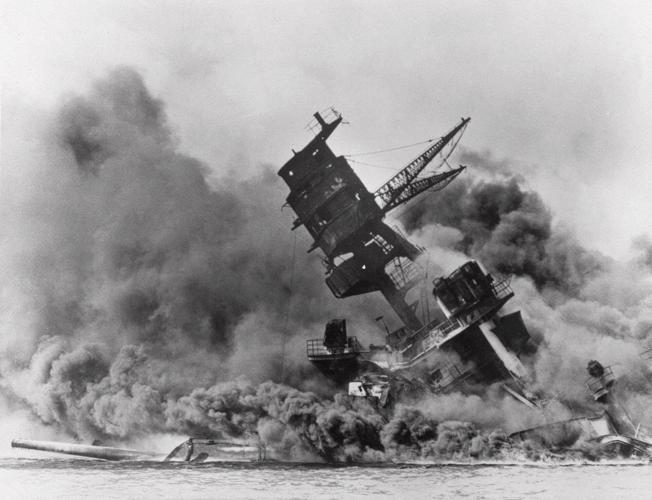
Most of us know its fate, but do we know its beginning?
From the Tucson Citizen, June 19, 1915:
Super-Dreadnaught Arizona Launched Today at Brooklyn Navy Yard
NEW YORK, June 19.—The battleship Arizona was successfully launched at the Brooklyn navy yard at 1:12 o'clock this afternoon. The Arizona shares with her sister ship, the Pennsylvania, the honor of being the world's largest battleship.
NEW YORK, June 19.—The hull of the superdreadnaught Arizona, gay with flags and bunting, is read for launching at the New York navy yard at high tide this afternoon. Governor Hunt of Arizona led a distinguished delegation from the state whose name the battleship will bear.
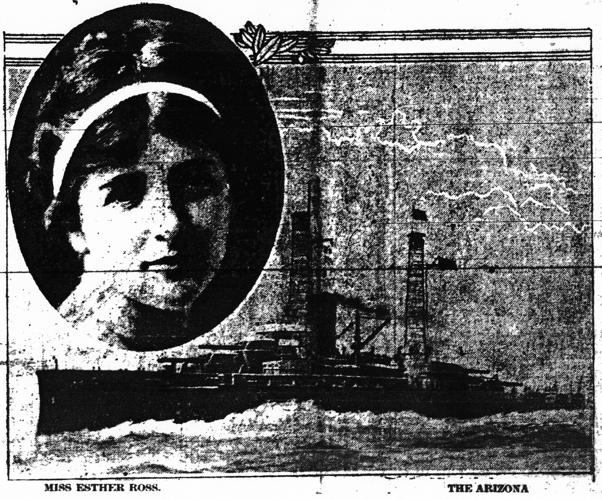
The Arizona party which included Senator Ashurst and Miss Esther Rose, sponsor, brought a carboy of the water first spilled over the Roosevelt dam, for use in the double christening of water and wine.
WASHINGTON, June 19.—Another fifteen million dollars battleship was launched for the American navy today when the superdreadnaught Arizona slid into the water at the New York navy yard. She is a sister ship to the Pennsylvania, recently launched at Newport News and in size and armament one of the largest and most powerful craft ever built for any navy.
Ships of the line, like the Arizona, are built to give and receive punishment in sea battles. Their mission has little in common with that of the battle cruisers which have been the largest ships to engage each other during the European war. Speed is sacrificed in the construction of the battleships to weight of armor and against such a ship as the Arizona with her broadside fire from twelve 14-inch guns and protection of more than a foot of the toughest steel that can be made around the vessel's vital parts like a wall, a battle cruiser would be helpless and must depend on her speed and seek safety in flight. There are few ships in any navy fit to cope with the Arizona ship to ship.
Thirteen-mile Range
The range of the Arizona's guns is from 12 to 13 miles as they will be set in her turrets, or as far as her gun-pointers and observers can see in brightest weather. As previous ships carrying the 14-inch guns, the Arizona's main battery will have a maximum elevation of nearly 20 degrees. It would be possible it is said, to almost double that elevation and add miles to the range of the guns, but already they can shoot and hit farther it is probable they would ever be called upon to do.
The Arizona will carry the three gun turrets which have been developed by American naval constructors, her twelve big rifles being housed in four turrets, two forward and two after. In addition she will have a secondary battery of twenty-two 5-inch long range rifles for defense against destroyers, torpedo boats and submarines. The big guns can be fired over either broadside and around the entire circle with the exception of an arc of less than thirty degrees directly forward for the after turrets and directly astern for the forward turrets. Four of the second battery guns two on each side are so placed that they can fire three degrees across the ship's bows taking the place of bow chasers of the old wooden ship days.
Oregon Like Toy.
Compared to the Arizona the old battleships of the Oregon class are almost like toys. The new ship could engage a fleet of three of them at the same time, turning upon each as many guns as it could bring to bear and her guns would be bigger and of longer range. In addition she would steam away from them or overtake them at pleasure, developing 21 knots against their 16 or 17. The remarkable thing about the great increase in size and gun power, however, is that each of the smaller ships would need as many or more men that the Arizona which will carry a complement of 915 in her crew.
The new sea fortress as she took the water today cost more than seven million dollars. That was for hull and machinery alone. The guns and armor will cost as much more and other equipment necessary to git her for duty will add another million to her total cost. She is longer and wide than any but the newest trans-Atlantic liners. If it is desired to put her through the Panama canal the locks and bends in the channel will be taxed almost to the limit to give her passage way.
The Arizona is the fourth battleship to be built in a government yard and her place on the ways will be taken at once by the California, a larger and faster but similarly armed ship.
People are also reading…
The Citizen's editorial page on the same date touched on the controversy of christening the ship with champagne when Arizona was a dry state. Perhaps some of the sentiments were prophetic, but the deed was done nonetheless.
THE CHRISTENING OF THE ARIZONA
The hull of what will eventually be the great superdreadnaught, Arizona, now rests upon the waves and Governor Hunt and the launching committee have done their duty. The controversy between those who favored using champagne at the christening and those who wanted only water broken over the bow of the latest addition to the navy was settled in favor of the former and a tradition of the navy upheld.
It certainly looks out of place to christen with wine a warship named after a dry state. About the only reason given for using champagne was that seafaring men are very superstitious about sailing on a ship which has not be christened with alcoholic spirits. If the navy is governed by such foolish superstitions, the sooner they are broken up the better.
But after all, while some of the radical drys may think that the Arizona is doomed to go to an early grave in the deep because she was christened with alcoholic spirits and a few superstitious sailors may look on her as a luck boat because champagne was used at the christening, all sensible people will pay no attention to this foolishness and when the superdreadnaught is completed she will sail the seas to carry to many lands fame of one of the greatest states for the Union. There will probably be few native or adopted sons among her crew, for men with sea legs are pretty scarce in Arizona, but may her valiant crew carry her to victory in many a fight if ever they are called upon to defend the colors against the aggression of a foreign nation. The people of the United States do not want war, but they are generally coming to realize that preparedness is the best preventative against war, and the need for many more great ships like the Arizona and many submarines do defend our coasts has been demonstrated by events of the past year in Europe.
May those who now rest within the Arizona do so in peace.


