

How would you feel if an Air Force jet crashed near your home or school?
Sure, later on, assuming you were unhurt, you could bask in the notoriety and tell your story to friends. But as the plane is coming down, debris dropping along the path, cars catching on fire, is it safer to run or stand still? Is there a hole you can crawl into to be safe?
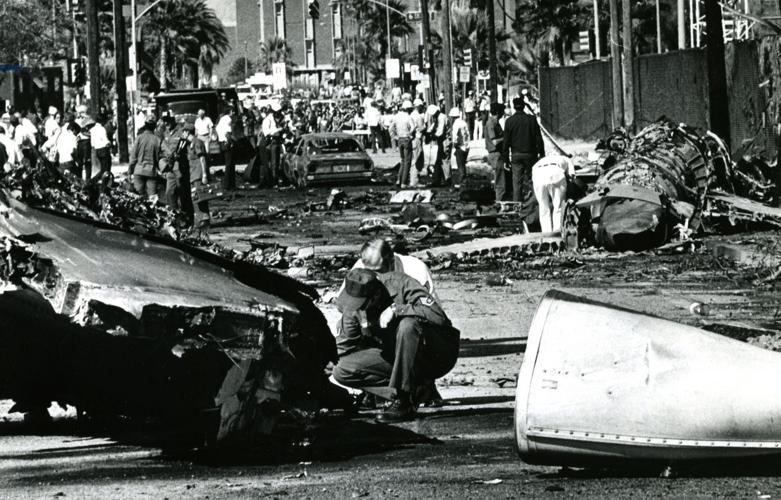
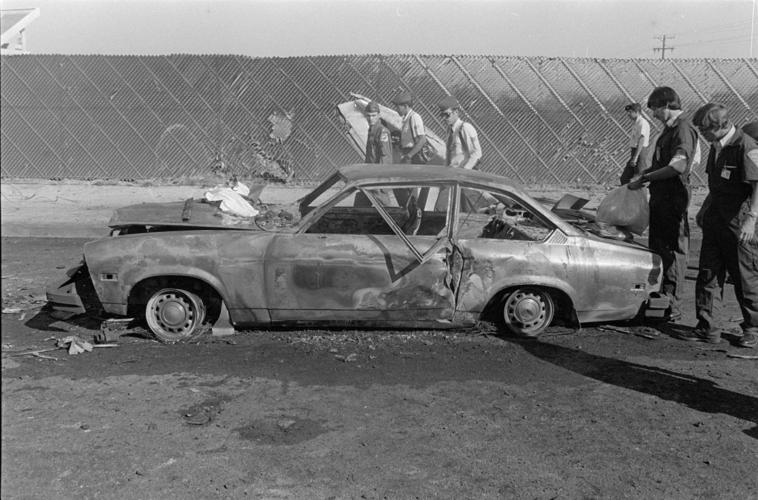
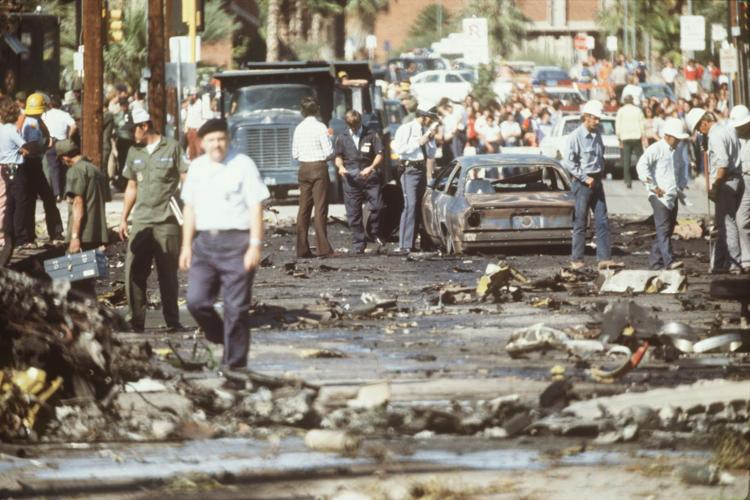
On Oct. 26, 1978, an Air Force A-7D crashed just south of the University of Arizona. Here are some of the first-hand accounts.
The first comes from a young man with a now-famous name. One might wonder what Bill Murray, the actor, might have said if he had experienced this event.
From the Arizona Daily Star, Friday, Oct. 27, 1978:
It came for me, and I hit the dirt
(Bill Murray, a 19-year-old journalism major in his junior year at the University of Arizona, stepped into his backyard at --- N. Highland Ave. just moments before the crash that scattered chunks of aircraft debris almost to the edge of his yard. Here is his firsthand account.)
By BILL MURRAY
Special to The Arizona Daily Star
"Holy #@%*&!" I thought when I walked into my back yard yesterday and saw a military jet too low to not be in trouble.
I've seen a lot of jets fly over my house, and I just knew something was wrong.
The jet seemed to be straining to stay in the air. I watched while it passed over the university in slight rolling motion and at an uncommon tilt, like in the movies when a plane comes in for a landing on an aircraft carrier, nose up.
As I stood looking at this jet, similar to those that fly over daily, it was coming closer and closer to me. I knew something was wrong, but it wasn't until I heard to pop of the pilot ejecting and actually saw the canopy rise and fall off to one side of the het that I really became scared.
At this point I realized, "Hey, I better get out of here — this thing is going down!"
I didn't run immediately. I knew I had to. It wasn't because I was frozen — I guess if was disbelief. The jet seemed to be heading right toward me.
Then the jet made a nosedive just after it had passed Wildcat Stadium a block from my house. I dove to the ground expecting the worst.
When I hit the ground I heard a loud explosion, but all I could see was the telephone wires jiggling and swaying from side to side.
I thought the jet would hit close enough to do me harm, but it didn't, thank God.
I lay on the ground for what I thought was long enough to feel safe — just until I heard the debris stop falling. Then I jumped up and rounded the corner of my house. My neighbor was screaming.
I was so shaken when I got out to the street my legs were like rubber. All I could see was thick clouds of black smoke and a van with one of the wings of the aircraft leaning against it engulfed in flames.
People came running from everywhere. I yelled at them not to get close to the wreckage — I thought it would explode again.
From where I stood, a few yards from the burning van, I couldn't tell if anyone was hurt or trapped. All I could see were flames, smoke and debris scattered over the street and yards in my neighborhood.
The flames were spreading to a university parking lot. I yelled again at people running toward the crash. I thought they were crazy. The only thing anybody could do to help, I thought, was not to get in the way.
My neighbors and I went back to our homes and waited for the fire and emergency vehicles that arrived very shortly after the crash.
Now I think back to all the aircraft that have flown over my house. It's still hard to believe one was coming right for me.
People are also reading…
If a young college student is that afraid, what about children?
From the Star of the same date:
Schoolchildren ran, screamed and wept — but all were safe
By SHERRY STERN
The Arizona Daily Star
At 12:15, they were seventh and eighth graders at Mansfeld Junior High School heading for the snack bar.
A minute later they were witnesses to an airplane crash, witnesses who mistakenly thought they had seen one of their classmates engulfed in flames and another running to the nurse's office in pain.
"Sure I saw it," said one seventh-grade girl. "I cried for about half an hour."
Other girls cried; boys screamed; everyone ran, and teachers yelled for order at the school, which at the northwest corner of Highland Avenue and Seventh Street is just 25 feet from the crash site. Yet damage to the school was minor — part of a fence was knocked down, and a small section of the playground was burned.
Inside the two-story school, a boom was heard, the building shook, lights flickered and windows rattled. And everyone ran outside.
The 15 to 30 kids already on the playground were immediately joined by most of the school's other 330 pupils. More crying, yelling, running and screaming — and everyone wanted to see what happened.
"It was turmoil. It was turmoil," said Patti Lindy, a teacher. "The kids will be wild. They're so emotional at this age. We'll just try and keep them as calm as we can."
They weren't calm, but they were soon experts on the crash.
Gergory DeConcini, a 12-year-old seventh-grader, was on the playground when the crash happened. He described the scene: "It was a fighter. He was about 10 feet from the roof of the school. He ejected. We got real scared and we started running here. I pulled the fire alarm."
Dennis Phillips, a seventh-grader, said, "First of all there was a noise like a sonic boom. They just looked up and everybody ran out in front. They didn't know what to think."
Police arrived to keep the children on the west end of the playground. Some also tried to get them out of the school to the north side of Sixth Street. A few children were sent to the school's other playground across Seventh Street.
Top Tucson Unified School District officials, including acting Superintendent Florence Reynolds, arrived, offering to help. The school's telephone lines were out, so Reynolds offered to set up a communications system. (Meanwhile district offices received calls continuously for three hours after from people inquiring about the children.)
Teachers finally got almost everyone into the cafeteria, which police decided was a safe area and which the kids found was a place to swap stories.
Rumors were rampant.
One seventh-grader said he saw someone walking near the corner of Highland and seventh.
"She got oil on her. She fell down. She got up. She started walking. It ignited. She burst into flames. She started running."
The student said a man grabbed her and rolled her in the ground to put out the flames.
Kids talked about a second pilot — a woman — on the plane (there wasn't one). They said — falsely — that their classmate, Erin Minder, suffered first degree burns and that seventh-grader Christopher Duarte was in shock.
A few kids finished their hamburgers or sipped from milk cartons. About 90 percent of them were standing, some were still crying.
Principal Maynard Farr finally got them seated and quiet. He calmly told them: "We are going to stay in here for a while . . . until it is safe to leave. I am concerned about the safety of every boy and girl. I am asking for your cooperation.
"This is a very bad thing that happened. We need your help . . . We don't want you running around in the street or near the wreckage or between school and home. You are safe here."
If their parents came, the children could go home. Otherwise they were to stay in the cafeteria, Farr told them.
Most stayed and almost all talked about the crash.
After about an hour in the cafeteria officials decided it was safe to send kids back to class, where they stayed until school got out at 3 p.m.
During the crash hysteria, teacher Alexandria Dodds remembered a conversation in the teacher's lounge three weeks ago.
They argued about the danger of the Air Force planes flying over the city and the school.
Dodds remembers saying, "It will take a tragedy before they do something about it."
Witness accounts were freely given to reporters. From the Star of the same date:
'Oh, God!' youth gasped as jet whistled 25 feet overhead
By KEITH ROSEMBLUM
The Arizona Daily Star
"All of a sudden it was dark. It was the middle of the day — and then out of nowhere comes this tremendous shadow. It was probably four lanes wide.
"And then it passes by, almost before I have a chance to think. There's an incredible explosion and flames that are high, very high.
"It didn't make sense. I watched it all, and I understood that it was a plane, but it still didn't register — a crash.
"I was shocked, stunned," said Brad Gillman, a University of Arizona freshman.
Gillman, stopped at the intersection of Sixth Street and Highland Avenue, was driving back to his room in Apache Dormitory.
A passenger in Gillman's car, UA freshman Mike Weinstein, caught the first glimpse. "Oh, my God!" he gasped. The body of the A-7D Corsair Jet was approximately 25 feet above the automobile. Forty yards in front of them, the plane hit the pavement.
"I didn't know what to do," Gillman said. "Should I back up? Pull over? Go help out? Everything happened quickly. One minute it seemed no one was around, and the next moment the streets were streaming with people.
"I went back to the dorm. It hadn't seemed real at the time, now it did. I was nervous, shaking, pacing. I called home (Olympia Fields, Ill.) and asked my sister if she had heard about the crash. She had.
"I told her if the plane had been 20 feet lower before it crashed I wouldn't be alive."
At home for the lunch hour, 21-year-old Joe Ortez heard a sound that "didn't sound like the other planes." He rushed to the door and saw the plane hit the ground.
"I took my wife and 2-month-old baby across the street to safety and then I rushed to the scene," he said. "There were three cars burning, and the street was filled with smoke and fire. Pieces of the plane were burning."
Nearby, at Mansfeld Junior High School, Randy Parsonage and several classmates watched from a different angle.
"It hit a car, bounced, and then rolled down the street in flames," he said. "There was a long streak of fire and then someone ran into the school and pulled the fire alarm."
At the reception desk of the Santa Cruz and Apache dormitories, senior Dan Cotto-Thorner, operating the dormitory switchboard, heard a "weird sound" and saw the plane swerving in midair.
"My initial thought was that the plane would swerve right into the dorm; then after another swerve, I thought it was headed for the (Mansfeld) junior high. When it hit, we all rushed out. First I thought there was debris falling from the sky, but then I realized it was the pilot parachuting," he said.
A resident of Apache, who requested anonymity, said he was the first person to arrive at the crash site. The student said in a phone interview that he had been playing softball when he heard a whistling noise and then saw the plane rapidly descending.
"I hopped over the maintenance fence and ran like hell for the cars that were on fire," the UA sophomore said. "I didn't have shoes on, so when I saw a woman, I told her to give me her shoes. I asked if she knew whether anyone had been hurt. She said she didn't think so. She was crying.
"I went over to a person lying in the street. She was burned beyond recognition. There was nothing I could do. There were five or six cars on fire and I looked around to help. I couldn't. The plane was gone. Except for a part of the wing, it had disintegrated."
Freshman Valerie Lim, a Tucsonan, said she could read numbers on the plane's fuselage as it sand past a window in the university Student Union. "We're lucky were were inside here," she said.
Among the students sitting outside on the UA mall was Jay Heater, a journalism major from New York.
"It's a reflex to look up in the sky when you hear a plane," he said, "and I followed this one. Then, almost simultaneously, I see a chair and a pilot eject from the plane, I hear an explosion, and see flames."
Heater said his first impulse was to run away from the scene, fearing an explosion. "But everyone else was running toward the scene and I followed," he said.
Next: Mistaken identities and helpful witnesses.


