

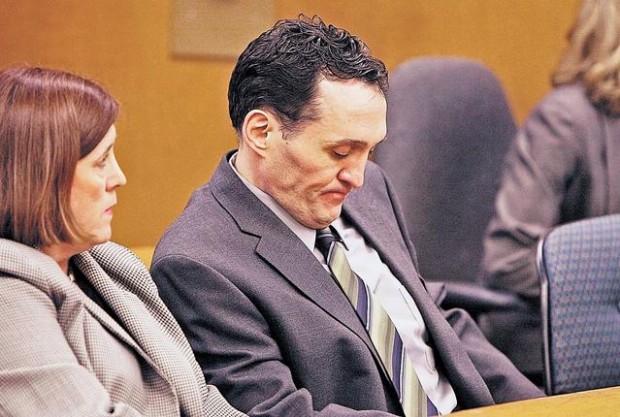
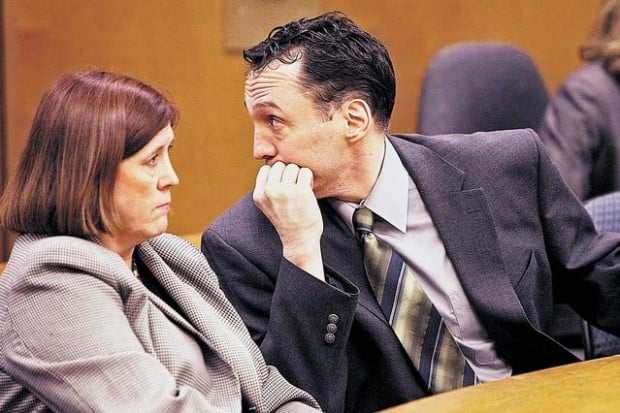
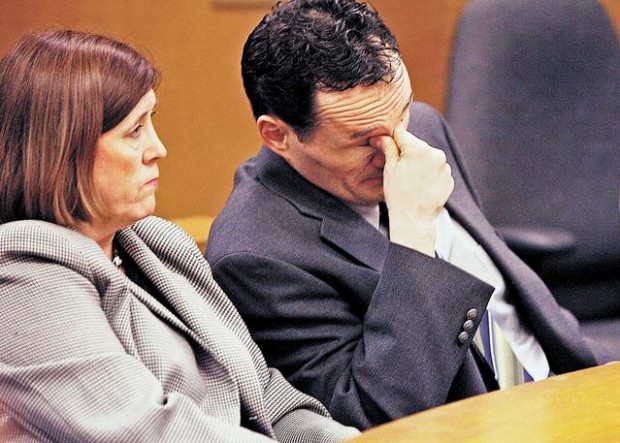
Ronald Bruce Bigger had a lot of sympathy among the 12 jurors deciding his fate, but that didn't stop them from convicting him Wednesday in the brutal slaying of Dr. David Brian Stidham.
After deliberating approximately 17 hours over four days, the jury found Bigger guilty of conspiring to kill Stidham and carrying out the attack on the pediatric eye surgeon.
Bigger faces the possibility of two life sentences with or without the possibility of parole. He is scheduled to be sentenced July 16 by Pima County Superior Court Judge Nanette Warner.
"Our hearts went out to him every day. (We think) he was sucked into a devious and manipulative man's world," jury forewoman Hannah Gardner said following the verdict.
Bigger, 41, was accused of stabbing Stidham, 37, to death in the parking lot of Stidham's medical complex on Oct. 5, 2004.
People are also reading…
Prosecutors Sylvia Lafferty and Richard Platt told jurors Stidham's former boss, Dr. Bradley Schwartz, paid Bigger $10,000 to murder Stidham and steal his car.
The pair argued that Schwartz was furious Stidham had abandoned their joint practice while Schwartz was in drug rehabilitation, costing Schwartz hundreds of thousands of dollars in lost patients.
The four jurors who met with members of the media after the verdict each had a somewhat different explanation for the verdicts.
For Elizabeth Freeman, it was the DNA evidence linking Bigger to Stidham's car along with a post-murder spending spree in Las Vegas. For Clayton Golson, it was a lot of the small details.
Sandra Holguin said she was convinced after learning Bigger was not only seen at a convenience store near the murder scene, but at a restaurant near Stidham's abandoned car miles away. Gardner, too, said she was swayed by the convenience store clerk who saw Bigger that night wearing scrubs and by many of the small details laid out by the prosecutors.
"It all fit," Holguin said. "They may not have had all of the evidence, but it all came together."
The jurors said they would like to have heard from eyewitnesses who could place Bigger at the murder scene itself. Several witnesses said they saw a man in medical scrubs at the medical complex, but none could identify Bigger as that man.
Gardner said another key piece of evidence for her was a jailhouse phone call between Bigger and his mother, Mary Sue Yadavia.
During the phone call, Bigger mentioned Schwartz and said, "He told me 'Don't worry about the car. Just come over there.' Never mind. I shouldn't say that. I shouldn't say nothing over the phone."
According to prosecutors, Bigger dumped Stidham's car at an apartment complex after the slaying and took a cab to meet Schwartz for dinner.
"When I heard (the call), it was one of those eureka moments," Gardner said. "It's one of the reasons I will be able to sleep tonight."
The jurors evaluated the evidence in the case in the order in which it came and they were evenly split during the beginning of deliberations, they said.
Over the last two months, the jurors bonded because of their shared experience and were able to amicably discuss each of their concerns during deliberations, the four jurors said.
Her voice quavering, Gardner said more than half of the jurors admitted during deliberations that they've cried at one point or another during the trial.
"All of us have had quite a few drinks, we've all lost sleep over this and we've all had dreams," Gardner said.
Seeing Bigger's and Stidham's mothers in the courtroom was much more stress-inducing than the media frenzy, the jurors agreed.
The jurors had high praise for the prosecutors and for defense attorneys Jill Thorpe and Harold Higgins.
"If I ever did anything wrong, I hope they don't prosecute me," Freeman said of Lafferty and Platt.
After the jurors spoke, Stidham's mother, Joyce Stidham, read a brief statement thanking them, the prosecutors, detectives and her many supporters here and in her home state of Texas for their help and support.
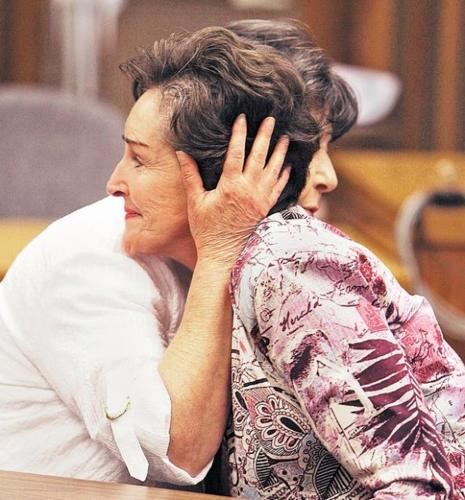
Yadavia, Bigger's mother, left the courtroom before the press conference but shared a hug with Joyce Stidham on her way out.
The prosecutors declined to comment on the verdict.
In an e-mail after the verdict, Thorpe said there are a number of judicial rulings she intends to bring up during an appeal. Those rulings include the preclusion of evidence concerning the state's DNA database and testimony about a man with ties to Schwartz who asked a co-worker if she would kill someone for money and was later seen washing off a bloody knife.
"We appreciate the words of the jurors who recognized that Dr. Schwartz was the evil master manipulator in Dr. Stidham's death," Thorpe wrote.
Thorpe and Higgins had tried to convince jurors that Schwartz stabbed Stidham to death, then attempted to frame Bigger for it.
Both juries were told that Bigger stabbed Stidham 15 times sometime between 7:26 p.m. when Stidham set his office alarm and 7:46 p.m. when Bigger made a phone call from a Denny's restaurant seven miles away to Schwartz.
Thorpe said Bigger didn't have enough time to commit the slaying, dump Stidham's car and get to the Denny's within that 20-minute time frame.
Find a photo slide show from the Bigger trial at azstarnet.com/metro


