

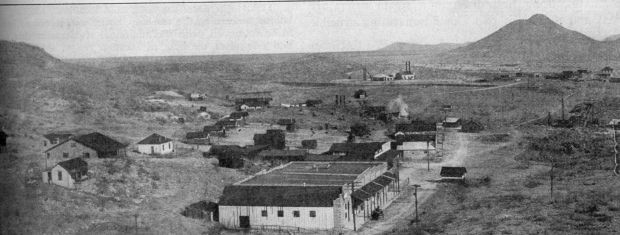
The Turquoise Mining District includes the towns of Courtland and Gleeson.
The area was originally mined for turquoise by Native Americans who used it for medicine stone.
It was heavily prospected by American miners in the late 1870s, resulting in many individual mining operations, some of which continue today. Copper, lead and silver were the primary minerals yielded by the district, though the area includes zinc deposits.
Some of the well-known mines from this district include the Mystery, Silver Bill, Tom Scott and Shannon (Gleeson).
Discovered in 1879, the Mystery Mine was worked in detail in the 1920s for zinc ore. The main tunnel reached a depth in excess of 750 feet, connecting it through a series of raises, stopes and side-drifts to the nearby Silver Bill workings. The Shannon (Gleeson) Mine was also a prominent shipper of copper for many years.
People are also reading…
Gleeson was established near the site of the former mining camp known as Turquoise. A post office operated in the town from 1890 until 1939. By 1910, the town attained a population of 500 people. During World War I, the need for copper on the national front brought renewed growth to the economy of Gleeson.
The town of Gleeson was named for John Gleeson, an Irish man who arrived with his wife in Arizona during the 1890s. While living in Pearce and working in the mines in the Gleeson vicinity, then known as Turquoise Camp, he discovered a valuable cache of copper. It became known as the Copper Belle deposit as well as the Leonard. By 1900, Turquoise Camp was renamed after John Gleeson.
The glory years for Gleeson occurred during World War I when demand for copper was at an all-time high. However, the next several decades proved challenging for the local economy. This was caused by a decrease in copper prices and a local fire in June 1912, which destroyed much of the town. The post office closed in March 31, 1939.
However, the Gleeson jail was restored as a museum in 2011.
Courtland was named after one of the owners of the Great Western Mining Co., Courtland Young. It was once a thriving town consisting of several thousand residents by the second decade of the 20th century.
Located in the southeast corner of the Dragoon Mountains, the town owed its existence to several large mining companies, including the Great Western Co., Calumet and Arizona, Copper Queen and Leadville. Notable mines included the Germania and Great Western, with more than 8,000 feet of development and ore running 7ƒ percent.
The town endured a series of booms and busts similar to that of its neighboring town, Gleeson. At one time, its population boasted several thousand and was projected by Calumet & Arizona superintendent Col. J.H. Talbot to reach 20,000 by 1915.
The combination of the McFate Courtland and the Great Western townsites formed Courtland proper, which consisted of scattered board shacks and tents with only a few substantial structures, including the Southwestern Mercantile Co., Renaud General Merchandise Store and the jail.
Over the next 30 years, the copper market experienced booms and busts. Courtland’s post office closed by 1942. Today, only the heavily graffitied Courtland jail remains standing.



 Tucson's newest Shake Shack gets neighbors


