

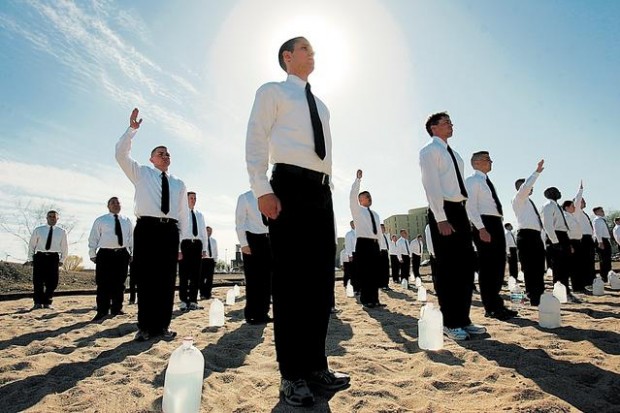
"Sir, yes sir" echoed off "A" Mountain and the walls of the Pima County jail on Monday as the Sheriff's Department brought its recruit training in-house for the first time in eight years.
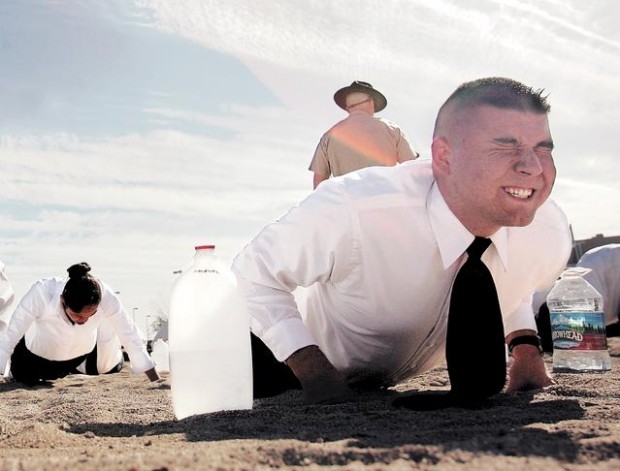
Forty-two deputy recruits spent much of their first day of class in "the pit," an oversized sandbox behind the jail used for physical training and endurance drills.
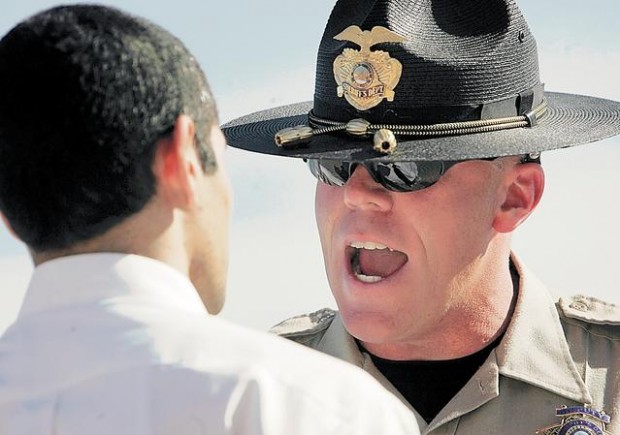
"If you can perform under arduous physical training, you can perform on the street," barked drill instructor Deputy Jim Murphy as the recruits sweated it out, doing push-ups in dress clothes.
The Sheriff's Department left the Southern Arizona Law Enforcement Training Center in favor of its own facility, allowing the agency to train its own recruits faster, officials said.
The regional academy does a good job of training a generic officer, said Lt. Scott Martin, commander of the Sheriff's Department's training section. But after graduation, the department's staff had to spend several weeks teaching a rookie the specifics of being a deputy, including radio systems, county geography and Taser training.
People are also reading…
Bringing training in-house will cut more than one week off basic training time because recruits will be learning sheriff-specific procedures as they go.
"We'll have a safer, more effective, more productive officer hitting the streets," Martin said. "That's our goal."
The in-house academy also means shorter days for recruits, who spend 10 hours a day at the regional academy or eight hours a day at the in-house academy, said Sgt. Michael Grider, the department's training director.
That doesn't mean training is easier. Lessons in accountability on Monday included being singled out by the drill instructor for not shaving close enough and for having a radar detector in a personal vehicle.
A few recruits typically drop out in the first week of training, Martin said.
Fourteen agencies in Arizona now are training their own recruits for efficiency, Grider said.
Nearly a year passes between the time candidates apply at the Sheriff's Department to the day they're fully trained deputies in the field, Grider said.
When the Sheriff's Department tried in-house training in 1998, it saw a promising retention rate, but the agency decided to continue at the regional academy, he said.
"It's tough to get qualified applicants these days, so if we can keep one we would have lost, that's a benefit," Martin said.
The sheriff's academy is using the same state-mandated curriculum as the regional academy and using staffers formerly assigned to teach there.
The regional academy also will benefit by giving more student slots to different agencies, officials said. The Sheriff's Department had been reserving a number of seats for each class.
The department spends $37,000 per training session at the academy for staffing and equipment. It has always trained its own corrections officers, Operations Bureau Chief George Heaney said.
The department plans to expand its training facility behind the jail, perhaps breaking ground in the fall using county bond money, Martin said. The addition now is being designed.
The new academy will host two classes a year for commissioned officers and six for corrections officers, he said.
The department has around 40 deputy vacancies, Heaney said.
● The next class for deputy recruits begins in June.
For more information about recruiting, go to www.pimasheriff.org/ employment.htm


