

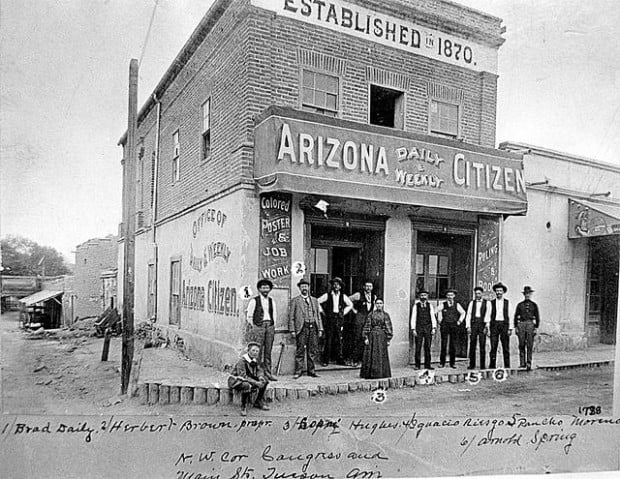
It covered the gunfight at the O.K. Corral and manned lunar landings, stagecoach holdups and the election of America's first African-American president.
Here's a look back at the storied history of the Tucson Citizen:
Like many frontier newspapers, the Citizen was created partly as a political soapbox.
When Republican Richard C. McCormick failed to get an endorsement for his re-election bid as a territorial delegate to Congress from the Weekly Arizonan — a paper he held an interest in — he hauled the printing press he'd bought for the Arizonan away.
Not long after, McCormick made a deal with John Wasson — Arizona's surveyor general — to start up a rival newspaper, the Arizona Citizen, published for the first time on Oct. 15, 1870.
Soon, the vitriol was flying, with Arizonan Editor Pierton W. Dooner calling Wasson a "stupid upstart" and Wasson firing back at Dooner as "a poor worm."
People are also reading…
Within months, Dooner's paper, established in 1859 as the territory's first newspaper, was no more.
Meanwhile, the weekly Arizona Citizen covered Apache raids, stagecoach robberies, military affairs and social events. Bowing to Tucson demographics, some of the news was printed in Spanish.
And the Citizen underwent the first of more than a dozen moves over the next 50 years.
In 1873, telegraph lines finally started snaking toward Tucson, but they had little immediate effect on the Citizen.
Wasson was hesitant about paying the costs of telegraph reports and also harbored the thought that an increase in news might force him to publish a daily, something he could ill afford.
On Oct. 23, 1877 — in the same year a rival paper that would become the Arizona Weekly Star started up in Tucson — Wasson sold the Citizen. His buyers then moved the Citizen to Florence, thought to be the next big thing.
Part owner — and former Indian agent — John P. Clum became editor of the Citizen, publishing his first issue in Florence on Nov. 9, 1877.
Less than a year later — on Sept. 6, 1878 — Clum was informing his readership that the paper was moving back to Tucson.
Two weeks later, it was back in business in Tucson, perhaps raising doubts as to the paper's claim to be Arizona's oldest continuously published newspaper.
On March 1, 1879, it became a daily — the same year the Star also went daily — though the Citizen also put out a weekly until 1912.
In February of 1880, longtime Citizen staffer Rollin C. Brown became the new owner, and Clum headed south to make friends with one Wyatt Earp and start up the Tombstone Epitaph.
The Citizen suffered several fires during its existence, including a disastrous one on June 10, 1881, that destroyed the press. For several weeks, it published a small-scale paper.
New owners would come and go over the last two decades of the 19th century, as the paper expanded its anti-Apache, pro-railroad agendas.
George H. Smalley became editor in 1898 and later recollected "four girls" who did the typesetting and "tramp printers who stepped off the trains for a few days' work."
Though by then a daily, the Citizen did not print on holidays, including Cinco de Mayo, which saved it money, since advertising was paid for by the month.
On April 11, 1901, mining men William C. Greene and Charles M. Shannon were announced as the new owners, with former Cochise County Sheriff John Behan as business manager.
Things did not go well, and hardly a month later, Behan was ousted. He did not go quietly. Armed with a loaded pistol, he kicked out the editor and took control of the building for several days, demanding he be paid back the $600 he'd invested in the paper. Shannon eventually righted things, and Behan departed.
During the early years of the new century, the paper railed against saloons open on Sunday and gambling. The game of bridge was denounced as "the road to ruin."
New owners appeared. So did another disastrous fire on Feb. 4, 1912, that destroyed part of the Citizen's plant.
For a time, Citizen offices were housed at the Star. In 1914, the Citizen moved to a new location at the corner of Stone Avenue and Jackson Street, where it remained until 1940.
In 1928, Frank Hitchcock took a controlling interest in the Citizen, and over the next few years he took a major role in promoting the building of what we now know as the Catalina Highway leading from Tucson to Mount Lemmon.
After Hitchcock died in 1935, the Citizen, near bankruptcy, was sold to William H. Johnson and William A. Small Sr.
One of Small's jobs was to enter into a deal in 1940 to have the Star and Citizen share a common building, along with printing and business expenses.
That same year, the two newspapers moved to 208 N. Stone Ave., where they remained until moving in 1973 to its final location at 4850 S. Park Ave.
In 1965, the Citizen bought the Star for $10 million to keep it out of the hands of an out-of-town newspaper chain.
That same year, the Justice Department filed an antitrust suit that went all the way to the U.S. Supreme Court, which ruled that the newspapers had violated the antitrust law.
Congress passed a bill, which became law in July 1970, allowing the Citizen and Star to resume their joint operating agreement.
But by then, the Small family had been ordered by the Supreme Court to sell the Star, and on April 8, 1971, Pulitzer Publishing Co. bought the Star, reportedly for $10 million.
On Dec. 28, 1976, Gannett Co. bought the Citizen from the Small family in a stock exchange deal for $30.2 million.
Ironically, both papers had become part of large newspaper chains.


 Nancy Guthrie's Tucson neighbors: Life with streamers 'unbearable'


