You can’t stare out at the rings of Saturn from the frozen surface of Titan, but you can see what that view might look like thanks to a long-time local scientist and his paintbrush.

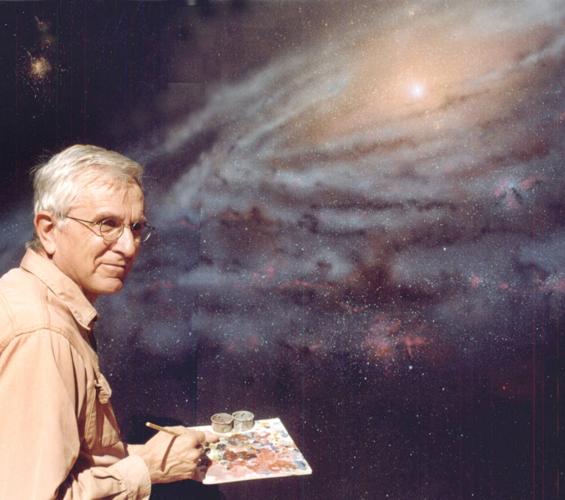
Planetary Science Institute co-founder and space artist Bill Hartmann works on a painting of the Milky Way. A collection of work by him and other space artists debuts Sunday at the institute's headquarters in Tucson.
Bill Hartmann has been studying the planets for more than 50 years, and he’s been painting them for even longer than that.
The Planetary Science Institute that Hartmann helped found will debut a collection of his otherworldly landscapes at its headquarters in Tucson on Sunday.
The William K. Hartmann Art Collection features hundreds of paintings by several different space artists, including the institute’s co-founder and senior scientist emeritus.

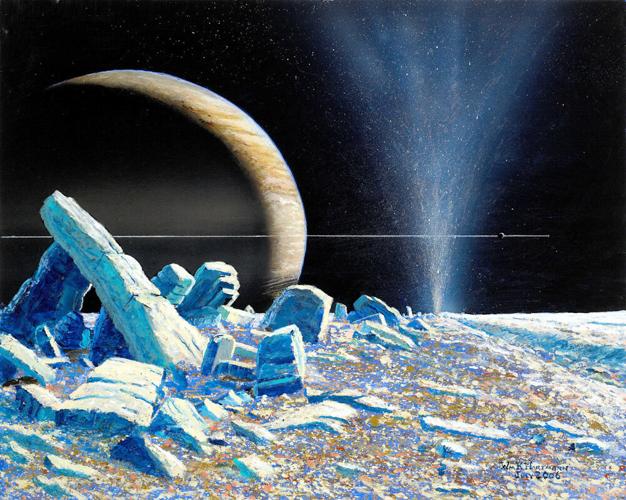
Bill Hartmann painted this piece, called "Saturn from icy moon," while at Hawaii Volcano National Park, turning the lava he saw there into a field of ice on Enceladus.
“My scientific knowledge informs my art, to be sure, but I would argue that the opposite is true as well,” Hartmann said. “When I’m painting, I’m thinking about the entire physical world around me — how light bounces off objects, the angle at which a subject might be viewed — which offers me a different perspective when compared to my scientific colleagues who might look at a problem with only one variable in mind.”
People are also reading…
Sunday's free opening of the new exhibit will run from 11 a.m. to 3 p.m. at PSI’s main office at 1700 E. Fort Lowell Road. Other artists on display include collaborator and fellow Tucsonan Pamela Lee, Marilynn Flynn, Peter Nisbet and Ron Miller, who has teamed with Hartmann on several books on planetary topics.
Hartmann earned a Ph.D. in astronomy from the University of Arizona in 1966 and partnered with three other enterprising young scientists in 1972 to launch their own research firm in Tucson.
One of their first contracts produced some of the earliest pictures of Mars captured by Mariner 9, a NASA mission for which Hartmann served on the imaging team alongside Carl Sagan.
Since then, the Planetary Science Institute has grown into one of the largest firms of its kind in the world and played a role in virtually every NASA mission to explore the solar system, as well as missions by Japan and the European Space Agency.

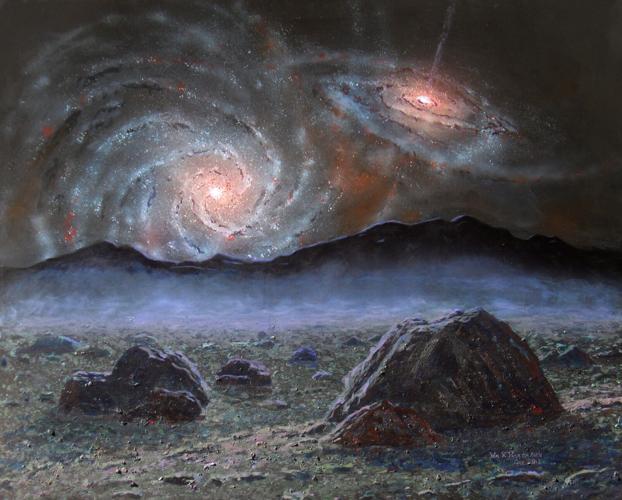
Hartmann's "Lonely planet" depicts an alien world whose star has been ejected into intergalactic space by a collision of the two galaxies seen in the sky. He painted the landscape during a space art workshop in Death Valley and finished the sky and galaxies in his studio in Tucson.
In addition to his scientific work on the origin and evolution of planets and planetary systems, Hartmann is a lifetime fellow of the International Association of Astronomical Artists. He has also written and illustrated numerous textbooks, nonfiction books and two science fiction novels.
In 1997, the American Astronomical Society’s Division for Planetary Sciences awarded him the first Carl Sagan Medal for Excellence in Public Communication.
Hartmann’s extensive collection of cosmic art includes more than 800 of his own paintings, along with dozens of pieces by other space artists with whom he has traded work over the years.
The selected pieces to be displayed at the institute were created over the past 60 years and provide a window into the history of space exploration and humanity’s evolving understanding of planetary systems.

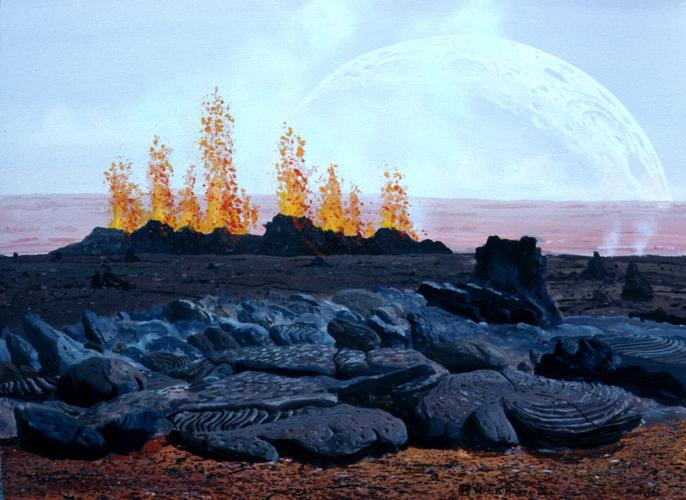
Hartmann painted "Fire fountains," his imagined view of a volcanic exoplanet with its moon looming in the sky, while at Hawaii Volcanoes National Park in 1986.
“Art is a critical tool for expressing, exploring, and reflecting on complex ideas,” said PSI senior scientist and fellow space artist Jamie Molaro, who is also leading the curation effort. “It shines a light on how the process of observing and studying a subject can be both scientific and artistic at the same time.”
A gift pledged by the Hartmann family will support the maintenance and management of the collection and seed an endowment to support future education and outreach associated with the artwork.
Viewing hours for the collection will vary after Sunday’s opening. More information is available on the institute’s website at PSI.edu.



 Plans floated to reopen San Manuel Mine as part of regional copper development