

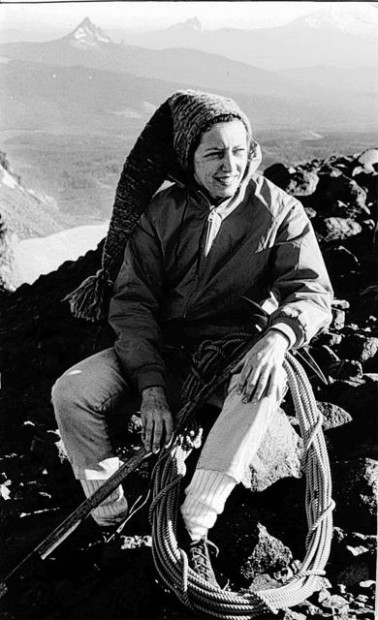
Dorothy Dell was as skillful at stitching together elegant opera costumes as she was at scaling the sides of snow-swept mountains, ice ax in hand.
It was that strength of mind and body that kept her fighting through two years of chemotherapy, radiation and painful surgeries to beat her uterine cancer into remission.
And it was her greatness of character that led her to refuse further debilitating treatment when she got news late last spring the cancer had returned.
Instead she and her husband of 54 years, John, carried out their plans to spend the summer working at the Utah Shakespeare Festival — she designing costumes, he working on publicity, both taking 6 a.m. hikes.
And in the autumn, Dorothy went back to work, designing costumes for the University of Arizona Opera Theater. She finished work for the November production just a few weeks before her Dec. 18 death. She was 72.
People are also reading…
Born in Vallejo, Calif., Dorothy possessed a sense of fearlessness and a keen interest for learning.
From her mother, Freida, a master seamstress, she learned the aesthetics of design. From her father, Edward Menhenett, a submarine inspector for the Navy, she gained mechanical knowledge.
"She'd get up on the roof and fix the air conditioning and do the plumbing if it needed it. She was better than I was," her husband said.
It was John who introduced his young bride to wilderness adventures. The two met at the San Francisco Art Institute.
Dorothy had been awarded a scholarship to the school after graduating from high school, and John had attended briefly after being discharged from the Marines.
"She was a real fascinating lady, as well as a good-looking girl," John said.
When his interests switched from art to forestry, he joined the National Park Service, and then the U.S. Forest Service. The couple's first post, in 1954, was to Yosemite National Park.
"I moved this little city girl up to Yosemite to a cabin in the woods," John said. "She had to cook on a wood stove and keep the bears away from the ice box.
"We're risk-takers from way back," he said.
John's 30-year career in forest management was split between sometimes-remote posts in California and the Pacific Northwest.
During their travels, the couple raised four children, hiked thousands of miles, climbed mountains, led treks into the wilderness and taught snow- and ice-climbing.
"We moved 35 times in 30 years," Dorothy said in a 1994 Arizona Daily Star article.
"The most remote was at Mad River, in Northern California. It was 70 miles to the nearest doctor or real grocery store. But it was also one of the best places we ever lived."
Dorothy had postponed her career interests to travel with her husband and to raise a family.
But after John retired in the mid-1980s, Dorothy said she wanted to go back to school.
So they sold their retirement home and headed to Brigham Young University in Utah, where John earned a bachelor's degree in English, and Dorothy excelled in her theater arts and textile classes.
"She turned out to be a top-notch student," John said.
Dorothy was honored two years in a row as costume designer of the year.
Through connections she made at Brigham Young, Dorothy earned an assistanceship at the University of Arizona, where she earned her master's in theater arts in 1988.
For a while, she taught classes at the UA on the history of costume in theater and taught stage makeup application at Pima Community College, all while helping stage local theater productions.
In the early 1990s, while doing makeup for a UA production of the Gilbert and Sullivan comic opera "The Mikado," Dorothy got a good look at the Opera Theater's costumes.
"She noticed the costumes were kind of in disarray" and asked the director, Charles Roe, whether he needed a designer, her husband said.
She got the job, and during the last 15 years or so, Dorothy designed costumes for more than 40 productions.
"She's done marvelous work," Roe said. "She was very detail-oriented, and she was very good at accessorizing.
"We did so many operas and she did so much research in designing the costumes. She was particularly good at color coordination," he said. "She was a gem. It will be so difficult to work without her."
Dorothy's expertise, attention to detail and eye for color made Kristin Dauphinais's job easier. As director of UA's "Opera Scenes" program, Dorothy fitted students with costumes for the vignettes they performed.
"She did a beautiful job and was very creative and a delightful woman to work with," Dauphinais said. "Her costumes always greatly enhanced the look of the production."
It was Dorothy's job to know about costumes from different historical periods, "from Greek mythology to modern-day dress and everything in between," Dauphinais said.
"Historic knowledge has to be vast. Everything from the appropriateness of hairstyles to facial hair on men to the shoes they wore and the purses they carried and the undergarments they wore. To really have that specificity takes a true talent and a true gift."
Student Amanda Wolff worked in the costume shop as Dorothy's assistant.
"She was such a wonderful teacher and so patient, but she puts her foot down when she has to," Wolff said.
"Everyone always loved their costumes, and she was always very careful to make sure they fit each person right and make them feel like their character when they put them on."
Between opera productions, Dorothy helped her husband guide nature and cultural history tours for PCC.
They conducted hikes in Arizona and California, took students on whale-watching excursions in Mexico and guided hiking tours of New Zealand and the Austrian Alps.
In 2003, Dorothy took a leave of absence from the opera company, and John took a break from guiding tours to go on a two-year mission to northern Italy for the Church of Jesus Christ of Latter-day Saints.
When they returned in late 2005, they went in for physicals. That's when her advanced uterine cancer was diagnosed.
"She never complained, never whimpered," John said. "She showed a lot of mettle, so I had to do the same."
In a letter he sent to family and friends two weeks after his wife's death, John wrote: "She was 72 years old and had always looked forward to the possibility of living into her 90s, like her mother and grandmother.
"Her goal was to beat the cancer, and she gave it her best shot, just as she did with every challenge she ever had."
Life Stories
On StarNet: Find a photo gallery of this Life Story at azstarnet.com/slideshows.
Life Stories
This feature chronicles the lives of recently deceased Tucsonans. Some were well-known across the community. Others had an impact on a smaller sphere of friends, family and acquaintances. Many of these people led interesting — and sometimes extraordinary — lives with little or no fanfare. Now you'll hear their stories. Past "Life Stories" are online at go.azstarnet.com/lifestories.

 $25M distribution center to be built in Tucson


