

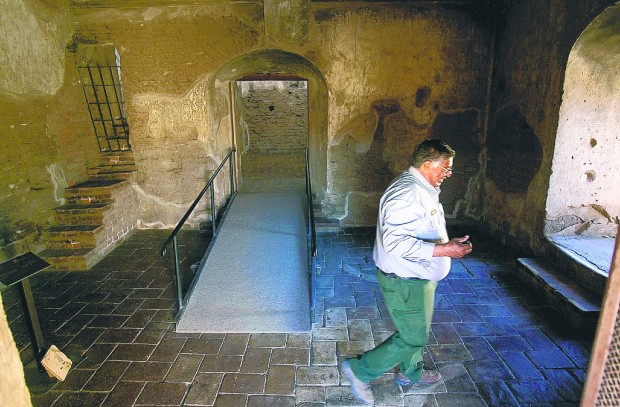
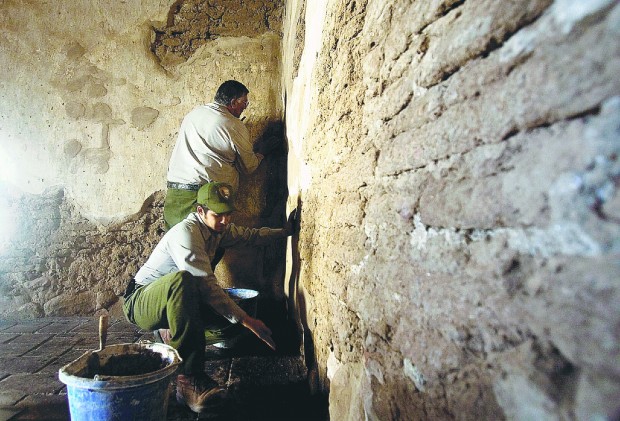
Adobe buildings tell David Yubeta their stories … and he listens.
Yubeta is the adobe whisperer (aka historic preservation specialist) at Tumacacori National Historical Park near Tubac. Stabilizing and preserving the church is part of Yubeta's job, but when he talks about adobe, it's clear it is his passion.
Catch Yubeta in his element - inside the mission at the park. He explains that the perfect mix for adobe is 25 percent clay and 75 percent sand. He talks about the different types of adobe, sun dried and fired. He touches the walls reverently and points to different areas in the church.
His words move beyond the realm of interpretive talk into poetry.
"Adobe is a noble material. It needs to twist, to move and to dance," Yubeta says.
An adobe building needs to breathe, he says, and patching it with cement or glue inhibits that natural process.
People are also reading…
Yubeta points out that the park service is charged with keeping the adobe buildings at the park in a state of arrested decay.
"The best compliment we can get is when people say it looks like we haven't done anything," he says.
In 1985, he was hired as part of the maintenance crew at the park.
"I got put on this crew to work on this church," he says. "The work kind of grabbed me. I knew that this was something that I understood. It came to me naturally."
Making adobe bricks was part of Yubeta's roots. He grew up in South Tucson, where his immediate and extended family lived. As a young boy, he walked the 10th Avenue Wash with his maternal grandfather looking for the right dirt to make adobe bricks.
"He would say, 'C'mon, Davey, follow me,' " says Yubeta, who is 61.
During each walk, Yubeta filled his sand bucket and turned it upside down. His grandfather, Jesus Estrada, would pour a little water on it from his canteen. The pair would make several piles of dirt in different spots in the wash. Later they would return to each pile. His grandfather would taste the dirt and knead it to check for clay content.
"If it tasted right, he would get his wheelbarrow and mix it up with water and make the adobe bricks in the wash."
Yubeta's grandfather used the bricks to fix houses in the area.
Working with dirt, stone and wood was not part of Yubeta's career path after he graduated from Sunnyside High School in 1966. He served in the Army for three years and did an 18-month tour in Vietnam. He received a degree in criminology in 1977 from the University of Arizona.
"I didn't use the degree," he says. He worked as a mill foreman for Anamax Mining Co. at the Twin Buttes Mine in Sahuarita for 12 years. He left for a similar job in New Mexico but was laid off after nine months. Three years later, Yubeta moved back to Tucson and was hired at the park service.
In 1993, Yubeta received the Governor's Award for Historic Preservation for general overall work on adobe structures all over the Southwest.
"It kicked me from an adobe worker to an adobe specialist," Yubeta says. "People wanted my advice instead of them telling me what to do."
Yubeta received The Appleman-Judd Cultural Resources Award in 1998 for work he did at Tumacacori and work on missions in Mexico.
"I don't think I'm special at all," Yubeta says. "I've been blessed with the best preservation crew in the park service."
Oscar Villa, 22, is a Pima College student and seasonal worker on Yubeta's crew.
"It's hands-on. You learn a lot about what people used back then trying to preserve history. It's pretty cool," Villa says.
The crew, which expands to about six in the summer and contracts to about three in the winter, has worked at the Casa Grande Ruins National Monument, Fort Bowie National Historic Site and other parks in New Mexico, California and Texas.
"We're the only park at the moment that has a crew that travels," says Lisa Carrico, park superintendent. "David's crew is one of - if not the only - crew in Southern Arizona that does preservation and stabilization."
Closer to home, the crew repaired the bridges in Sabino Canyon Recreation Area after the 2006 flood.
"Regionally, they are the crew. People across federal agencies with stabilization and preservation questions call David. David is the man," Chris Schrager says. Schrager has a similar position with the Coronado National Forest Service and the U.S. Bureau of Land Management. The two men have worked together on various projects, in particular Kentucky Camp, old mining quarters in the Santa Rita Mountains.
"Very few people have David's expertise and even fewer are willing to do it for the public," Schrager says. "He does an incredible amount of volunteer work."
J.J. Lamb, president of the Vail Preservation Society, asked for Yubeta's help in stabilizing Vail's Old Post Office. She says Yubeta jumped right in to help with a Boy Scout project to preserve the last standing building in the original town site this summer.
"He is so good at working with the rest of us who don't know that much about the medium," Lamb says. "Not only does he understand adobe, he cares deeply about community. He gets a lot of satisfaction from teaching people about something new and old at the same time."

 Tucson's El Güero Canelo for sale


